In November 2023, a mass rally in support of Israel after the October 7 massacres took place in London. Body parts were still being scraped from burnt Kibbutzim, but the news cycle had already moved on. A crowd of a few thousand Israelis and Jews stood lonely in Parliament square, clutching posters of hostages. Then, suddenly, a tall woman walked confidently on stage, accompanied by men holding an Iranian flag, with the symbol of a lion, sword and rising sun. That support from the Iranian diaspora – at a time when much of the world had little sympathy for Israel – meant a lot to British Jews and Israelis.
This weekend, British Jews were able to return the favour. A rally took place outside Downing Street in support of the brave protestors in Iran. Tens of thousands of the Iranian British community gathered, waving the same lion and sun flag that represented their homeland before the 1979 revolution. There were also many Israeli flags in the crowd, Hebrew songs were sung, and Israeli and Jewish activist groups were among the organisers and speakers at the rally.
The same woman, British-Iranian human rights activist Elaheh Djamali, known as Lily Moo, was on stage again, chanting for a free Iran, and calling for action from the UK government against the Islamic Revolutionary Guard Corps (IRGC) – which has for decades simultaneously been supporting Hamas and hunting down Iranian protestors.
There was a sense of fear in the air. Every Iranian I spoke to mentioned the petrifying, scattered reports of the scale of killings, hidden by the communications shutdown. ‘I’m in a state of trauma and autopilot. I haven’t slept in 14 days,’ Moo said after the rally.
There was also a lot of heat and anger. One protestor brought a puppet head of the Ayatollah Ali Khamenei, tied to a stick. Later, another protester set it on fire.
‘Hamas terrorists took action on a day when the Islamic Republic felt safest. Today they don’t feel safe anymore: their proxies are depleted, and [we see] Iranian men who are part of the Islamic Republic suppression forces joining the people,’ Moo said.
Many Iranian protesters describe the past few weeks as the beginning of a genuine revolution. Sheyda Rahbari, a former Iranian student who led the Woman, Life, Freedom protests in 2022, explained that she had to flee after being captured and tortured, but said these days she feels optimistic. ‘The economic reasons were only the trigger; it’s not just a protest, it’s a revolution’.
When I asked about the clear presence of Jews at the rally, many mentioned the ancient connection between the nations. ‘Jewish and Israeli people truly support us, more than any other people. I am really proud and grateful for that’, Rahbari says. The same is true online, where Israeli content creators and influencers go above and beyond to raise awareness of Iranians’ plight.
In Jewish collective memory, the Persian king Cyrus the Great’s decision to liberate the Jews from Babylon 2,600 years ago is still very much alive. Now, some Iranians hope that Israel will repay the gesture.
One of them is Arian, who left Iran six years ago, and held a massive Israeli flag at the demonstration. ‘We are trying to convince western governments that we need military action. I am holding an Israeli flag to show that we really appreciate the last time they did it. We desperately need help, and after that we will be allies. We will become a second Syria if it won’t happened,’ he says. Arian was referring to the 12 day Israel-Iran war in June 2024, the first full-scale direct confrontation between the enemy states; ‘It gave us a hope that it is possible to crash the Ayatollahs.’
The protesters were also looking to the US. ‘President Donald Trump has reassured Iranian people that he will show up for them. We don’t need to look for bombs to drop on Iran – the IRGC’s infrastructure and communications systems are destroyed, they cannot reach the Iranian people as much as they want to,’ Moo suggests.
Not all Iranians who oppose the regime want foreign intervention. At least three different Iranian protests were organised in London over the same weekend – showing how Iran’s diaspora opposition isn’t monolithic.
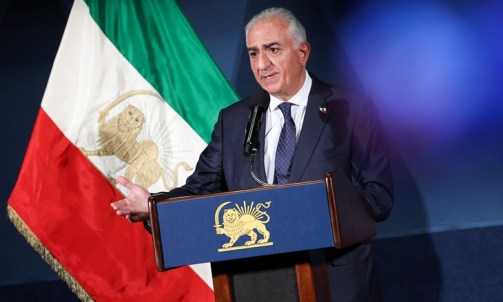
‘I cannot go to this protest and see all these photos of the Shah,’ an Iranian friend of mine said about the protest I attended, with a note of contempt. The Downing Street protest largely attracted monarchists, who see the exiled crown prince Reza Pahlavi as a unifying figure. Monarchists claim that videos from Iran showing chants for the Shah, from Tehran to distant Kurdish and Baluch areas, prove that the Iranian opposition finally has a leader to rally behind.
Other Iranians perceive Pahlavi as an extension of the western interventionism that restored his father, Mohammad Reza Pahlavi, to the throne in 1953 as an authoritarian ruler, after the UK and US collaborated to remove Mohammad Mosaddegh, the prime minister who sought to nationalise Iran’s oil industry.
Moreover, some argue that Israel’s attacks inside Iran have, at least in the short term, produced a rally-around-the-flag effect, pulling even opponents back towards the regime. There are also less significant segments of far-left Iranians, who adopt the regime’s talking points about the Israel-Palestinian conflict.
Yet, when we set aside Iran’s domestic politics we are still left with the old, resilient alliance between Israel and Iran that thrives even after 47 years of Ayatollah-led incitement. The Iranian liberal diaspora, as varied as it is, largely proved this on October 7.
Iranians and Israelis recognise the same radical Islamist ideology which led to the blood-stained clothes of Iranian women who dared to protest and were dragged into the regime’s prisons, and of Israeli women who were dragged to Gaza by Hamas jihadists. Iranians’ heroic battle for freedom is not a separate tragedy: it is the same war, the same cruelty.