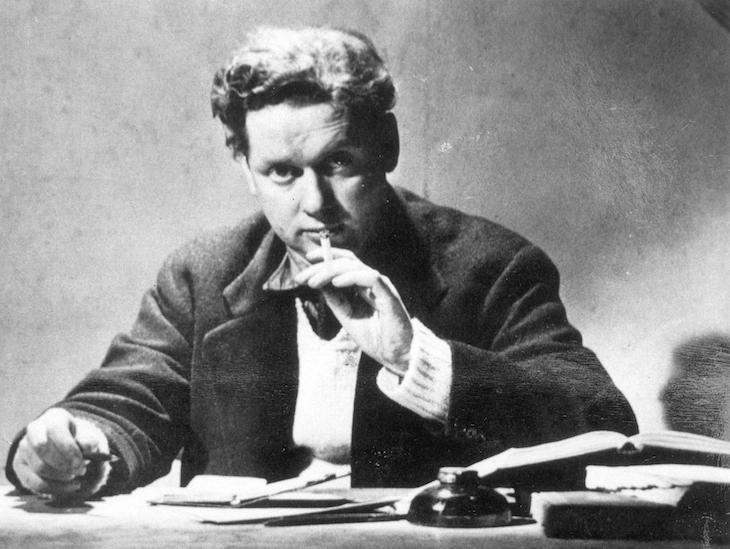
‘Immature poets imitate; mature poets steal.’ This quote from TS Eliot has become a critical commonplace. And if we’re to take it as the truth, the young Dylan Thomas was even more precocious than we had previously realised. An academic at work on a complete collection of Thomas’s poetic output has discovered at least a dozen instances, dating from even before Thomas’s teens, of his publishing poems by other people under his own name.
The schoolboy Thomas obviously already had an ear, and he used it to steal light verse from Punch
Having tracked down thirty poems the young Thomas contributed to his school paper, Alessandro Gallenzi said that Thomas ‘plagiarised several of the poems he published under his name in the Swansea Grammar School Magazine. He had not simply drawn inspiration from other texts, imitated or parodied them, as he later claimed: he had stolen the work of other authors wholesale, at times changing the title or a few words, perhaps to dodge detection.’
Here, then, was an immature poet who stole. It’s quite the discovery – though discovering that Dylan Thomas was a bit of a rogue may not come as a surprise to those familiar with his life and behaviour. Risk-taking, self-mythologising, narcissism, the attraction to the short-cut: it’s perhaps no surprise that the characteristics of the addict were present in the second most famous Welsh alcoholic long before he picked up a drink.
In that respect, I tend to differ from Mr Gallenzi’s view that this will ‘revolutionise our thinking of Dylan Thomas’s formative years’ – by which, I take it to mean, what in an elegant essay in the TLS the scholar calls ‘the Vulgate version’ of Thomas as an infant prodigy when it came to poetry. How much more the prodigy, you could argue, if he didn’t even put in the apprentice work and those teenage poems were lifted wholesale from others! Auden as a schoolboy, I once read somewhere, thrashed himself into the writer he was by making himself write at least 1000 words, or verse equivalent, every day. Thomas, as it were, seems to have missed that bit – and yet he still went on to write some astonishing verse.
Perhaps he decided he wanted the reputation of a poet before he had acquired the facility to deserve it. The funny thing is that he went on to do so – and he wasn’t just a considerable poet, but a considerably *original* poet in his maturity. You can see Shelley in Browning and Milton in early Robert Lowell and Emily Dickinson in Marianne Moore or Stevie Smith, but you can’t – or at least I can’t – see much of anybody else in Dylan Thomas. He’s kind of a one-off.
Here, maybe, we return to that Eliot line about mature poets stealing. Eliot, of course, had skin in the game there; genius creating the taste by which it will come to be appreciated, and all that. If Eliot had been ChatGPT there’d have been some sort of Anthropic-style class action suit taken out against him. But the important thing when it comes to poetry, as Eliot knew, is not the fact of stealing: it’s that the great know exactly *what* to steal. Julian of Norwich can hardly resent, at this stage, having supplied one of the best bits of ‘Little Gidding’.
An ear, when it comes to poetry – that intuitive sense of what sounds right, which collocation of words will be a surprise, where lines should be broken and how vowel sounds thread through a line – comes before everything. Thomas’s great anthology poem these days remains ‘Do Not Go Gentle’– and, being a villanelle, it’s technically virtuosic as well as rhetorically powerful. But it’s somewhat metronomic, as villanelles will be. To tune into the real strangeness of Thomas’s ear, his oceanic way with the music of verse and his kaleidoscopic imagery, give ‘Fern Hill’ a go, or the dourly knotty ‘The Force That Through the Green Fuse’.
The schoolboy Thomas obviously already had an ear, and he used it to steal (mostly) accomplished light verse from Punch and The Boys’ Own Paper. Between the ages of 11 and 14, even with an exquisite ear, that’s probably to be expected: like Picasso, you need to be able to draw a face right before you can draw one wrong. He may not have been writing the stuff he submitted, but he knew what the good stuff was, all right.
If he’d been plagiarising abject dross – and I have a hunch there’d have been a plentiful supply of same in the places he was lifting the stuff from – he’d never have acquired that Vulgate reputation as a prodigy in the first place.
A bit of a toe-rag he may have been, young Dylan, in what he called his green age. But he knew what he was about, even when he was hoodwinking his peers with, as the title of the anthology has it, Other Men’s Flowers. And what a poet he turned into when he started a garden of his own.