‘Where are the snows of yesteryear?’ lamented the French poet François Villon. Professional writers around the world are devising their own variation on this refrain: ‘Where has the money I used to make from speechwriting gone?’ Is it the economy? Yes. Is it because our business leaders have all the charisma and moral courage of East German politicians circa 1987? Yes. Is it because of AI? Well, that isn’t helping at all, either.
Speechwriters like me are having to face three harsh possibilities: the craft we have practised over decades will cease to be a marketable skill; that AI will eliminate the need for the last creative and sensitive person left at the top of corporate and political ladder; and that all of us will be replaced, as one mild-mannered speechwriter put it, with a ‘sociopathic plagiarism machine that’s prone to flattery, racism, and delusions, weakens critical thinking, and is an environmental disaster’.
The leaders of the top organisations don’t care about how good the writing is
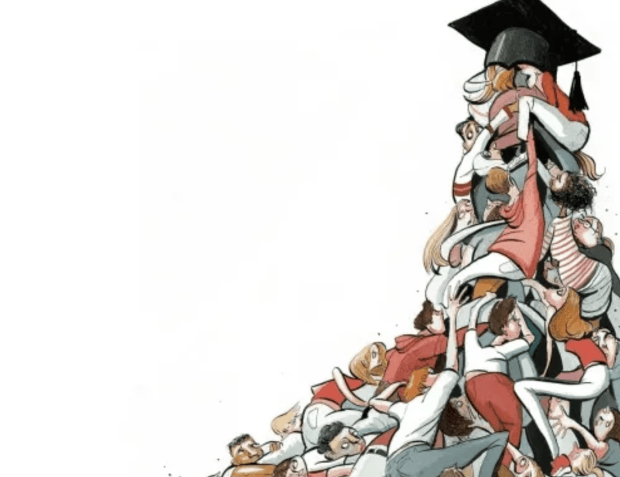
But the root of the problem actually long pre-dates AI. The graduate class has massively expanded. The system trains them to write in an abstract and colourless style. They don’t understand the concept of persuasive speech.
They emerge into the outside world and see themselves as leaders by election, not grace. They want the top jobs, but the long and painful task of learning to stand up in front of an audience, talk with the groundlings and motivate a team is one most of them are keen to avoid.
The crisis came in 2015. Jeremy Corbyn was the joke candidate in the Labour leadership election which pitted him against three Oxbridge graduates. Of course, it was supposed to be a fast-stream stitch-up. The problem was that the Oxbridge graduates couldn’t make a decent speech.
Corbyn had patiently learnt his trade espousing unpopular causes in town halls over many years, while Yvette Cooper, Andy Burnham and Liz Kendall were over-promoted graduates who never considered that rousing an audience to action was part of the job description.
The pattern has continued. Modern leaders are far more comfortable with data and digital intermediation. They go to great lengths to avoid direct confrontation with voters, customers or employees. They’ve taken ‘performance’ out of the role because it’s too difficult.
Demosthenes, when asked what was the most important factor in speechmaking, replied, ‘Delivery, delivery, delivery.’ Millions of people hate the Orange Man, but Donald Trump is brilliant at delivery. Are business leaders and politicians actually going to spend hours memorising and rehearsing their AI scripts? Of course not.
In recent years it has been common for high-status people to ask speechwriters to find some words to go with their slide deck. They have a baffling faith in the ability of slides to convey ideas. The miracle of AI is that it can really do this – in seconds. It’s not surprising that big companies love it.
They imagine AI will increase productivity, but as Rory Sutherland will tell you, the potency and meaningfulness of any communication depends on the ‘costliness of its creation’. AI, like PowerPoint before it, will solve the problem of the speaker who needs to find ‘content’, but the tool does nothing for audiences who crave leadership and something worth listening to.
For the past fifteen years, we have been trying to enliven the meaningless platitudes spouted by CEOs about growth, technology, globalisation, health, net zero and DEI. These topics appeal because they allow top people to align themselves with ideal images of society. Ideal images of society that have little relevance to the real political problems that bedevil us.
The Canadian-British commentator Cory Doctorow has got some fascinating things to say about ‘enshittification’, a process we’re seeing on our apps, on our supermarket shelves and in our public life. We all know that month by month we’re getting products and services that are of a lower quality and a higher price, but where are the business leaders pointing this out for competitive advantage?
It’s hard to find a business leader who talks about customer service any more, because that’s not a feature of authoritarian capitalism. They’re all trying to run restaurants, supermarkets and helpdesks as automated systems. They want to dispense with tiresome and expensive human beings altogether.
This is why, let’s be honest, AI talk fills us with dread. We know that the leaders of the top organisations don’t care about how good the writing is. I once wrote for a chief executive who had grown up in Albania during its most repressive times. What good preparation for a modern corporate executive, I remember thinking. Nobody expects CEOs to challenge the status quo, entertain or provoke controversy.
Back in 2010, the UK Speechwriters’ Guild gave the then British Airways chairman Sir Martin Broughton a communication award for the quality of his jokes. Today, I would struggle to name a British business leader under 65 who has made a joke. Where are the Anita Roddicks, the Jimmy Goldsmiths and Freddie Lakers of yesteryear?