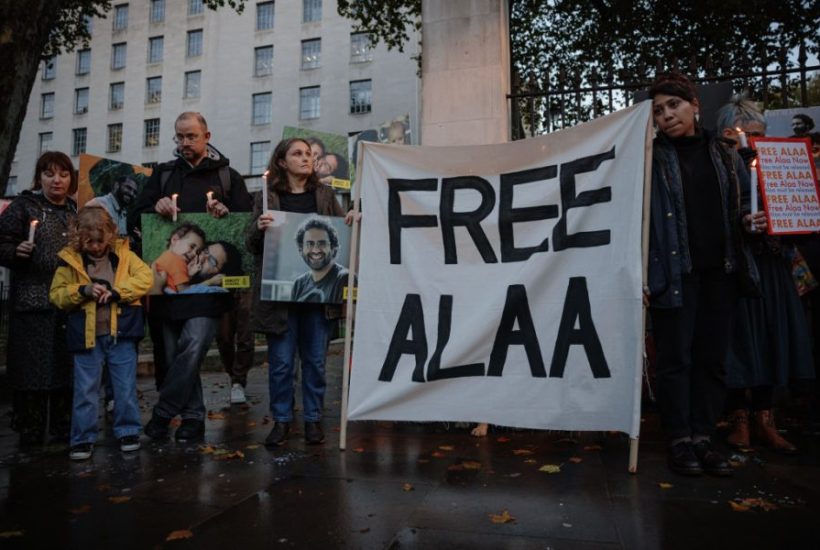
It’s a difficult Monday for the Prime Minister. Shortly after Keir Starmer expressed his ‘delight’ that Egyptian dissident Alaa Abd el-Fattah had arrived in the UK, it emerged that the PM’s ‘top priority’ apparently hates Jews, white people and the English most of all, if his past tweet are anything to go by. As a result, the government is now facing demands from Nigel Farage, Kemi Badenoch, and even senior Labour MPs to strip el-Fattah of the citizenship he was granted in 2022 while a prisoner in Egypt.
How plausible is this? In fact, although such demands are very unusual in British politics, the deprivation of citizenship is a long-established ministerial power. Under the 1981 British Nationality Act, the Home Secretary has the right to deprive ‘any British citizen, British Overseas citizen, British National (Overseas), British Protected Person or British Subject’ of their citizenship if they are ‘satisfied that such an action is conducive to the public good’.
British citizenship is more than a piece of paper
This is specifically defined. ‘It is in the public interest to deprive an individual of British citizenship because of their conduct and/or the threat they pose to the UK’. Examples include ‘the interests of national security’, ‘where the person has been involved in serious organised crime’ and ‘where the person has been involved in…unacceptable behaviour’. It is left to the Home Secretary to ‘determine personally whether a person’s actions are such that it is in the public interest that they are no longer a British citizen’. One key limit on this power is that the Home Secretary can’t make such an order if it would make the person ‘stateless’.
Such powers have been tested very recently, in the case of Shamima Begum. Unlike el-Fattah she had lived in Britain from birth until she was 15, at which point she left the country to join Islamic State.
In 2019, the then Home Secretary, Sajid Javid, deprived her of her British citizenship on the basis that she posed a ‘risk to national security’. At that point, Begum was still a citizen of Bangladesh. She, supported by people within this country, mounted an appeal on numerous grounds, including the ‘public sector equality duty’ and that deprivation of British citizenship would make her ‘de facto’ stateless, because there was no realistic prospect of Bangladesh allowing her to enter the country.
In February 2024, the Supreme Court unanimously dismissed Begum’s appeal, rejecting all of her arguments. The matter was settled in British law, and the Home Secretary can deprive someone of their British citizenship, even if they are only theoretically entitled to citizenship in another country. This legal reality is accepted on the left, with organisations like the Runnymede Trust publishing research showing that ‘up to nine million people’ could have their citizenship removed by the Home Secretary under existing powers.
Given all of this, it would not be difficult or unreasonable at all for Shabana Mahmood to conclude that the presence in this country of a man who has described white people as ‘a blight on the earth’ and England as ‘the nation responsible for the greatest number of massacres in human history’ is not conducive to the public good. It seems he has never resided in the UK, his citizenship was issued just a few years ago and he still holds Egyptian citizenship. The Home Secretary could lawfully and swiftly remove el-Fattah’s British citizenship and order his deportation.
What is particularly interesting about this case is that it has changed the conversation about who is British. For the longest time we’ve been asked to accept that the mere grant of a British passport makes someone as British as people who have lived here their whole lives and whose ancestors have lived and died in these lands for centuries. That claim is obvious nonsense, and at last it is crumbling.
We all know that people like el-Fattah are not British in anything but an administrative sense. Of course he should be stripped of British citizenship and deported. And perhaps this will begin a wider, more pragmatic conversation about who we wish to share our country with. The UK issued nearly 270,000 British citizenships in 2024 alone. In fact, we’ve granted more citizenships since 2022 than Japan has since 1967. If British citizenship is to mean anything, then we must recognise that it is more than a piece of paper, and we should ask how many other new British citizens hold views as dangerous, and unconducive to the public good, as el-Fattah’s.