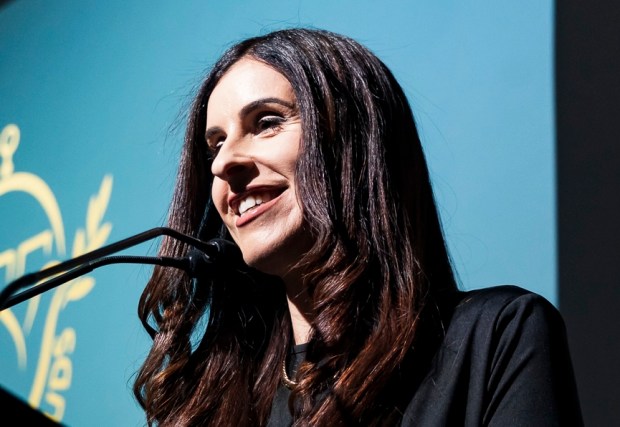
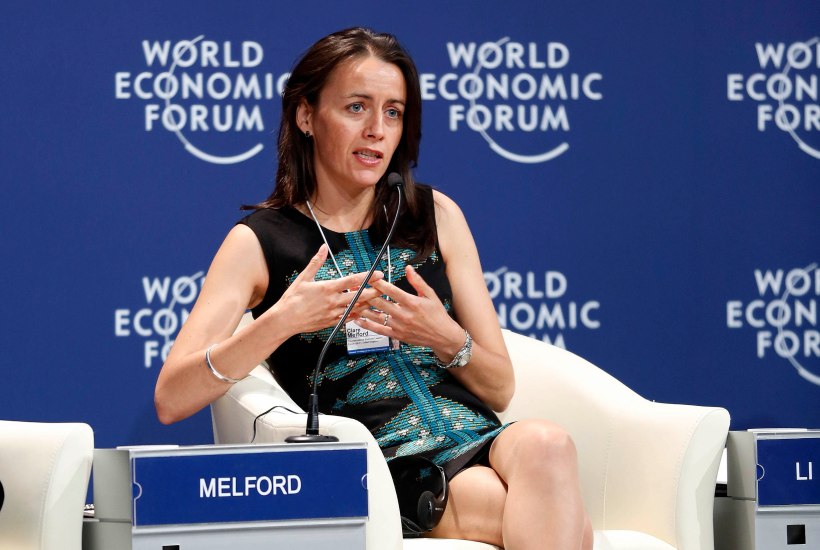
How tempting it is to rush to the aid of Clare Melford, one of the five people told by the Trump regime that they cannot have a US visa on the grounds that their presence in the country is not conducive to America’s commitment to free speech. It is hypocritical, one might say to Team Trump, to make a show of defending free speech by banning people you don’t like from entering your country. Indeed, that was the reaction of Chi Onwurah, chair of the Commons committee on Science, Innovation and Technology. She said last week: ‘Banning people because you disagree with what they say undermines the free speech the administration claims to seek.’ Before accusing the Trump administration of hypocrisy, however, we should know who Melford is. Let’s look at her approach to the subject of free speech.
Melford was once a general manager of the entertainment television channel MTV. In 2012, in an episode of the BBC Radio 4’s Four Thought titled ‘Buddah in the Boardroom’, Melford said that she left the company following a bizarre-sounding meeting with a ‘long-haired sailor’. She was living in Stockholm at the time, and she came across this man (she didn’t say how) who asked her a life-changing question. ‘You work for a media company,’ she remembered him telling her. ‘Have you ever wondered whether advertising is a good thing? After all, we live on a finite planet.’ This rather banal query apparently put her in a state of ‘existential angst’ about the ills of capitalism. She resigned from her job and escaped to Panama, where she lived with the man on a boat and they tried to grow mangos on a small patch of land.
In 2018, the newly enlightened Melford set up something called the Global Disinformation Index (GDI). The organisation describes itself as an independent, not-for-profit body with a mission ‘to strengthen the systems of the internet so that truth has the advantage and disinformation loses its power’. Melford, who is still chief executive of the GDI, has herself described its role as ‘defunding disinformation’. The GDI started off by providing ‘risk assessments’ for advertisers whose adverts were appearing next to content of which Melford disapproves. It has since discontinued that activity, saying that its role now is to ‘help shape the rules and standards that make the internet safer. We advise governments, industry, and civil society on solutions that strengthen accountability, and resilience against disinformation.’
But what constitutes ‘disinformation’? According to a report on the GDI website about ‘Climate change disinformation in Canada’, for example, it suggests that disinformation includes the assertion that climate polices will impose ‘unaffordable costs’ in citizens, or claims that the Intergovernmental Panel on Climate Change (IPCC) is politically biased. It is ‘disinformation’, too, apparently, to claim that climate models might be ‘inaccurate or unrealistic’, or to question whether climate change causes natural disasters. My apologies to Melford if I have missed something, but I have not come across her showing much interest in dodgy information on the other side of the debate. What about Ed Miliband’s claim that green electricity will save us £300 a year?
You don’t have to tell porkies to fall foul of Melford’s definition of disinformation. In an online session hosted by the LSE in 2021, titled ‘Bankrolling Bigotry’, Melford cited as an example of the material she wanted to suppress an item on the Breitbart website which rounded up crimes committed by illegal aliens in the US. The cases have been true, she conceded, but they constituted ‘cherrypicked elements of truth’ which were presented to advance a ‘misleading narrative’ that illegal migrants have a higher crime rate than US citizens, which, she says, isn’t true. Whatever the reality of migrant crime, is it really misinformation to highlight a few especially heinous crimes committed by people who shouldn’t really be in the country? Who is Melford to decide what the ‘narrative’ presented by a specific article is?
I can’t say I feel like rushing to the barricades to stand up for Melford
The GDI doesn’t seem to be above a bit of cherry-picking of information itself, by the way. Its website answers the question ‘Where does GDI get its funding?’ by stating ‘GDI is supported by foundations and philanthropic partners who share our mission of building a safer information ecosystem.’ What it doesn’t say – but we know thanks to a parliamentary question asked in 2023 – is that the GDI received just under £2 million of UK taxpayers’ money courtesy of the Foreign Office between 2019 and 2022, plus another £600,000 in the year 2022-23. Quite why a Conservative government felt it a good idea to throw so much money at an organisation that is committed to suppressing right wing opinions is somewhat mystifying. It might be noted that this was the period when Boris Johnson’s government was seeking to suppress vaccine-sceptics and lockdown-sceptics, while frightening people with adverts asserting that people who broke Covid rules (i.e. as a few government ministers and advisers were caught doing) were morally responsible for bumping off grannies.
I don’t like the idea of governments refusing visas to people with whom they disagree, and Donald Trump is not my idea of a great champion of liberty and free speech. Like so many powerful bullies before him he is an enthusiastic user of libel laws to suppress his critics. Nevertheless, I can’t say I feel like rushing to the barricades to stand up for Clare Melford’s right to visit the US. She, it seems to me, has an equal desire to shut people up when they are saying things she doesn’t like. What’s more, while few people may have heard of her, she is in a very powerful position to lobby for laws to regulate the internet. While the liberal-left rush to her defence, I might just sit on my hands.