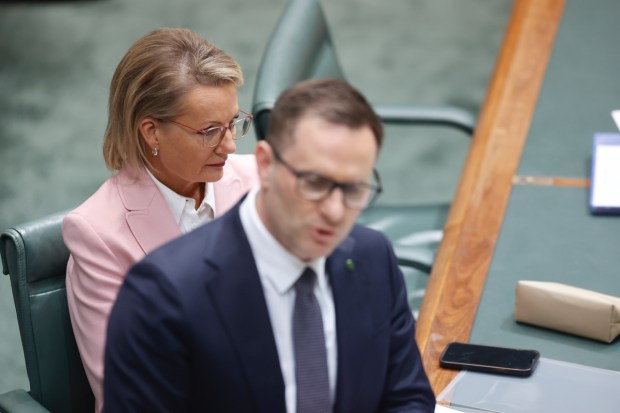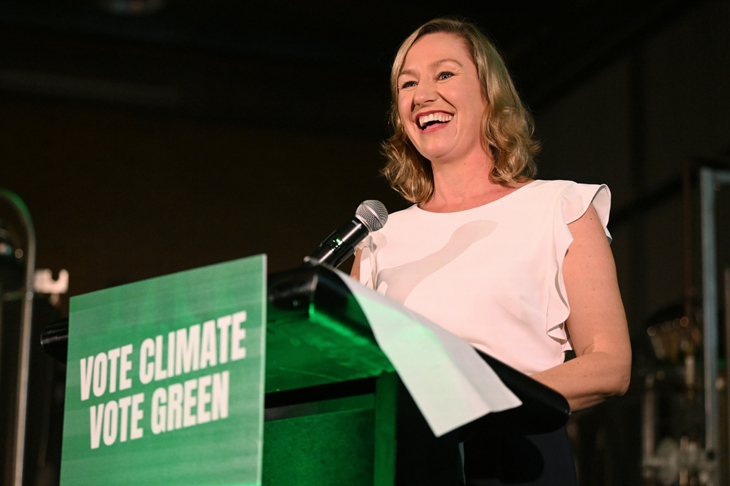
It wasn’t easy being Green this year. The protest party par excellence protested too much and was cut down to size: leader Adam Bandt lost his seat, the party fell from four to just one in the lower house, and Dorinda Cox defected to Labor.
But the eco-catastrophists didn’t let their bollocking at the ballot box crimp their style when it came to spending your money. It’s their party room, after all, and they’ll splurge if they want to, since you are footing the bill.
The renovations for their single room – plus 15 leather swivel chairs for the 11 remaining members and an official photograph of Bob Brown – blew out from $886,000 to $1.6 million. It’s hard to imagine how you can spend that much on one room. What are the chairs upholstered with? Luxury mushroom vegan leather? Recycled wind-turbine hide?
Senate President Sue Lines said that ‘opening up the ceiling for the establishment of this party room has provided good learning for what needs to happen in the future.’ Could that good learning be: don’t open up the ceiling next time? What was on it – frescoes by Michelangelo? A chandelier from Trump Tower?
But when it comes to providing ‘good learning’, nobody can beat the Bureau of Meteorology (BOM), which forked out $96 million on a new website that everyone in the country agrees is worse than the old one and that all the BOM got after spending a bomb was a bomb. Everyone, that is, except its CEO, Stuart Minchin, who told Senate Estimates he didn’t accept that the website was, to use the technical term, ‘a stuff-up’, insisting instead it was ‘a learning moment for the bureau’.
In a strange twist of fate, it was Greens Senator Barbara Pocock, perhaps fresh from her own party room ‘learning moment’, who described the Accenture contract as ‘land and expand’, you might say ‘quote and bloat’, or ‘pucker and sucker’. That’s how a $4.1 million estimate ballooned out to $96 million.
The Greens’ renovation is perhaps a ‘learning moment’ for the whole country on why the Labor/Greens $10 billion Housing Australia Future Fund didn’t build a single house in its first term and only managed to renovate 340 dwellings, about 0.07 per cent of the 600,000-plus shortfall.
At $1.6 million a room, it would cost the Greens over $11 million to renovate a three-bedroom house with a kitchen, dining room, living room and bathroom – and the bill for 340 would be $3.8 billion. Even if they blew all $10 billion, they’d manage only 893 houses – leaving 599,107 still to go.
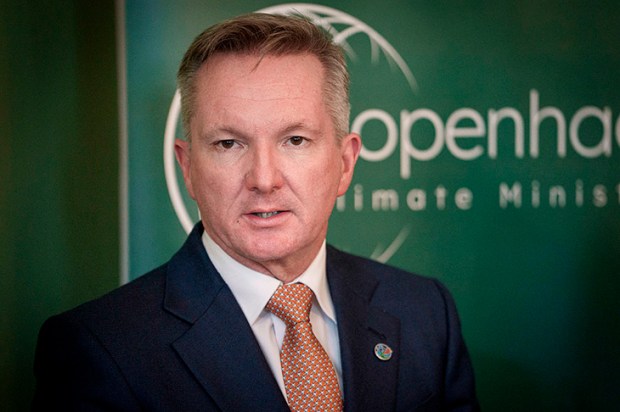
The Greens’ renovations might also explain why Chris Bowen, the part-time Minister for Energy and full-time Minister for Globetrotting, thought he’d need up to $2 billion to host his climate conference. Whoever said talk is cheap has clearly never underwritten a United Nations jamboree.
Bowen presumably chose Adelaide to showcase it as the wind capital of Australia. But just when you thought all you had to worry about with wind turbines was bird slaughter, sleep-destroying subsonic hums and ruined views, asbestos has now been found in the brake pads of Chinese-built turbines – appropriately enough, during National Asbestos Awareness Week. As the pads wear down, they will release fibres into the turbine towers and – who knows? – where else afterwards. Asbestos has already been found in imported children’s crayons and coloured sands used in schools, as the Chinese allow up to 5 per cent asbestos in products without labelling it. Yet inhaling a single fibre can be fatal, only 18 months after diagnosis.
Meanwhile, South Australia, having blown up its coal-fired power stations, relies on a trickle of gas to firm its renewables and on expensive, interconnector-constrained interstate imports of coal-fired power. The result? Some of the most expensive electricity in the country.
For Adelaide, a city with neither the hotel rooms nor the venues for an event even one-tenth the size of Cop, an entire energy-hungry pop-up city would have had to be built: accommodation, pavilions, exhibition zones and secure compounds requiring acres of air-conditioning, lighting, catering, IT networks, security systems and media studios – each guzzling electricity at industrial scale.
For the global managerial class, Cop is an annual pilgrimage of virtue signalling, generating a carbon footprint exceeding that of a small South Pacific nation – and enough frequent-flyer points for a couple more carbon-intensive round-the-world trips.
For Canberra’s mandarins, it’s the Burning Man of climate diplomacy: a temple of public expense, with more lanyards and less nudity.
For everyone else, it is a modern-day Bonfire of the Green Vanities: a spectacle in which the global clergy of climate righteousness torch vast sums of money in the name of planetary salvation, with UN Secretary-General António Guterres as a latter-day Savonarola warning us to ‘Repent! Repent!’ as the era of global boiling is upon us.
Bowen has already spent $7.5 million on the conference that isn’t to be and may yet have to stump up millions more to consultants, labour-hire firms and lawyers contracted during the failed bid.
A total of 75 government officials attended this year’s Cop, including ministers, staffers and assorted bureaucrats. Australia’s pavilion alone cost $1.4 million and hosted more than 90 events with 4,500 attendees. Asked about the cost of sending staff to Cop30, acting deputy secretary Amanda Lee said the figure wasn’t available but confirmed the Department had spent $6.8 million on travel between July and September, $1.2 million on business class, $2.4 million on international travel, and $4.4 million on domestic travel. If emissions matter so much, why not fly economy? Because business class is a condition of their enterprise agreement: 81 officials, 91 trips, $13,100 per flight.
Meanwhile, the people of NSW learned this week that, instead of receiving a cut of $275 off their power bill as the PM promised in the 2022 election campaign, their electricity bills in 2025 are, on average, $1,200 a year more expensive. And the Australian Energy Market Operator warns that more costly interventions – giant batteries, synchronous condensers and the rest – will be required to keep the lights on if the Eraring coal plant closes before 2029, pushing power bills up further.
With electricity demand skyrocketing thanks to AI and the government’s energy plan in tatters, it looks like dirty old diesel will provide the power during the inevitable shortfalls. Perhaps it’s just as well that the UN’s climate worriers won’t be here to see it. Let’s call it a learning moment.
Got something to add? Join the discussion and comment below.
You might disagree with half of it, but you’ll enjoy reading all of it. Try your first month for free, then just $2 a week for the remainder of your first year.