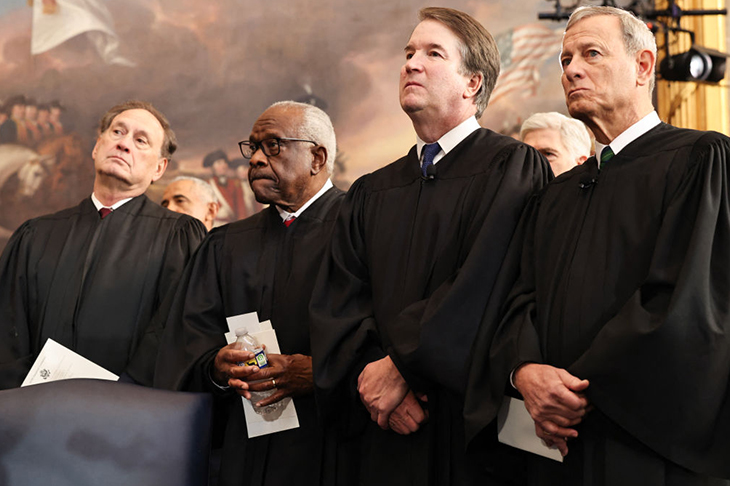
As the United States Supreme Court opens its new term, it also marks Chief Justice John Roberts’ twentieth year on the bench. While media and echo chambers obsess over the political storms surrounding Donald Trump, the Roberts Court has been engaged in the more enduring work of restoring legal clarity and restraint to a system that for half a century veered toward judicial policymaking. In a climate where US politics – alas, currently the greatest show on earth – has become more winner-takes-all, the Supreme Court is arguably now the most important and coherent institution in the democratic world.
The Court’s transformation has not been a lurch to the right, but more accurately a return to discipline. Since the mid-2000s, under Roberts and his conservative colleagues, the Court has been re-anchored in constitutional text and structure after decades of improvisation under the ‘living Constitution’ philosophy. The Wall Street Journal has described this as a ‘constitutional revitalisation’. It began with Antonin Scalia and Clarence Thomas establishing early beachheads, which were consolidated under Roberts and Samuel Alito. It has matured and moderated with the Trump appointments of Neil Gorsuch, Brett Kavanaugh and Amy Coney Barrett. All three of the Trump-era justices are centre-right institutionalists much more interested in durability than disruption.
The description of the Court as ‘Trump’s Court’ misunderstands everything. Since 2016, the Supreme Court has repeatedly demonstrated that its allegiance lies not to Trump but to the constitutional order itself. There have been moments of support for executive authority – as in Trump v. United States (2024), where the Court affirmed that presidents are immune from prosecution for official acts – but this was no personal favour to Trump. It was an utterly conventional restatement of a principle every functioning democracy relies upon: that the executive must be free to discharge core duties without the chilling prospect of retrospective criminalisation. The so-called ‘unitary executive’ theory, often invoked in alarmist tones by the New York Times and others, is hardly radical. It simply recognises that the executive branch must be under the control of the person whom voters actually elect to run it. Reasonable minds differ on the required balance, but without a serious check, the administrative state can veer toward technocratic tyranny.
Nor has the Court hesitated to check Trump when the law required it. In Mazars v. Trump (2020), it upheld Congress’s power to subpoena presidential records. On other occasions too, the Court ruled against Trump’s administration where the law demanded it – and, after the 2020 election, it gave short shrift to attempts to relitigate the result through the courts. It reaffirmed that no president stands above the law.
What distinguishes the Roberts Court is not its ideology but its moderate temperament. The project has actually been one of normalisation – returning the Court to its constitutional role after decades of what even progressives recognise was experimental doctrinal improvisation. Three decisions in particular have restored equilibrium to areas of law long distorted by judicial overreach – distortions that in the end only deepened public division.
The first was Dobbs v. Jackson (2022), which overturned Roe v. Wade. The Court did not legislate morality; it refused to do so. It acknowledged that abortion policy belongs with voters and state legislatures, not judges – a position of judicial modesty reflecting in practice what we have in Australia. The second was Loper Bright Enterprises v. Raimondo (2024), which ended the Chevron doctrine that for forty years had required courts to defer to bureaucratic interpretations of law. That decision restored the separation of powers, and limits Congress delegating policy decisions to the administrative state. The third was Students for Fair Admissions v. Harvard (2023), which struck down race-based university admissions and reaffirmed the Fourteenth Amendment’s 1868 ‘second founding’ promise of equal protection. The Chief Justice’s line from an earlier case – ‘The way to stop discrimination on the basis of race is to stop discriminating on the basis of race’ – was finally fully vindicated.
Each of these rulings corrected progressive overreach by previous Courts, or bureaucrats. Each returned hugely polarising issues to the realm of public debate where, as the Founders intended, persuasion rather than diktat must prevail.
The Court has endured criticism from both sides. Roberts twice rescued Obama-care by rewriting its tax provisions – a move that many conservatives regarded as judicial creativity. In Bostock v. Clayton County (2020), a majority including Justice Gorsuch extended the Civil Rights Act to cover sexual orientation and gender identity – a textually adventurous decision that was nonetheless well intentioned. Yet these episodes also reveal a Court mindful of its institutional legitimacy. Roberts has signalled many times that preservation of the Court’s authority depends not on ideological purity but on public confidence.
In Trump v. United States, the Court’s articulation of executive immunity has been attacked as partisan, but its implications are far broader. The ruling will protect Joe Biden and future presidents from the weaponisation of the criminal process – an essential safeguard in a system already strained by lawfare. In refusing to let the judiciary become a partisan battlefield, the Court has protected not Trump, but the institution of the presidency itself. That fidelity to institutional equilibrium is precisely what distinguishes this Court. It recognises that the survival of the republic depends less on who wields power than on whether the players understand its limits and obey them.
Across the democratic world, the US Supreme Court now serves as a model of constitutional endurance. Its jurisprudential methods are a little more flexible than ours, but under Roberts they provide the architecture of freedom. In an age of populism, administrative-state overreach, and political hysteria, the Court has shown that restraint itself can be a form of courage. The United States is a fractious and noisy democracy. Yet amid a chaotic period, its highest court has re-established a kind of constitutional peace with a committed recognition that law must outlast politics. It has done so by reminding Americans that generally the constitutional words mean what they say, and that government must abide limits in order to protect freedoms. The upcoming challenge to Trump’s use of emergency powers to unilaterally impose ad hoc tariffs on the rest of the world is a blockbuster statutory interpretation case, sure to test the Court yet again.
In an era when many public institutions have submitted to partisanship and fashion, the US Supreme Court has held its ground and quietly rebuilt integrity. As a human institution it is neither infallible nor omniscient, but it remains deadly serious about the Constitution and the rule of law. That seriousness is a blessing not only to the United States, but to the democratic world the US still leads. I like to think that when history assesses this turbulent era, it will judge that the most important stabilising force in American life was a group of justices who remained steadfastly committed to the Constitution they swore to uphold.
Got something to add? Join the discussion and comment below.
You might disagree with half of it, but you’ll enjoy reading all of it. Try your first month for free, then just $2 a week for the remainder of your first year.