Politics is very much like marketing. Just as private businesses sell goods and services for money, political parties sell policies and proposed institutional changes for votes. Marketers use phrases like ‘market share’ or ‘audience share’ which are, in practice, not that different from ‘voter share’. Target demographics (or target audiences) are renamed constituencies, and advertising is renamed campaigning, but in the end, the fields have much in common.
This, however, does not augur well for the Liberal party under the leadership of Sussan Ley. In her recent statement removing Senator Jacinta Nanpijimpa Price from the shadow cabinet, Ley made clear the foundational aspects of her marketing strategy:
‘Reflect modern Australia, respect modern Australia, and represent modern Australia.’
It is true that a politician in a representative democracy needs to represent people, but we must look at the word ‘represent’ within the context not only of this whole quote and its invocation of some sort of ‘modern’ Australia (which invariably presupposes some sort of ‘premodern’ Australia that clearly isn’t being prioritised), but also Ley’s repeatedly-declared commitment to increasing ‘women’s representation’ in the highest ranks of the Liberal party. Ley is clearly voicing support for a very specific marketing strategy – a strategy built around the idea that representation of women and minorities in prominent positions grows market share. However, this marketing strategy has proven itself to be absolutely disastrous on more than one occasion. Let us review three high-profile case studies.
The first case study comes from the video game industry – the largest entertainment industry on Earth. Among the largest video game publishers is Electronic Arts, and in late 2024 they released a game called Dragon Age: The Veilguard (the latest sequel in an established franchise). In a recent interview with one of the writers of previous instalments in the franchise, it was revealed that EA’s marketing strategy for the game presumed that the franchise had a built-in audience that would show up for the game simply due to the title (this audience was described as denizens of a ‘nerd cave’), and thus in order to increase sales the game had to target a so-called ‘modern audience’. To appeal to said ‘modern’ audience, the game’s tone and graphics were noticeably cartoony (in great contrast to the earlier titles’ darker feeling) with flippant, quippy character dialogue, as well as highly prominent ‘trans’ themes. The game’s character creator allowed players to have mastectomy scars (despite the game being set in a fantasy world without the technology to perform mastectomies, and with functional magic that could make such surgeries unnecessary), and one of the game’s companion characters embraced a ‘non-binary’ identity including gender-neutral pronouns (despite the fact that said character was from a culture that already had its own very heterodox gender system). The game was a commercial flop and had stunningly low player numbers even when released onto streaming services – clearly the denizens of the ‘nerd cave’ didn’t stay and if the ‘modern audience’ turned up it was much smaller than presumed.
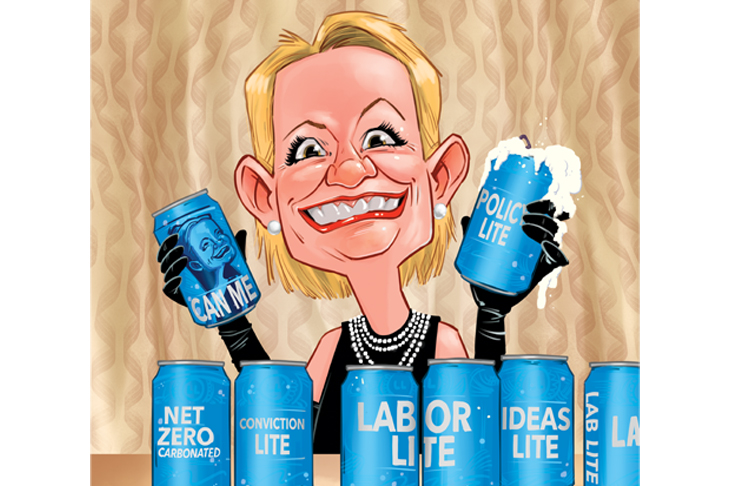
The second case study is Alissa Heinerscheid’s disastrous attempted market repositioning of the US’s most popular beer – Bud Light, owned by Anheuser-Busch. Heinerscheid presumed that young and female drinkers didn’t like Bud Light due to the product having an ‘out of touch’ and ‘fratty’ image. In order to counter this, she enlisted the marketing prowess of Dylan Mulvaney – a trans woman (i.e. biological male) who was celebrating one year of living as a woman (or at least Mulvaney’s own idea of what that meant, which Mulvaney’s critics generally summarised as ‘airheaded neurotic’). Heinerscheid’s move is estimated to have cost Anheuser-Busch $US1.4 billion in sales alone, as well as billions more in shareholder value. Alissa’s demonstrated contempt for Bud Light’s current, mostly-working-class market was exceptionally grating, particularly given the fact she’s a multimillionaire graduate of Harvard University. Satisfyingly, her complaint about Bud Light being ‘fratty’ came back to bite her when investigations showed she was notably enthusiastic about socialising with fraternity men during her college years.
The final case study is the undisputed Queen of marketing seppuku – Kathleen Kennedy – and her disastrous reign over the Star Wars franchise. Despite the franchise being specifically intended by its creator to target 12-year-old boys, and despite Disney having bought it (at a price of over $US 4 billion) specifically to appeal to that demographic, Kennedy convinced Disney CEO Bob Iger that the pre-existing fanbase would show up for anything that had Star Wars in the title, and thus the franchise’s appeal could be expanded by focusing on female and ‘diverse’ characters (or, as South Park memorably summarised, ‘put a chick in it and make her gay!’). The result was a string of flops (with less than a handful of exceptions, mostly made without Kennedy having creative control) across movies, streaming series, video games and even themed hotels. Perhaps her most infamous (and most overbudget) creation was The Acolyte, which attempted to appease the ‘modern audience’ through focusing on a strikingly multi-ethnic coven of lesbian space witches. Not only did the fabled ‘modern audience’ fail to show up, but Kennedy’s works have driven away the predominantly-male legacy fanbase (as Variety magazine tacitly conceded in a 21 August report).
In fairness, Sussan Ley herself is almost certainly not responsible for choosing the current marketing strategy of the Liberal party – these strategies are usually developed by consultancies and voted on in party rooms. However, Ley has publicly championed these strategies on numerous occasions and, as party leader, she is in a position to right the ship. The best thing she could do for her leadership is to take note of the fact that ‘diversity’ marketing has caused several billions of dollars of damage to business behemoths far larger than her party. Her ‘modern Australia’ – the ‘modern audience’ in other words – is far smaller than marketers think, and frankly the kind of person who needs to see someone of their own sex or race to feel acknowledged already votes Labor-Green and cannot be won over. Most critically, the legacy audience or the denizens of the ‘nerd cave’ – the party’s established base in ‘premodern’ Australia – cannot be taken for granted or dismissed as the Australian version of ‘fratty’. To hold them in contempt and attempt to socially gentrify them, to hide them in the shadows as if they were shamefully ‘uncool’ is hateful, alienating and electorally suicidal.
Got something to add? Join the discussion and comment below.
Dr Andrew Russell is an economist & philosopher. www.drcasino.substack.com
You might disagree with half of it, but you’ll enjoy reading all of it. Try your first month for free, then just $2 a week for the remainder of your first year.