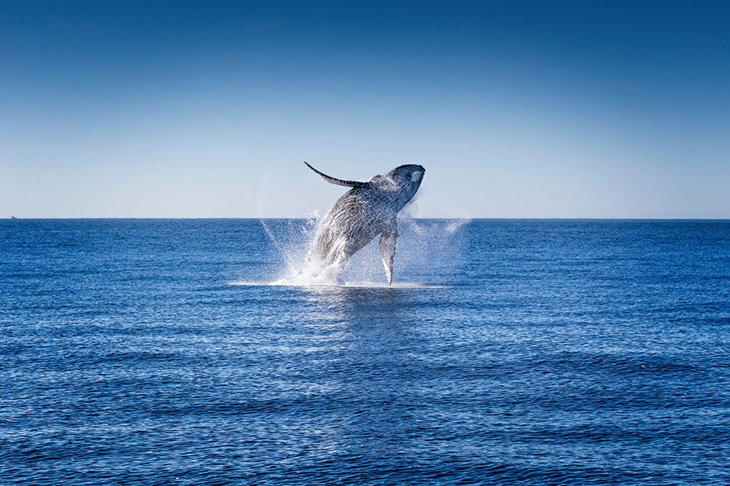
Further evidence that global warming is good for mammals emerged in South Australia last week, when marine biologists confirmed that the algae bloom which has been discolouring the Great Australian Bight since last September – and which climate alarmists were quick to attribute to anthropogenic CO2 – seems to have created ideal living and breeding conditions for at least one of our relatives. The Southern Right Whale needed the 1986 global whaling ban like a hole in the head (geddit?), but forty years later had not recovered to the point where it could be taken off Australia’s endangered species list. Over the last six months, however, the species has enjoyed something like a population explosion off South Australia, with more documented sightings this year than in the previous five combined. Since the only other observable change in these normally pristine waters has been the appearance of the algae, scientists have not unreasonably inferred a causal relationship: that is, the reduction of shark numbers caused by the algae has triggered a boom in the smaller fish which sharks depend on, and this, for filter-feeders like the Southern Right, has turned the Great Australian Bight into the Great Australian All-you-can-eat Buffet. But if the climate catastrophists are right, the spectacular local recovery of a much-loved species might come at a national cost: if we don’t drastically reduce the amount of oil and gas we burn in our power stations and vehicles, whale numbers off our southern beaches, like crocodile numbers in our northern estuaries, could soon reach problem proportions. Being able to guarantee tourists whale sightings will certainly compensate South Australian communities like Port Lincoln for a fall-off in their Great White Shark cage encounter traffic. But how long before a minor local revenue source becomes a major international shipping hazard? If Australia doesn’t lift its game meeting emission reduction targets, how long before the Southern Right Whale is to the Great Australian Bight what Houthi Rebels are to the Red Sea?
The only thing in mainland Australia which is changing colour faster than the Great Australian Bight is the political party that’s supposed to care most about such things. I first became aware that the Greens are no longer the single-issue tree-huggers they once were when I was creating advertisements for their paramilitary wing, The Wilderness Society, and noticed that the campaigns opposing Daintree development weren’t as well funded as the ones attacking Canberra conservatives. This concerned me no more than a good barrister is deterred by the suspicion that his client is guilty. But if saving the planet was the great passion of my life, as is the case with many long-time Greens voters, the party’s recent unquestioning embrace of all far-left causes would have tested my allegiance, and the decimation of its senior ranks that we’ve seen lately would have come as no surprise. Greens veteran Drew Hutton and ex-leader Christine Milne left because of their inability to toe a party line which is a direct inversion of the natural order: that women can have penises. Delegate Gail Harrison objected, specifically, to senior officials referring to women as uterus havers (sic) and menstruators (sicker). Greens Sydney Councillor Tina Kordrostami, on the other hand, resigned because of the refusal of her federal colleagues to condemn the actions of Hamas and Hezbollah – both of whom are openly committed to an especially abhorrent version of species extinction.
The mission creep of the Australian Greens – the gradual displacement of ecological emergency by ideological extremism – is the local manifestation of a global trend. A phenomenon which was perfectly personified by the blink-and-you’ll-miss-it transformation of Greta Thunberg from anti-oil harridan to pro-Palestinian harpy. Despite this broadening of her activist bandwidth, Thunberg is still only 22, so there’s still plenty of time for her do a Patrick Moore. Moore is an ex-president of Greenpeace, and the only member of its founding board with a science degree. But he was almost 40 before he identified the cuckoo in the nest. ‘Greenpeace was highjacked by the political left,’ he said, explaining his resignation. ‘When they saw there was money and power in the environmental movement, they changed it from a science-based organisation to a political fund-raising organisation.’
Moore, who is now a persuasive opponent of wind and solar, and an advocate for more, rather than less, atmospheric CO2, earned his Greenpeace stripes crewing the boats which sabotaged whaling fleets in the 1970s. If South Australia’s algae problem can’t be solved, perhaps that hands-on experience could also be drawn on. Just as Australian Greens founder Bob Brown, once a big fan of all things renewable, now leads the charge against putting wind turbines in the Bass Strait, perhaps the South Australian government should lure the co-founder of Greenpeace out of retirement to lead whale-culling expeditions in the Great Australian Bight?
Got something to add? Join the discussion and comment below.
You might disagree with half of it, but you’ll enjoy reading all of it. Try your first month for free, then just $2 a week for the remainder of your first year.