The green movement has always fascinated me. Not for its occasional, well-meaning mission to rid the world’s waterways of plastic bottles and other detritus left on beaches by lazy skanks, people, who, in my opinion, should be rounded up and banished from their villages, preferably on the backs of oxen while locals throw rotten fruit and vegetables at them. No, it’s something else. A perverse form of secular evangelism has infected this movement. There is a self-assured hubris among radicals that dates back to the 1970s, when the dreadlocked masses started trying to protect every single species of flora and fauna from extinction.
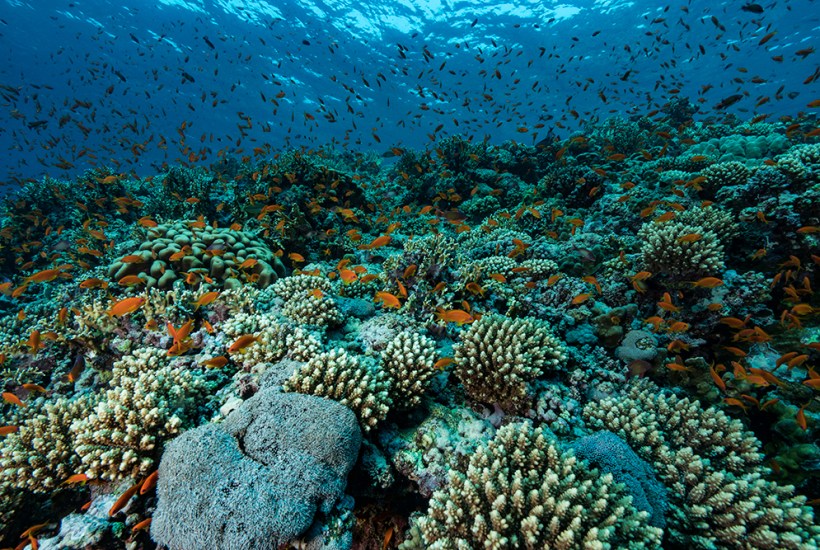
For what seems like an eternity, this quasi-religious cult has tried to convince us that the world will end if we do not repent of our sinful carbon-burning ways. Climate change is the church’s holy writ; heretics are excommunicated. It’s like the prophecy of the destruction of Sodom and Gomorrah, except instead of fiery punishment from above, our inability to recycle tin cans is causing the planet to heat a few degrees. Consider coral reefs, which are among nature’s most breathtaking sights. In 1999, the climate activist and part-time sandwich-board prophet George Monbiot warned readers of the Guardian that coral in the Indian Ocean would die within a year. Since that time, doomsday acolytes have cynically used the plight of the world’s coral reefs as a tool for activism.
So, imagine my surprise when I turned on the television to find out that there is an underwater inferno burning in Australia’s waters. I figured it was just another wacky YouTuber attempting to break a hard-core barbecue record. No such luck. This is how the BBC reported the recent increased water temperatures near Ningaloo, home to Australia’s largest fringing reef. I naturally expected the media to focus on the Great Barrier Reef (GBR) given that it is the aquatic equivalent of the rainforest in climate Armageddon terms. Wrong, again. For this particular moral panic, a crew was deployed to report on another Unesco World Heritage Site, located off the Ningaloo Coast in Western Australia.
It will come as no surprise to readers of this magazine that Australia gets extremely hot during the summer months. At the start of the year, temperatures on the West Coast began to rise, heating the ground and eventually the surrounding waters. This ‘marine heatwave’, as the BBC describes it, has stripped the colour from the corals, leaving them white, a process known as bleaching. Bleaching happens when water temperatures rise for a brief period, causing coral to expel symbiotic algae – the photosynthetic organism that gives the corals their characteristic colour.
Then I realised why. Well, to be honest, I was told. This is the first time the coral reefs on both sides of the country have been bleached. According to the BBC, it is part of a ‘global bleaching event’ that scientists predict will destroy more than three-quarters of the world’s coral reefs. It is because we are constantly told this to be true that people willingly accept this sort of nonsense. The New York Times headlined ‘Heat Raises Fears of Demise for Great Barrier Reef Within a Generation’ last year, but it failed to address one essential point: data. On the same day the newspaper covered the story, a report by the Australian Institute of Marine Sciences was published, presenting a more optimistic perspective that did not receive extensive media attention. It revealed that average coral cover – the criterion used to measure coral health – was increasing rather than decreasing. The health of all three sections of the reef was improving – the northern and central sections were at their highest levels in 38 years. When bleaching events have occurred in the past, the reef often recovers.
Of course, this does not imply we should neglect the reefs, since they are home to a wide range of exotic marine life, and it is critical to implement protective measures, hence the start of annual monitoring. But we need to know the whole story. If we’re told something is dying when it’s not, it weakens your cause and reduces public support. Conservation is an important civic duty for both current and future generations. Some of the eco-friendly ideas are pretty decent, like banning seabed trawling, which is great, but most are just plain crazy. It’s unsurprising given that the green movement has been operating in the same absurd manner for half a century. Unfortunately, histrionics and outrageous claims are the sine qua non of the green movement, which is ideologically corrupted by availability bias.
This week’s BBC feature is another example of how apocalyptic hyperbole in environmental reporting consistently fails to convey the complete picture. There appears to be an editorial line among the commentariat that things are getting worse, and it is all because of us, selfish human beings burning fossil fuels as the planet advances inexorably toward heat death. This is the narrative regardless of data. When things contradict their world-view, they do what any good censors would do: isolate and remove.
This is what happened to Peter Ridd. Ridd, a regular contributor to this magazine and a geophysics specialist, has spent more than forty years examining the reef. In a recent report Ridd claims that the impact of bleaching is ‘routinely exaggerated by the media and some science organisations’, and that ‘not a single reef or even single species of reef life has been lost since British settlement’. He proposes that Australia cease allocating the annual $500 million it gives to conservation projects and instead direct these funds towards tackling genuine environmental issues, such as eliminating invasive plants and controlling feral animals. In 2018, he was fired from his professorial job at James Cook University for violating ‘the university’s code of conduct relating to public commentary about the GBR’. In other words, he was turfed out for challenging the dominant ‘settled’ narrative surrounding the green scam.
Science proceeds by falsification. Challenging elite opinion should be praised, not demonised. I hope the reef is still healthy in fifty years. Yet somehow I don’t think you’ll hear much about it in the press.
Got something to add? Join the discussion and comment below.
You might disagree with half of it, but you’ll enjoy reading all of it. Try your first month for free, then just $2 a week for the remainder of your first year.