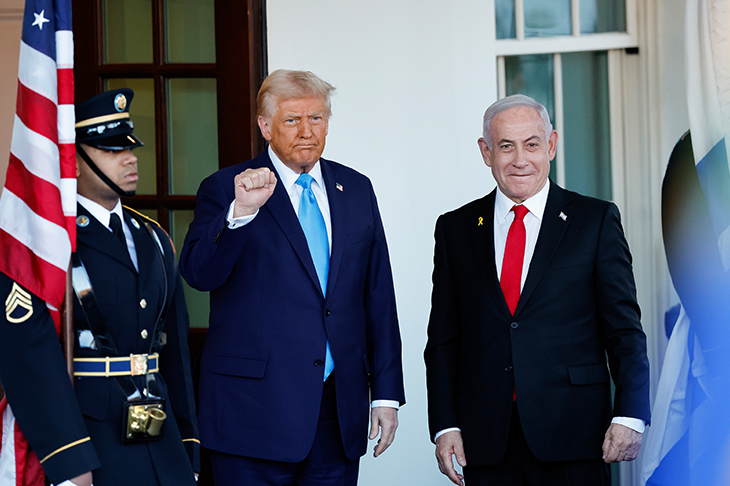
‘Now is the time for peace!’ declared Donald Trump, shortly after US B-2 stealth bombers obliterated three nuclear sites in Iran – Fordow, Natanz, and Esfahan – with six bunker-buster bombs. Responded Benjamin Netanyahu: ‘Your bold decision to target Iran’s nuclear facilities, with the awesome and righteous might of the United States will change history.’ That, of course, is the problem. Trump’s decision will definitely change history but whether for good or ill, or a mixture of the two, is another matter altogether.
Americans – progressive, populist or otherwise – remain haunted by the consequences of America’s intervention in Vietnam, Cambodia, Iraq (twice), Afghanistan (twice), Libya, Syria and so on. One credible estimate of the money spent on ‘nation building’ in Afghanistan in the years 2001 to 2022 is $2.3 trillion, while over 4,000 servicemen and contractors are estimated to have died. And for what? The return of the Taleban to power.
It was no coincidence, then, that Trump touted himself as the anti-war candidate on the campaign trail last year: ‘We will measure our success not only by the battles we win, but also by the wars that we end, and perhaps most importantly, the wars we never get into.’ Six months into the job, however, Trump was participating in the Iran-Israel war, if only to give Netanyahu the imprimatur on 13 June to begin its aerial assault on Iran, providing the IDF with live intelligence, and shooting down Israel-bound Iranian missiles.
Trump’s unwavering praise and support for Netanyahu – ‘We have worked as a team like perhaps no team has worked before’ – provoke ire on both the left and the right. Even before the B-2s dispatched their massive ordnance penetrators, Dave Smith, libertarian comedian-cum-podcaster, was calling for his multi-million audience to ‘turn on’ Trump: ‘I supported him last year. I apologise for doing so. It was a bad calculation. At the time, it seemed like the right one. He should be impeached and removed.’
Smith, his critics might say, is particularly predisposed to an anti-Israel perspective and, in any case, was a latecomer to the Trump phenomenon. The negative sentiments of Steve Bannon, Tucker Carlson, Marjorie Taylor Greene and other Maga superstars are a different story. Their accusation that Trump – again, before Fordow – was betraying his own America First doctrine carried real weight. That said, Republicans in general and self-identifying Maga types in particular remained supportive of Trump, according to the polls, and soon Carlson was apologising for his invective while Bannon acknowledged that the Maga movement would ‘get on board’ with whatever Trump decided.
Two important questions remain though, one more easily addressed than the other. Firstly, is America’s complicity – Carlson’s term – in the Iran-Israel war a betrayal of the Trump Doctrine? If that (adaptable) creed means prioritising America’s national security interest before all else then the answer is a negative. In his official statement after Fordow, Trump claimed the Fordow operation had ‘gone a long way to erasing this horrible threat to Israel’. That might be misinterpreted by Dave Smith and his ilk as an unintentional admission on Trump’s part that he has been played by Netanyahu and entangled America in a foreign war unrelated to its national security. They could not be more wrong.
It was as long ago as the 1950s, when the Soviet Union first developed an intercontinental ballistic missile capable of delivering a nuclear warhead, that the Atlantic Ocean ceased to be America’s eastern moat. In short, the calculations of old-style geopolitics ended on 21 August, 1957, the day a R-7 Semyorka missile was successfully launched from the Kazakh Soviet Socialist Republic. The IDF’s destruction of Iran’s ballistic missile programme, it follows, is no less advantageous to the national security of Little Satan (Israel) as it is to Great Satan (the United States). And so, in a sense, it is Trump who has played Netanyahu. Perhaps, to be fair-minded in in our judgement, the US President is right to say that he and Netanyahu ‘have worked as a team like perhaps no team has worked before’.
Unfortunately, though, stymying the Islamic Republic of Iran’s inchoate capacity to wipe the ‘Zionist entity’ off the face of the planet and reduce Houston or Philadelphia to ashes is not the end of the matter. As Andrew Miller argues in Foreign Affairs, demolishing Fordow et al. might be an ‘illusionary success’ if the mullahs remain in power and live to fight another day, which would likely mean obtaining nuclear-weapon capacity, bought or homemade, so that Israel (and the United States) can never again threaten them.
Next time around, Miller contends, Iran might announce it has nuclear weapons post hoc. The Iranian regime could look to North Korea with its alleged arsenal of approximately 50 nuclear weapons as the way forward – after all, Kim Jong Un’s regime is unlikely to be exposed to the ‘awesome and righteous might of the United States’ any time soon. A counter-argument is that Israel took out Iraq’s nuclear reactor in 1981 and Syria’s in 2007 and permanently interrupted their respective attempts to become nuclear powers.
Meanwhile, Iran’s state television originally announced that ‘now every American citizen or military personnel constitutes a legitimate target’. How ominously reminiscent this was of Osama bin-Laden’s 1996 declaration of jihad against the ‘Judeo-Crusaders’. In any case, Supreme Leader Ali Khamenei is unlikely to go gently into the night. Even if he flees to Moscow or is killed by the IDF, will his successor be any less bent on revenge? Maybe a secular and democratic leadership will take power in Tehran but no one, apart from Crown Prince Reza Pahlavi and his coterie, is going to wager on that outcome.
Doubtless Trump made the delayed decision to strike Iran hoping against hope it will attract as little blowback as possible, as was the case with all his military forays in his first term – Soleimani, Baghdadi and various other initiatives in Syria. The announcement of a ceasefire between Iran and Israel suggests Trump might have got it right again. We are informed, nevertheless, that Trump was especially troubled by the possibility that US military intervention could lead to the collapse of the Iranian regime and cause ‘another Libya’. Perhaps what eventually persuaded him to act was recalling that Bill Clinton could have eliminated North Korea’s embryonic nuclear programme in the 1990s but flunked his opportunity to change history.
Got something to add? Join the discussion and comment below.
You might disagree with half of it, but you’ll enjoy reading all of it. Try your first month for free, then just $2 a week for the remainder of your first year.