A few years ago, Sally Brock – women’s world champion many times over – told me she’d like some coaching in declarer-play from Artur Malinowski. Artur, she said, just seems to make more contracts than other people. And it’s true: he has extraordinary table presence. He relies on ‘reading’ his opponents as much as he does on playing the odds.
I was reminded of this during a recent TGRs Super League match:
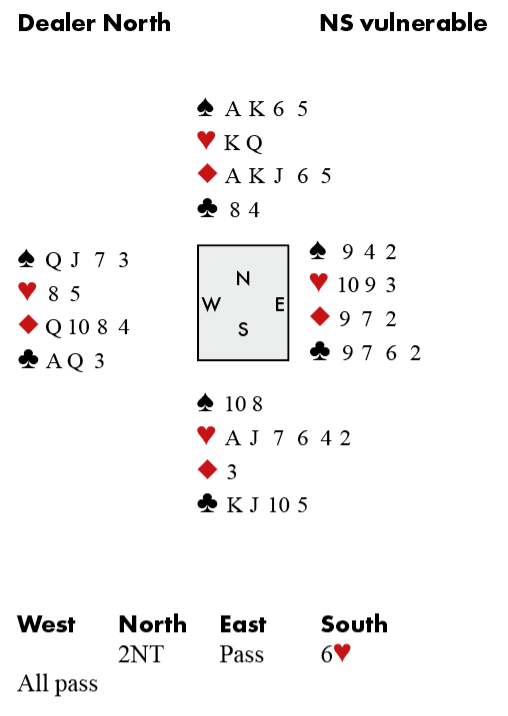
West led the ♥️8. The obvious line is to cash the ♥️KQ, play the ♦️A, ruff a diamond, draw the last trump, play a spade to the ♠️A and cash the ♦️K. If the ♦️Q falls, you claim. If not, you ruff again, cross to the ♠️K, pitch a second club on your last diamond, and play up to the ♣️KJ, hoping to get it right.
But Artur had noted West’s hesitation and passive trump lead, suggesting he had some values. He won the ♥️Q, and, deciding that West wouldn’t lead a singleton trump, overtook the ♥️K with his ♥️A! To him, the small risk of a 4-1 break was worth it: he got to watch what his opponents discarded while they still had no idea what was in his hand.
On the third trump, West discarded a spade (as did Artur). On the fourth, he threw another spade, making Artur think that he was either short in spades or under pressure. Artur discarded a club, and so did East, which suggested to Artur that the ♣️Q was with West (it’s not easy to discard from a queen). On the fifth, West threw a club, Artur a spade, and East another club.
Artur’s strong hunch now was that West held the ♦️Q and ♣️Q. He played a diamond to the ♦️J, pitched two clubs, ruffed a diamond – and claimed.
Got something to add? Join the discussion and comment below.
You might disagree with half of it, but you’ll enjoy reading all of it. Try your first month for free, then just $2 a week for the remainder of your first year.