Like every country whose peace and prosperity has depended, for as long as most of its population has been alive, on an international rules-based order, it seems Australia should now brace itself for the possibility of at least five years of US isolationism. That is, for a geo-political landscape in which old friendships and shared values count for nothing and the phrase ‘punching above our weight’ – a metaphor we have heretofore used only in a sporting context – must acquire a grimmer, more literal currency.
Or must it? Unlike Britain, France and Germany we are not surrounded by nations with whom we can form natural military alliances. Unlike North Korea, Pakistan and Israel we do not have nuclear weapons with which to deter interventionists and bullies. And even if the government we elect in a few weeks were to up defence spending to 10 per cent of GDP, thereby enabling us to take delivery of 10 new submarines in 5 years rather than 5 in 30, the effect this would have on what many believe to be China’s current expansionist ambitions, absent our big American brother, is roughly the same as the effect that achieving Australia’s greenest net zero targets would have on global warming. Which is to say, no effect at all.
It is the implications of this realpolitik which last week prompted Mr Albanese and Mr Dutton to suspend traditional pre-election hostilities long enough to sign off on a bi-partisan defence policy which both men will take to the ballot box. And it is thanks to the accidental inclusion of your columnist in a Signal group chat between Mr Albanese and Mr Dutton that I can share key elements of this policy with Speccie readers. And the gist of it is this: instead of spending billions of dollars arming ourselves for a conflict which would be even more one-sided than the ones currently laying waste to Ukraine and Gaza, the next Australian government will re-purpose all that money towards the achievement of a completely new and much more realistic foreign policy objective. And one which, happily, is both inspired by and consistent with the land custody protocols of our First Nations.
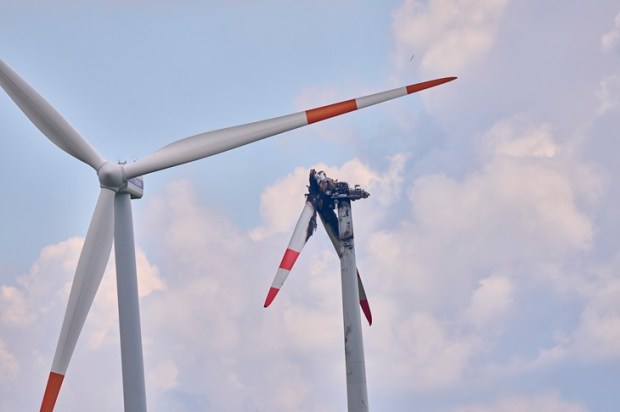
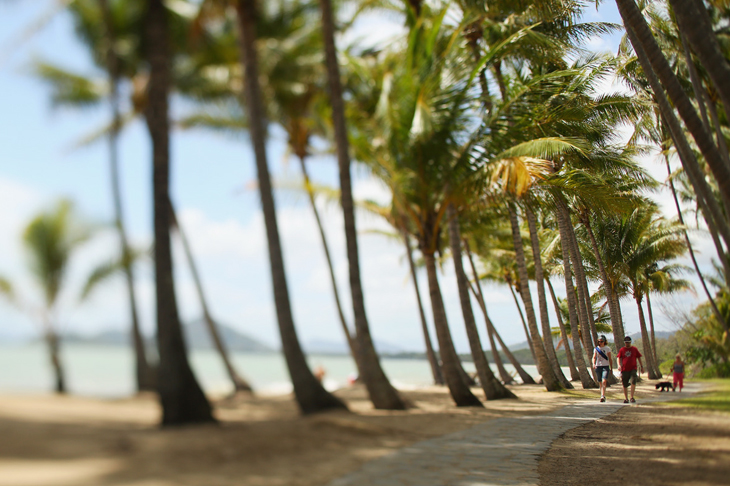
This will start, on the morning of 16 May, with the planting of millions of juvenile coconut palms along the coasts of Queensland, the Northern Territory and the top half of Western Australia. Even the most optimistic computer modelling says it takes 5 years to build a single nuclear submarine from scratch. But it takes less than 5 years for seedling coconut palms to produce harvestable coconuts. The coconut meat mountain and milk lake this will quickly produce will, of course, greatly increase Australia’s lamington and Anzac biscuit capacity. But it is the normally discarded shells of these coconuts – or rather, the coarse fibres attached to them – which will help to safeguard the nation’s future should we find ourselves facing Chinese aggression alone. Because instead of being thrown away or made into place mats and carpet underlay, this harvested coir will be separated and cleaned in purpose-built factories – many already in construction – before being re-combined and compressed into squares of stiff dense bristle. These in turn will be joined seamlessly together to create vast rectangles, each one 50 kilometres long, 30 kilometres wide and 20 metres thick. These will be towed by naval vessels to predetermined positions off the beaches of all our major coastal towns and cities where they will be anchored to the ocean floor much as wind turbines are, but minus the visual pollution and whale toll. Once completed, this will create a dotted line which roughly follows the route of Matthew Flinders’ inaugural continental circumnavigation, with the result that in the not-too-distant future, for the first time in its pre- and post-colonial history, Australia will be girt by something other than sea. Like the Great Barrier Reef and the Dingo Fence, this astonishing construction will be visible from outer space. And not just visible, but, crucially, readable, too. Because picked out on each of these giant floating mats, large and bold enough to be conspicuous to anybody whose job it is to study such satellite images, will be two identifiable Hanzi characters. Which, as any Australian teenager prescient enough to be learning Mandarin will be able to translate as the word WELCOME.
Got something to add? Join the discussion and comment below.
You might disagree with half of it, but you’ll enjoy reading all of it. Try your first month for free, then just $2 a week for the remainder of your first year.