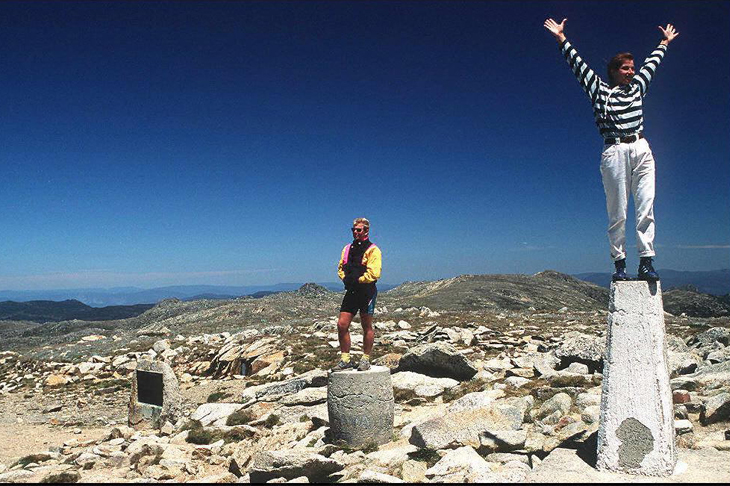
Apart from being capital cities, what do the following places have in common: Perth, Adelaide, Melbourne, Hobart, Sydney and Brisbane? The list can be added to: Bathurst, Goulburn, Richmond and Beaconsfield. There are also mountains: Wellington, Kosciuszko, Gladstone, Byron and Victoria; and the islands, Norfolk and Lord Howe. The answer is that all of these places are named after men and women who never set foot in Australia. There are many more. I was reminded of this fact when I recently read of a suggestion to rename Australia’s highest peak, Mount Kosciuszko. The mountain was named by the explorer Count Paul von Strzelecki after the Polish patriot and freedom-fighter. Why stop at mountains: Australia’s longest river is named after the Secretary for War and the Colonies Sir George Murray. Some of the people after whom places are named had an association with Australia, such as the colonial secretaries, but many did not.
Australia is not alone in naming places after people who never visited. The Duke of Wellington was a tad busy defeating Napoleon to journey to New Zealand. As was Horatio Nelson. Should the townships of Nelson and Trafalgar be renamed because of association with the British admiral? Then there is Auckland and Palmerston North in New Zealand, itself named after a Dutch place, Zeeland by Abel Tasman who sailed past the island subsequently named after him. The list goes on. There is the Guy Fawkes river and the state of Victoria. The Americans had no trouble with New York and New England as well as Richmond, Manchester, New Bedford and Cambridge, amongst dozens of other places.
I am sure that readers can think of many other examples. Renaming places is part of the modern fetish that is intent of obliterating connections to our British past, even though it is the foundation of the institutions of Western civilisation we enjoy today and the prosperous nation from which we benefit. As usual, the ABC is leading the way, commencing programs by reference to the Aboriginal land upon which the broadcast was made.
In a new book, Kosciuszko: The Incredible Life of the Man Behind the Mountain, Anthony Sharwood, who has written two previous books set in the Australian Alps, says he decided to write a book about Tadeusz Kościuszko after waking one morning, thinking, ‘Wait, who is this person?’ ‘I was so familiar with the mountain, and I didn’t really know anything about the person it is named after,’ he told the Australian recently. ‘I started researching him, I fell in love with him, because how could anyone not? This was a man who tried to free the enslaved of Thomas Jefferson. He’s unblemished, he’s uncancellable. He was saying “black lives matter” two hundred years ago. You couldn’t find a better person.’
Even a cursory examination of Tadeusz Kościuszko’s life reveals a patriot and freedom fighter of courage and renown. He was a Polish military engineer, statesman and military leader who then became a national hero in Poland, the United States, Lithuania and Belarus. He fought for the Polish-Lithuanian Commonwealth in the struggles against Russia and Prussia and on the US side in the American Revolutionary War. As Supreme Commander of the Polish National Armed Forces, he led the 1794 ‘Kościuszko Uprising’. It should be remembered that Poland embarked on the world’s first experiment in democratic constitutionalism in 1791. The UK had been developing responsible and responsive government since the Glorious Revolution of 1688; and the French monarch permitted a National Assembly in 1789, but the prerogative of the Bourbons remained strong and the nation slid into a bloody revolution soon afterwards.
The 1791 Polish constitution resembled the British, but went further by protecting religious freedom. The 3rd May constitution stated, ‘We owe to all persons, of whatever persuasion, peace in their faith and the protection of the government, and therefore we guarantee freedom to all rites and religions.’ The demise of the 3rd May constitution effectively erased the nation from the global map. By 1795, Central Europe’s three black eagles – Prussia, Austria and Russia –partitioned the Polish provinces and for all of the nineteenth and most of the twentieth centuries, Polish culture was besieged. This was true of Bismarck’s Kulturkampf as it was of Stalin’s Sovietisation; it was true of the Hapsburg’s Ausgleich as it was of Hitler’s genocidal Lebensraum.
How did Polish culture survive to create another democratic nation? Václav Havel observed that, ‘I am convinced that the deepest roots of that we now call human rights lies somewhere beyond us, and above us; something deeper than the world of human covenants – in a realm that I would, for simplicity’s sake, describe as metaphysical.’ The most famous modern Pole, Karol Wojtyla, asked rhetorically in one of his poems: ‘Can history flow against the current of conscience?’
Why would we not want to honour a man who was intimately involved in the building of democracy – and the nation which nourished him? His place in the world is more significant than many of the others after whom places are named in Australia and other nations. ‘I could not refrain from giving it the name of Mount Kosciuszko,’ wrote Strzelecki in his report of the expedition. ‘Although a foreign country on foreign ground it [was] amongst a free people who appreciate freedom and its victories.’
Why pick on Tadeusz Kościuszko? The author is not necessarily arguing for a name change; in fact he believes it would not only be controversial, but very difficult to achieve. But let us make the case for Tadeusz Kościuszko before the neo-Marxist left gain a head of steam to cancel him. Niech żyje jego pamięć. Long live his memory!
By the way, which country is the most aggressive coloniser today? Regretfully for the neo-Marxists who condemn colonisation, it is China. Xi Jinping proclaims himself as the chief proponent of Leninist-Marxism today. He has annexed Tibet, and is in the process of obliterating the culture of Xinjiang. He is wiping away the democratic culture of Hong Kong and Macau. He would do the same to independent, democratic Taiwan if possible. He threatens Japan and the Philippines. Yet he has the audacity to protest about human rights in Australia. The ‘plank in his own eye’ is more like a log. Where he cannot colonise, his aspiration is to
make other states vassals of the Chinese Communist party, also known as the People’s Republic of China. But the neo-Marxists have little to say about his ongoing program of colonialisation.
Got something to add? Join the discussion and comment below.
You might disagree with half of it, but you’ll enjoy reading all of it. Try your first month for free, then just $2 a week for the remainder of your first year.