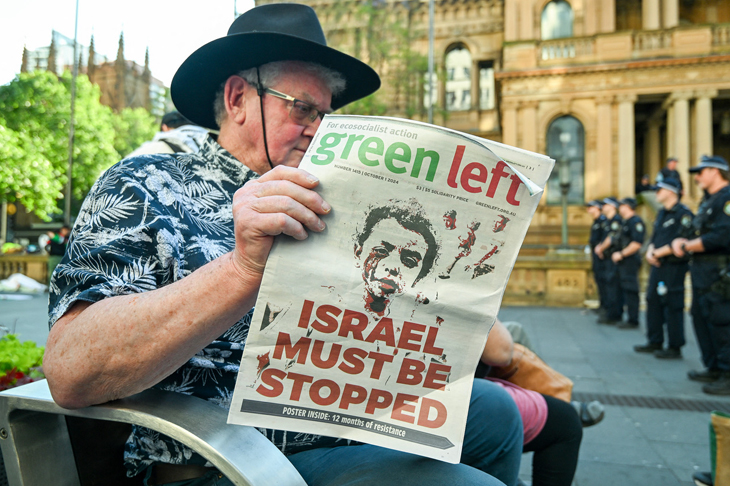
The conflict in Gaza has, paradoxically, caused the greatest problems in Australian public debate for the politically correct class who have always been fervent supporters of the Palestinians and implacably hostile to the state of Israel.
It is hardly surprising that many Australian Muslims are very sympathetic to the Palestinian position but it has long been somewhat puzzling that the devotees of political correctness have held a deep hostility to Israel as one of their basic doctrines. Those doctrines, however, go well beyond the view of the Middle East conflict and include the following tenets:
– portrayal of Australian society as essentially racist
– hostility to the resources industry in the context of climate policy
– antipathy to all forms of the Christian religion
– transference of power from parliaments to courts by way of a bill of rights
– advocacy of open borders without any restrictions on unauthorised immigration
– suspicion of the activities of law enforcement bodies
– governance by international bodies, such as the UN, when they disagreed with an Australian government
Electorally this group has some correlation with the Greens vote but its power and influence greatly exceeds any impact at the polls. This is because it has captured a wide range of public and private institutions which now largely reflect its views, some of these being:
– many mainstream media organisations, especially the ABC and the Nine newspapers, particularly the Sydney Morning Herald and the Melbourne Age
– almost all departments and faculties in universities
– community welfare groups
– various legal professional bodies
– literary and cultural festivals
– commercial sporting codes
– boards of many government and private sector corporations
The views of this group are not shared by most members of the general community, although constant exposure to them has no doubt had some impact on Australian society, particularly for young persons in schools and universities where there is seldom any opportunity to encounter a contrary opinion.
What the conflict in Gaza has done, however, is to make the general community aware of the antipathy to Israel and the sympathy for Hamas and Hezbollah in some sections of society. As already noted, these views have been long held in politically correct circles but previously have not been the subject of any real publicity.
The problem for those circles, as they realise, is that most members of the general community, while not necessary partisan supporters of Israel, recognise that Hamas and Hezbollah are terrorist organisations dedicated to the destruction of the Israeli state. There are those, of course, in Australia who make no bones that this is a desirable goal. But the astute practitioners of political correctness have been more circumspect and focus on such questions as to how there might be a cessation of hostilities and how hostages might be exchanged. They are happy to adopt the mantra of the two-state solution, even though neither side sees it as a solution when Hamas and Hezbollah do not want there to be an Israeli state at all and the Israelis know that this is the position of their opponents.
There are no benefits from the war in Gaza but it has at least in Australia brought out into the open those who have for many years had an abiding hostility to Israel, even if it has caused some of them to be more cautious in their rhetoric. Some of these views may embody a form of traditional anti-Semitism but more generally they reflect a rejection of Western civilisation, although, as largely affluent members of Australian society, the politically correct class has been amongst the greatest beneficiaries of that civilisation.
As already noted, the influence of the politically correct class greatly exceeds their electoral numbers but they remain dissatisfied with a political process that seemingly does not allow many of their agendas to be implemented quickly enough. One of their responses to this problem has been to turn to the courts as a way around the difficulties of the parliamentary process.
This has led to an ever-increasing series of court proceedings designed to stop natural resources projects – coal, gas, oil – going ahead. Some have been halted, despite many years of work and expense to get the project to a starting point and numerous others have been significantly delayed by initial proceedings and then resort by the objectors to the appeal process when they have lost at first instance.
Speaking of this phenomenon in the British context, John Gray has pointed out that, ‘In crucial areas, the decisions of government cannot be implemented. Authority has been transferred to the courts, and policies are made by judges. Almost anything government does can be litigated and undone… Government has surrendered much of its authority to institutions it cannot control while losing a sense of the common good.’
This is the ultimate objective of a bill of rights whose advocates welcome the transfer of power from elected parliamentarians to unelected judges and have already succeeded in implementing this kind of legislation in Victoria, Queensland and the Australian Capital Territory. Not content with transferring traditional political questions like freedom of speech and freedom of assembly to the courts, they want these charters to include social and economic rights, such as housing and education. Under the Westminster system the resources devoted by governments to areas like housing and education are the subject of budgetary allocations that have to be finally endorsed by the parliament. The prospect of these kinds of questions about government expenditure being litigated in the courts is simply inconsistent with the democratic theory of responsible government.
It is something of an irony that a distant conflict in the Middle East has become a subject of emotional public debate in Australia and that this debate has highlighted the long-held but little-publicised hostility to Israel on the part of the politically correct class.
Perhaps it might also raise questions in the mind of the general community as to the other unsavoury views held by this influential but shadowy group.
Got something to add? Join the discussion and comment below.
You might disagree with half of it, but you’ll enjoy reading all of it. Try your first month for free, then just $2 a week for the remainder of your first year.