In February last year, this esteemed magazine published a column by your correspondent on the crackdown on the Traditional Latin Mass by Pope Francis, warning that the plan was to eliminate it entirely within two years.
It seems that time has come.
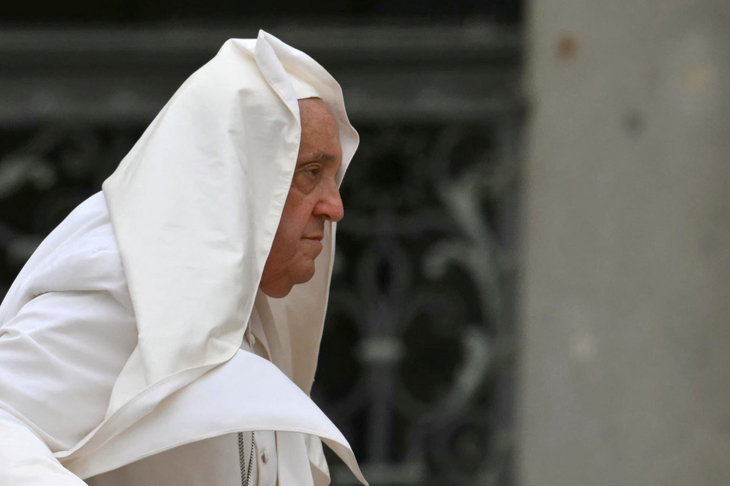
Last week Rome was buzzing with rumours that Pope Francis is planning to ban the Latin Mass from almost every Catholic church in the world.
Francis, who insults those attached to the traditional liturgy as ‘reactionaries’, and ‘unbalanced backwardists’, stigmatising them as nostalgic, and his henchman, Yorkshireman Cardinal Arthur Roche, the Prefect for the Dicastery for Divine Worship – who has taken to the task of imposing restrictions on the Latin Mass like a latter-day chief of the Black and Tans – apparently are planning to make the Latin Mass ban ‘as wide, final and irreversible as possible’.
This is despite the fact that the widespread offering of the traditional liturgy – thanks to Pope John Paul II and Pope Benedict XVI – has had the effect of breathing life into an otherwise moribund Church, since most in attendance are young families.
It’s hard to have nostalgia for the Latin Mass if you were born after 1969, when it was replaced with the vernacular liturgy, which in most parishes often resembles a poor impression of the Mamas and the Papas greatest hits.
As Damian Thompson reports, last month, 18,000 young people (the vast majority from Gen Z) walked on pilgrimage from Paris to Chartres Cathedral in order to demonstrate their love of the Traditional Latin Mass.
It appears that the new liturgical restrictions will be published on 16 July, the third anniversary of the ironically named Traditionis Custodes (Custodians of Tradition), the document that first placed severe restrictions on the Traditional Mass. This has led to the banning most recently of the offering of the traditional liturgy in St Patrick’s Cathedral in Melbourne.
However, the perception that Francis is hypocritically trolling traditionalist Catholics is no longer limited to Latin Mass circles.
Many Catholics are outraged by the Vatican’s vendetta against faithful believers at a time when the Pope himself is mired in scandal. Thompson – among others – has outlined several times how the pontiff is implicated in the protection of a string of convicted or credibly accused sex abusers.
La Nación, Argentina’s biggest daily newspaper, reported in 2019 that when Pope Francis – who was born Jorge Mario Bergoglio – was Archbishop of Buenos Aires, he had been active in promoting those who covered up clergy abuse in the past. These include Bishop Gustavo Zanchetta, who in 2017 was appointed Assessor of the assets of the Holy See despite seven priests – including three of Zanchetta’s vicar generals – formally accusing him of financial mismanagement, authoritarianism and sexual misconduct. In 2022, Zanchetta was found guilty of sexually abusing two seminarians, and Francis was forced to sack him.
Then there is the case of Theodore McCarrick, the former Archbishop of Washington. Banished by Benedict XVI once he discovered that McCarrick loved to seduce seminarians, he found himself back in favour as soon as Francis was elected, travelling around the world as the pope’s unofficial fundraiser. Eventually the New York Times revealed that McCarrick was accused of child abuse, at which point Francis had no choice but to strip him of his title of cardinal, especially after he was charged in Wisconsin, accused of assaulting an 18-year-old boy at a lakeside cabin in the south-eastern region of the state in 1977.
Add to this the matter of Cardinal Óscar Rodríguez Maradiaga, one of Francis’ closest confidants. Once dubbed the ‘vice-pope’, Maradiaga was finally forced to resign as Archbishop of Tegucigalpa in Honduras in February 2023 after years of allegations of financial and sexual misconduct, for which he has refused to answer. The stench of a cover-up is hard to ignore.
The most notorious case is that of the celebrity mosaic artist Fr Marko Rupnik, a close friend of Francis who was thrown out of the Jesuit order (coincidentally the same order to which Papa Bergoglio belongs), accused of sexually abusing nuns in a Slovenian convent he had founded. He is also accused of one of the most serious church crimes a priest can commit: offering sacramental absolution of sin to his own sexual partner and co-conspirator. The Jesuits have since confirmed that Rupnik was excommunicated in 2019, only for that to be lifted in 2021 after, allegedly, he admitted to the crime and repented. There are reports Francis was involved in lifting the excommunication. In fact, last year Rupnik preached at papal retreats, and earlier this year he was allowed to concelebrate Mass publicly and the Vatican communications office continues to promote his artwork.
This attempt to rehabilitate Rupnik prompted an open letter in which five women allegedly abused by Rupnik accused Francis of running a shallow ‘publicity campaign’ for his supposed ‘zero tolerance’ of abuse. The letter added that, ‘they have been waiting for a definitive, clear, maternal answer for more than a year. But they have only received silence’. Their open letter came after receiving no reply from Francis to four earlier letters.
Last year Francis appointed as his doctrinal chief Cardinal Manuel Fernandez, whose extensive theological expertise can be found in a notorious book he published on French kissing and ‘mystical orgasms’.
Thompson asserts that many bishops who have no particular attachment to the traditional liturgy nonetheless enjoy warm relations with their local Latin Mass communities. They regard them as loyal Catholics and believe the Vatican’s hostility to them is senseless.
He adds that there is a sense of a scandal-ridden pope losing the confidence of his bishops. Indeed, as one Australian bishop told me (who, for obvious reasons, I cannot name), loyalty to Francis is wearing thin.
Many readers would be familiar with the Peace Prayer of St Francis, which exhorts ‘[W]here there is hatred, let me sow love; where there is injury, pardon; where there is doubt, faith; where there is despair, hope; where there is darkness, light; where there is sadness, joy.’
It seems Jorge Bergoglio, who took the name of that great saint for his papacy, has sadly done these things in reverse order, to the immense detriment of the Church.
Got something to add? Join the discussion and comment below.
You might disagree with half of it, but you’ll enjoy reading all of it. Try your first month for free, then just $2 a week for the remainder of your first year.