David Martin Jones, a philosopher and political commentator who made his career in Singapore and Brisbane, London and Budapest, died last week at Charing Cross Hospital in London, with family at his bedside. He was 73.
David was witty and intellectually generous to the end. I had the pleasure of drinking a coffee with him in Sydney just a few days before he passed. And in the days after, I have spoken to friends of his on several continents who are heartbroken by the news.
He was a man of the world who never lost something of a Cardiff boy’s lightness and charm. He is already missed, but it will take time for his contributions to conservative thought to be assessed.
David was brought up in Wales and he never forgot it. It is entirely characteristic that he celebrated, in his last Spectator Australia piece, relatives of his who were ‘small tenant farmers across Meirionnydd’, and a grandmother who had left behind, at her death, not much more than ‘a Welsh bible, Y Beibl’, which David kept among his possessions.
He attended Cathays High School in suburban Cardiff. The school’s name points to decisions taken by the marquesses of Bute – inheritors of Cathays House – in the nineteenth and twentieth centuries. But however etymologically null it may be (and it is), ‘Cathay’ still catches my eye. For David was a Cathays lad who went on to write The Image of China in Western Social and Political Thought, and to reflect deeply on the place of China – old ‘Cathay’ – in the early twenty-first century.
After taking a degree with honours from the University of Reading, David lived for a wild year or two in what we might call a London ‘acid house’. This was the 1970s, after all. And before he went east (on which more in a moment), he went west – moving to Ontario, Canada, to further his studies.
He obtained a master’s in Canada, before deciding to leave unfinished his doctoral work at the University of Toronto. From Toronto he returned to London, where he received his doctorate from the London School of Economics in the Orwellian year 1984.
The influence of one of the LSE’s conservative luminaries, Kenneth Minogue, was decisive. David seems to have found in Minogue, and in his own doctoral work on conscience and allegiance in English political history, a sense of where his own highest allegiance lay. To echo the title of a collection of Minogue’s essays, David stood with liberty, and against its enemies. This would never change.
It is therefore no coincidence that David put the phrase ‘illiberal democracy’ into circulation, back in the heady 1990s. (What is more, he seems to have had a hand in coining the ‘surveillance state’ a decade on.) His concept of illiberal democracy was meant as a direct challenge to the hubristic ‘end of history’ narrative that Francis Fukuyama was making fashionable at the time.
The National University of Singapore brought David to Asia in 1989. He lectured there, in political theory, until 1995. And in that half-decade, he closely observed ‘Asian democratisation in a spirit of scholarly scepticism’ – as he dryly put it – finally realising that there is no pre-established harmony between liberal tradition and democracy. This simple realisation put him several disastrous decades ahead of most political commentators – and politicians – in the West.
From Singapore, David moved with his first wife, Teresa Lawler, to Australia, where he served as a lecturer at the University of Tasmania and later as a professor at the University of Queensland. He embraced life in the new country and established himself as an acute observer of national politics and an original commentator on geo-politics. It is no surprise that, when David dubbed the Islamic State a ‘death cult’ in 2014, then-Prime Minister Tony Abbott followed suit.
David’s commitment to liberty attuned him to the menace of Islamist violence in the 1990s, years before the iconic strikes on New York. His non-doctrinaire thinking about terrorism led him to challenge more than one of the Western doctrines that resulted, in the ‘War on Terror’ years, in nothing but failure and disorder in the Middle East and beyond.
In 2016, married to his second wife Jo Cohen (stepdaughter of Kenneth Minogue, as it happens), David staged a return to London. He took up a visiting professorship in War Studies at King’s College London, and authored – or often, beginning in the 1990s, co-authored with M.L.R. Smith – brilliantly unorthodox books on history and geo-politics.
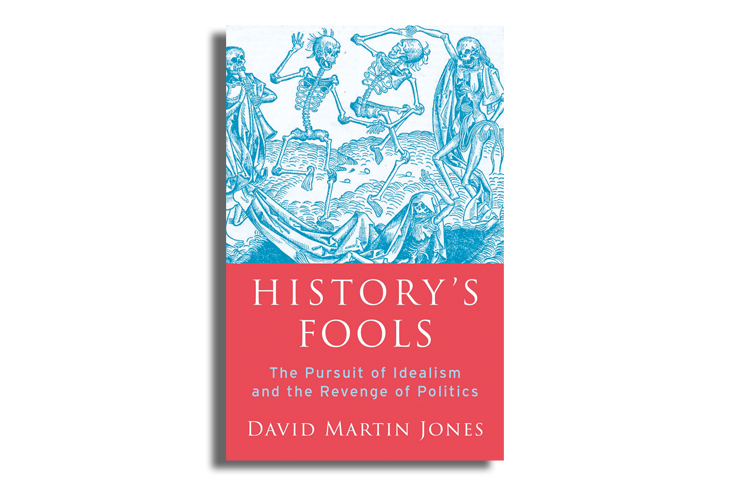
His signature study of the post-Cold War debacle, History’s Fools, came out in 2020, when much of the West was in hard lockdown. (There have been better times for a book to appear, as he occasionally remarked.) Its cover is an eery Renaissance woodcut of the Danse Macabre, and it looks more contemporary now than when it appeared. For as we edge towards 2025, liberal democracy itself seems to be one of the dancing dead.
In History’s Fools, David tells us why. ‘Post-Cold War progressivism’ did not draw history to a conclusion, but it did oversee a ‘progressive loss of liberty’ in the West. What we have been witnessing since 1991 is the accelerated, and still accelerating, dénouement of a particular history. Namely, the one that Western politicians are bound by law, if not always by conscience, to defend.
This is why David, who introduced the concept of ‘illiberal democracy’ in the 1990s, accepted John O’Sullivan’s invitation to be the Danube Institute’s director of research, in Budapest, in the 2020s. Of course, he knew of Prime Minister Viktor Orbán’s claim that Hungary is becoming, and by design, an ‘illiberal democracy’. And David’s commitments were unchanged.
He had concluded, however, that the real-world meanings of ‘liberal’ and ‘illiberal’ had altered beyond recognition in the last thirty years. He had come to believe that it is not a vaguely reactionary Central Europe, but rather a frenetically avant-garde West, that made the ‘progressive loss of liberty’ a defining political reality in our day.
Notorious events in Brussels, in the last week of David’s life, seem to bear this out.
David Martin Jones was an old-school man of letters. Loyal to his Welsh roots, fascinated by China, habituated to Australia, and committed to his inherited traditions of liberty. A realist, but never a cynic. A man of passion, and conviction. A singular conservative voice that we needed, and still need.
Got something to add? Join the discussion and comment below.
You can read David’s Speccie pieces at: https://www.spectator.com.au/author/david-martin-jones/
You might disagree with half of it, but you’ll enjoy reading all of it. Try your first month for free, then just $2 a week for the remainder of your first year.