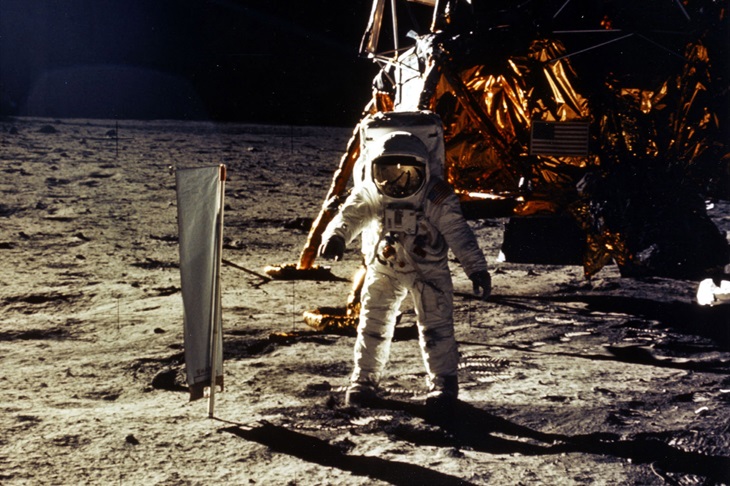
The American-based Navajo Nation has raised an objection to the latest ‘space funeral’, calling for the mission to be delayed because it would ‘desecrate’ the Moon according to their Indigenous beliefs.
To be clear, the Navajo Nation is not indigenous to the Moon…
Common sense prevailed, and the Vulcan Centaur set off as scheduled on January 8 and is due to arrive on the Moon February 23 with a mixed payload of scientific instruments and commercial interests. The commercial component, which includes human remains, helped to pay for the mission in a trust the science era that has trillions of dollars spare for ‘climate change’ but only loose change for space.
The scientific mission on the surface of the Moon is scheduled to last 10 days.
While the attempted interference of an indigenous group over a space mission failed this time, it could become a hindrance to space exploration if the politics of ‘first nations’ people from various countries extends its influence to other planetary bodies.
Space burial is a niche. The companies involved in this space funeral are Elysium Space and Celestis.
In the same way sailors like to be buried at sea, there is something fitting about space explorers and science fiction writers being laid to rest on the Moon. This is why it came as a shock to hear that one indigenous group was trying to claim a measure of spiritual authority over the Moon. If anything, the nation with its flag planted on the Moon probably has the most right to it, if we’re going to invoke the old rules of conquest. Let us settle in the middle and say that the Moon is a communal object owned by no one and everyone.
The delicacy of this communal ownership didn’t stop the Navajo Nation from appealing to the Department of Transportation and the head of Nasa:
‘It is crucial to emphasise that the moon holds a sacred position in many Indigenous cultures, including ours. We view it as a part of our spiritual heritage, an object of reverence and respect. The act of depositing human remains and other materials, which could be perceived as discards in any other location, on the moon is tantamount to desecration of this sacred space,’ wrote Navajo Nation in a letter.That’s all well and good, but the Moon is sacred to all the peoples of Earth, and some of those people find the act of being buried on the Moon an act of worship, reverence, and celebration. Whose culture gets to decide? Navajo Nation added, ‘We believe that both Nasa and the USDOT should have engaged in consultation with us before agreeing to contract with a company that transports human remains to the Moon.’ The question is, why? Why would anyone negotiate with one group on a planet of 7.8 billion people? What makes the Navajo Nation special when it comes to Moon politics? The answer is, nothing. I sympathise with Celestis’ CEO Charles Chafer who said:
‘I think it’s the polar opposite of desecration. It’s a celebration. I don’t understand why doing that on a dead planet is desecration – where we have literally millions of ash-scattering sites on the living planet Earth, and we don’t consider that desecration.’Chafer’s opinion is of equal weight to the Navajo Nation. Added Chafer, ‘I don’t want to question anybody’s religious beliefs, but having said that, what they are asking for is basically ownership of the moon for purposes of their sacraments, and that’s a giant black hole to walk into.’ Joel Kearns, Deputy Associate Administrator for Exploration at Nasa said:
‘We recognise that some non-Nasa commercial payloads could be a cause for concern to some communities, and those communities may not understand that these missions are commercial. Nasa really doesn’t have involvement or oversight to other commercial payloads.’According to Scientific American, the Celestis payload includes ‘70 people and one dog’ along with DNA samples from the company’s co-founder.
‘Among the lander’s “passengers” are prominent science-fiction author Arthur C. Clarke, Star Trek icons Gene and Majel Roddenberry and NASA geologist Mareta West, who helped select the Apollo 11 landing site.’The rules that govern the ownership of space and celestial objects is meant to operate on a mixture of maritime law and international treaty, although Russia and China aren’t particularly interested in adhering to some of the ‘greater good’ restrictions. When it comes to orbital regulations, it’s more like pirate code… What we can say for sure is that space is outside the legal bounds of spiritual claims, particularly an indigenous group that has never been to the Moon. The Scientific American notes that nations are required to avoid ‘harmful contamination’ of the Moon and other objects, such as Mars. That hasn’t stopped us, in the case of Mars, turning it into the first world inhabited entirely by robots. If we want to explore, if we want to learn, if we ever want to crawl off Earth and out into the stars – it’s going to involve a bit of littering. Sacred or not, our solar system is destined to become space dust and if we stay here forever, humanity will die. We cannot allow indigenous groups to trap us on Earth in case we offend the gods. It is possible that indigenous politics could handicap American space missions under the weakness of Democrat leaders desperate to keep themselves in power while Russian, Chinese, and Indian missions go ahead without a hitch. Groups such as Navajo Nation would have had a stronger case to stop space burials if they’d run the line about preserving the Moon from organic contamination for the purpose of study. We don’t know if there are traces of life on the Moon and have had little opportunity to run detailed investigations. From a purely scientific perspective, the case against raining down organic matter on the Moon is far stronger. That said, it is a bit late. Eugene Shoemaker was ‘buried’ on the moon in the late 90s after the Lunar Prospector, along with his ashes, crashed into the moon. The Navajo Nation objected to that as well. ‘The moon is revered, and it regulates life cycles, according to Navajo traditions and stories. To send something like that over there is sacrilege,’ they said, in a 1998 letter to Nasa.
‘It is crucial to emphasise that the Moon holds a sacred position in many Indigenous cultures, including ours.’Someone should press them on what they define as ‘indigenous’ when talking about the people of Earth in relation to their worship of the Moon. Which of us is not indigenous to Earth? Which of our cultures is not sacred in their worship of the Moon? What about the descendants of those who built Stone Henge in worship of the seasons, driven by the Moon? What about the ancient nameless cultures in Europe who worshipped the Moon before the Americas were discovered by tribal groups? The word ‘indigenous’ needs to be scrutinised to prevent it from being used as a means to suppress the rights of other people, especially when we are talking about the human race as a whole. As Chafer says, ‘No one, and no religion, owns the Moon, and were the beliefs of the world’s multitude of religions considered, it’s quite likely that no missions would ever be approved. Simply, we do not and have never let religious belief dictate humanity’s space efforts – there is not and should not be a religious test.’