When wind farms were nothing more than an apocalypse-mongering salvation shouted from the lips of a distraught truanting European teenager, plenty of adults were swept up in the hyperbole. They were drawn in by the tears and duped by the pleas.
‘Oh yes,’ they would say, ‘I’m all for wind energy. Free. Cheap. Green. Love it.’
Who would dare resist the demands of a child rage-crying at the United Nations…?
For most Australians, wind farms and renewable energy spent decades sitting somewhere between ‘adopt a sea turtle’ and ‘sponsor a starving African child’. They were a slogan on the local MP’s campaign poster and a ‘safe’ cafe conversation among parents desperate to earn social approval.
More importantly, wind turbines were off in the distance. Out of sight.
Very few enthusiastic wind advocates envisioned their lives being intrusively and aggressively impacted by renewable energy. No one told them these green skyscrapers would be built on their beaches, across their properties, and through the middle of their communities.
The closer wind farms get to being built, the more people despise them.
While commentators in this publication have correctly guessed that energy prices will contribute to the death of renewable energy – especially as people’s power bills double in the middle of a self-inflicted financial crisis – it appears green economics will serve as the final nail rather than the opening blow to the neck.
The fatal wound to wind energy will be the visceral rage Australians express toward the construction of wind farms and their accompanying nightmare of transmission wires.
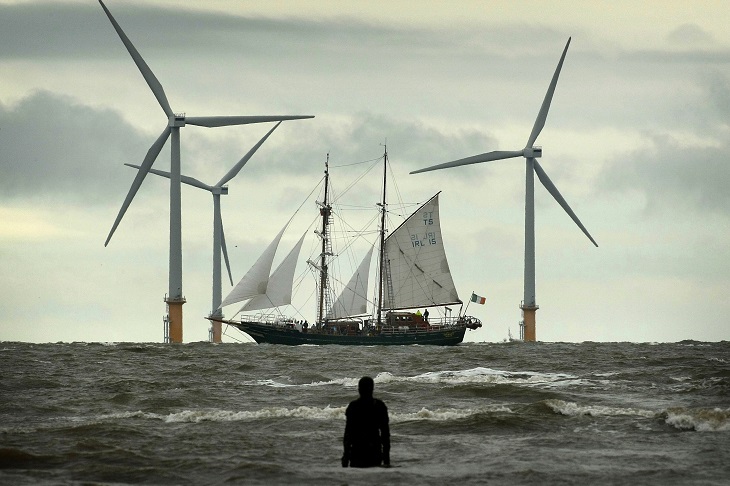
It does not take a degree in conservation to know that these steel and concrete towers crowned with 200-ish metre blades are not a harmonious part of the natural landscape. Wind turbines don’t just murder the local wildlife, they terrorise the view.
Farmers, tourists, and environmentalists already hate the existing network of transmission lines carving highways through forests and agricultural land. This infrastructure is endured because, with coal-fired power providing dense and reliable power closer to cities, they have minimal footprints.
Wind and solar energy offer the reverse, with their misleadingly named ‘farms’ placed in the middle of nowhere. This results in an astonishing amount of transmission infrastructure, at least 10,000km worth, covering the landscape like some horrible resurrection of early 19th Century power.
Enthusiasts of renewable energy are aware of this, with The Conversation writing:
Flat White is written and edited by Alexandra Marshall.
Victorian farmers and residents protest the AusNet project in the belief the new infrastructure will mean loss of control over their lands, an uglier landscape, and possible restrictions on farming practices such as irrigation. Their concerns are legitimate. But the need is also great, and time is limited.Renewable energy does not look advanced, it does not look ‘green’, and people are growing mighty suspicious of the end times mantra. As one Victorian farmer said in the Financial Review: ‘The whole reason that the project is actually coming through this corridor now is because AEMO couldn’t get social licence on a previous corridor closer to Bendigo and Daylesford. Moving it west doesn’t reduce the offensiveness of the project, they just think it offends fewer people.’ The fight for regional Australia feels insurmountable. Ultimately, the state has powers of last resort which can compel farmers and communities to obey. As the Financial Review wrote:
The clash of interests politicians must resolve doesn’t come much starker: 23 million people on the eastern states’ grid who mostly just want the energy transition to succeed versus fewer than 1,000 farmers who say their livelihoods – even their lives – may be at stake.The same article reports that some communities would fight to the death and blockade work to protect inter-generational farms. We often hear the government talk about the connection Aboriginal people have with the land, but where is their respect for the deep spiritual bond farmers share with the land of their ancestors? Let us be honest for a moment. Politicians could not care less about the bond farmers have with their land because there is no political gain for them and everyone knows it. Worse, landholders who are being forced to accommodate these transmission lines have discovered that the Rural Fire Service is forbidden from fighting fires around the lines meaning farmers and landholders will be forced to watch their homes burn for the sake of renewable energy. No one mentioned that little detail when all the feel-good propaganda was drowning the election campaign. Unfortunately, the voices of farmers and rural landholders are too few and far between to worry Labor’s unfeeling climate agenda. They have millions of inner-city greens to please – people who have been told the world will ‘literally boil’ if they don’t build wind turbines. No. The death of wind energy will come with the construction of offshore wind turbines along large stretches of the coast. Not only does this destroy the quality of life for rich, typically left-wing voters, it upsets pretty much everyone who lives near the sea – including environmentalists. Watching Australia’s coastlines slowly vandalised by giant concrete and steel structures is a crime against nature. It looks wrong. It feels wrong. And most Australians are starting to push back with a ‘not in my town’ approach to wind. The latest rebellion has come from the Limestone Coast community, who are desperately worried about the construction of 77 bottom-fixed turbines in an offshore wind farm in the Southern Ocean by BlueFloat Energy. They are expected to have a rotor width of 275 m and height of 165-190 m. The project is planned to sit in Commonwealth waters, not state waters, around 8 km off the coast. The project also lists two offshore substations and transmission lines. This will include infringing on private and public land. As one local man observed, these wind turbines will be three times higher than the local mountain range. In one breath, a spokesperson for the company building the turbines said the wind farm ‘should not impact ocean views of residents in coastal towns’ and then immediately admitted, ‘On a clear day, there will be visibility of the turbines, they’ll be sitting on the horizon.’ That’s called impacting the ocean views of residents.
‘What we’re going to do is we’ve been along various parts of the coastline, we’ve identified popular spots where we’re going to be taking a panoramic photo of the sea. From there, we’re going to simulate what view of the turbines you would get from each of these points and we’ll be publicly releasing that.’People don’t want to see a single turbine. Ever. That is the material, non-negotiable point. One abalone diver, who fears the waters where local businesses fish and work will be destroyed, said, ‘There’s a lot of anxiety in this community right now. Particularly from the cray fishermen and the future of their industry.’ The local man added:
‘As mostly professional fishermen and coast-dwellers, we’re green to the core, we really don’t have a bone to pick with green energy. ‘I think we have the most to lose. The grounds they’re talking about placing them on is where we catch a vast amount of the southern zone rock lobster quota. ‘And it is actually in the path of the blue whale and other creatures that use the Bonney Upwelling to feed.’It is the same argument over and over. ‘I love green energy!’ ‘Just not in my backyard.’ Every coastal town has the same objection. No one wants their precious piece of Australia soiled by massive spinning blades cemented into the sandbank. Not the surfers. Not the whale watchers. Not the fishermen. Not the environmentalists. And definitely not homeowners. Even the simple joy of walking down an Australian beach and looking out into the ocean is about to be ruined by Chris Bowen. He will be the first man in history to destroy Australia’s natural beauty on a colossal scale for ideological vanity. If Labor thinks blowing up one Indigenous site is a travesty – how can they possibly defend destroying tens of thousands of kilometres of coastline? When it comes to negotiations, residents of these coastal towns are worried their voices won’t be heard. They’re probably right. Chris Bowen insists that ‘consultations’ are being done that ‘consider all sea users’ but as everyone knows, these government-directed consultations often come back with a favourable result for the government. That’s the trouble with ‘greater good’ ideology. When you put ‘saving the world’ on one side of the equation, no amount of local anger can tip the scales back to sanity. While the Minister will ‘consider all evidence’, we can predict the end of this story with a fair amount of confidence. At one of the ‘consultations’ with the community, a resident complained:
‘People weren’t able to have their say as a community group and everything is reliant on putting in a submission. A lot of people in this community aren’t that computer literate, so that’s difficult. More community consultation is important and to be able to have a big community discussion is important.’The environmental cost of wind energy for zero impact on the global climate is too much for most. ‘They’re only telling us what we want to hear, they’re jumping around every question, pinballing off the sides of the questions we’re actually asking,’ said one resident.
‘It’s going to completely destroy the bottom [of the bay]. You’ll never catch another cray there and the rest of it is history.’As for decommissioning the wind farms in 30 years – the extent of their useful lifespan – residents complain they haven’t been told anything.
‘So, 30 years is their useful life, then is it disturbed again or is it going to be pollution left in the sea?’Residents are telling Chris Bowen to get out of their community and take his wind turbines with him, but the Minister is not listening to their voices.
‘Establishment of an offshore wind industry could support the decarbonisation and future of onshore manufacturing powered by cheaper, cleaner, energy. Powering these South Australian and Victorian communities with cheaper, cleaner energy will support them to unlock new regional job opportunities in energy and manufacturing.’These are meaningless words from a vacuous minister.
Flat White is written and edited by Alexandra Marshall.