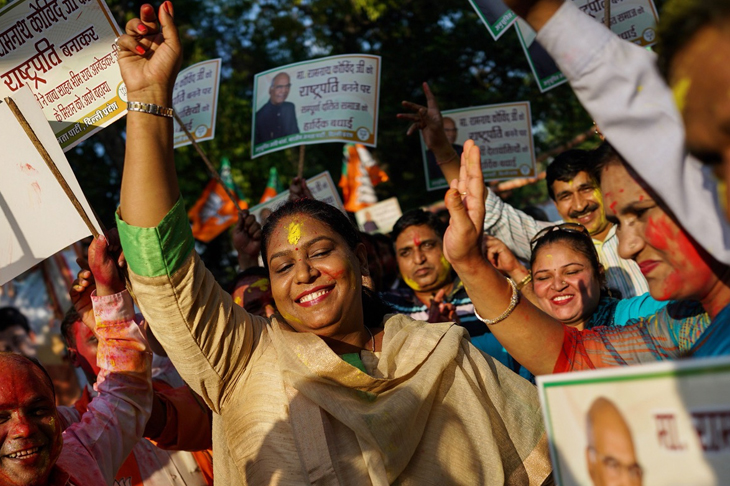
In the UK, where the Conservatives have been in power for over twelve years, the Royal Air Force illegally discriminated against 160 white men in the woke effort to meet its ‘aspirational diversity targets’. Why do we ignore the pathology of sectarian affirmative action policies in the world’s biggest laboratory? After 73 years of constitutionally mandated preferential policies, India is ever more sharply conscious of caste identity at every level of society and in every sphere of public activity. I am currently with family in India. In my home state Bihar, the most caste-conscious in the country, anytime someone outside the immediate family drops a name into the conversation, it’s accompanied by that person’s caste identity. Where the British divided and ruled, Indians have subdivided and misruled. Politicians find caste identity the most potent tool of mass mobilisation. The president, vice-president, governors, heads of government, party leaders and election candidates are chosen on the basis of caste alignments with constituency demographics. This fuels the victimhood industry among the target group at the expense of merit, application and hard work, while creating fresh grievance among others. What should be earned becomes a matter of entitlement, from school admissions to jobs. Moreover, reservations have steadily expanded to cover an endlessly growing number of subgroups, with even Muslims and Christians demanding quotas for the ‘dalit’ (oppressed) among them despite the caste system being peculiar to Hinduism. And caste calculations have moved from recruitment to promotion. Over time the dead hand of the state has also intruded into the private sector. Sound familiar with respect to calls for gender quotas in boardrooms, parliaments, cabinets, vice-chancellorships, police chiefs and other high profile positions? But not the low-status, poorly paid, physically demanding and most dangerous jobs.
The very fact of the endless expansion of identity-based reservations is proof of the failure of the scheme. As group-based programs permeate the public institutions of a country, they institutionalise the very divisions they were meant to eradicate. Marketed as temporary expedients, they persist and proliferate. Quotas for the historically disadvantaged castes and tribes were prescribed in the constitution in 1950 for 15 years. Had they worked, they would have fallen into desuetude. Instead they kept multiplying and expanding. On its own internal logic, after more than seven decades of the reservations system being in force, the number and proportion of the disadvantaged has risen alarmingly. If this is not failure, what is? One is reminded of Einstein’s definition of insanity.
Every affirmative action produces an equal and opposite sectarian reaction. The motive underlying preferential policies – to atone and compensate for past group-based discrimination and injustice – is noble. But it implies guilt and compensation are inheritable. By institutionalising affirmative action in favour of some groups, the government effectively discriminates against others, alienates them and feeds their sense of grievance, without necessarily helping the most needy. In conditions of scarcity, the number of aggrieved is several times more than could have got the job or admission. Every year, about one million Indians apply for the federal civil services, the peak of which are the Indian foreign, administrative and police services. Even after retirement, officials will proudly put IPS/IAS/IFS on their calling cards and house nameplates. In the three-stage process, under one per cent make it to written test, around 2,000 are interviewed and 1,000 selected. The best indicator of their value is the marriage market, literally, in terms of the dowry the men command (long illegal, but that’s another story). Now, consider this. If 1,000 candidates apply for every vacancy and half the vacancies are filled by caste quotas, then for every successful recruit 499 disappointed people will feel hard done by because of the system of reservations. Yet only one of them could have been successful in open competition.
Faced with government-created obstacles to educational and career aspirations, the best and the brightest among the upper- caste ‘elites’ are migrating to countries more hospitable to their talents. India’s loss is the West’s gain. Furthermore, if one’s chances of being admitted into prestigious institutions or getting good jobs are improved by being able to claim a particular identity, the requisite documentary proof will always be available at the right price. The cycle of preferential entitlements and the need to ensure against fraudulent claims lead to an expanding role for government, when the need is to reduce government intrusion into the economy and society.
Preferential policies create and nurture vested interests. Caste is used in India today for capturing political power and distributing political spoils. Meant to reduce and eliminate intergroup disparities, these policies create dependency of group leaders on the perpetuation of perceived disparities. A solution of ethnic or gender problems would deprive the leaders of a platform and a role. Upping the ante by raising ever-expanding demands enlarges the role of group activists and gives them a bigger stage from which to manipulate still more people. Benefits are captured by the better educated, more articulate and more politically skilled urban elite among the ‘disadvantaged’ groups. With regard to gender quotas in politics, for example, there’s been a proliferation of the ‘bibi, beti and bahu’ (wife, daughter and daughter-in-law) brigade. When I was at Otago University, one of my students with a parent who held one of the country’s top three public offices won a scholarship for Maoris to a highly desirable American university. Disadvantaged background? Yeah, right.
Preferential policies foster the values of solidarity based on the cult of victimhood – instead of thrift, hard work, self-improvement and property ownership. Resting on the assumption of superiority in non-target groups, they reinforce the sense of inferiority in target groups. There’s another distasteful consequence. The quota beneficiaries can never escape the taint of unmerited preferment. With the recent Project Veritas exposé of the Pfizer practices on Covid vaccines, how many people thought ‘diversity hire’ without the courage to verbalise this in the current censorious climate?
Like tinpot dictators who rob and bankrupt their countries but send their own kids to Western schools and park themselves in Western hospitals when ill, the top echelons of the Indian ruling elites too have made provisions for education and health services in the West, of course at public expense. If I had my way, they would be forced instead to use the domestic public education system and consult the quota-qualified doctors and specialists for all health needs for their families. Let’s see how long the preferential policies last after that.
Got something to add? Join the discussion and comment below.
You might disagree with half of it, but you’ll enjoy reading all of it. Try your first month for free, then just $2 a week for the remainder of your first year.