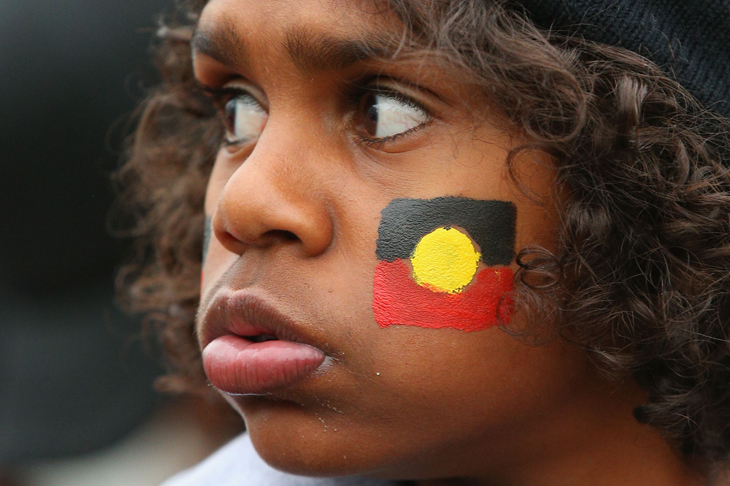
You may not have heard of ‘Reconciliation Australia’ (RA) which describes itself as ‘an independent not-for profit organisation (to) promote and facilitate reconciliation by building relationships respect and trust between the wider Australian community and Aboriginal and Torres Strait Islander peoples’.
Recently it released a report showing that Aboriginal people are experiencing greater levels of racial prejudice than they were in 2020, with 60 per cent suffering racism in the past six months. Race and racism research Professor Chelsea Watego says that’s likely an underestimation. ‘What this barometer doesn’t give us a sense of is institutional racism, which is far more covert, and every day and embedded into the fabric of our society. So while it is alarming, it is also an underestimation of the reality of racism in Australian society.’
Professor Watego is an expert on institutional racism and has previously argued that, in Australia, ‘The problem for Blackfullas (sic) is that news and current affairs… is an apparatus of colonial control that makes the brutality of colonisation seem perfectly rational and acceptable’. She claims that reconciliation can’t happen until the broader population acknowledges the wrongs of the past which, she argues, are still with us today. As proof of this she cites her own experience outside a Brisbane night club in 2018 when she was arrested after being forcibly removed from the club at closing time. She was charged with obstructing police and refusing to leave a licensed premise. Professor Watego subsequently pleaded guilty to a charge of public nuisance but later stated the arrest left her with post-traumatic stress disorder. She lodged a racial discrimination complaint against Queensland Police with the Queensland Civil and Administrative Tribunal (QCAT). In October 2022, QCAT dismissed her complaint, stating that, ‘the tribunal member felt that there wasn’t enough evidence that the decisions that the police made were on the basis of race’. Some might think that the arrest of a senior Aboriginal university academic outside a nightclub at closing time is concerning. For Watego, the fact that the QCAT preferred the police version of events to her own was further proof of institutional racism.
According to RA, our history until recently was silent on the impact of colonisation on Aborigines and it is undeniable that a deliberate distortion of early colonial history continued well into the 20th century. According to RA, ‘Too often, our history covers up the brutal nature of colonisation, and leaves out the resilience and contribution by First Peoples. The effective advocacy by Aboriginal and Torres Strait Islander peoples and the three decades of the reconciliation process, have all been part of a relearning of Australian history in which the myth of peaceful settlement by courageous European pioneers is making way for a more truthful representation…. A national effort across these areas should involve collaborating to re-story, reconcile and heal, including through local reconciliation committees, advocacy, and partnerships across the Australian community. Such community truth-telling can underpin and support a widespread movement of truth-telling and build understanding of our shared history, (Truth Telling and Reconciliation, RA 2018 p.19). For RA ‘truth-telling’ seems to mean unequivocal acceptance of their version of Australian history.
In 2016 the Centre for Independent Studies published a report which found that there are 1,082 separate programs addressing one aspect or another of Aboriginal disadvantage (Mapping the Indigenous program and funding maze, Sarah Hudson).
Over the last decade, the Productivity Commission’s Indigenous Expenditure Reports (IER) have consistently shown that total Commonwealth, state and territory government per capita expenditure on Aboriginal and Torres Strait Islander people is approximately double the per capita expenditure on non-Indigenous Australians, (Indigenous Affairs 2019/20 Budget overview. James Haughton). There are many reasons for greater allocation of financial resources to Aboriginal citizens than to the rest of the population. The most obvious is that of need. Aboriginal disadvantage is well documented. Not so well documented are the thousands of projects which are designed to remedy the inequality. In its 2019/20 report the National Indigenous Australians Agency claimed that, ‘The NIAA funds more than 1,100 organisations through the Indigenous Advancement Strategy (IAS) and Aboriginals Benefit Account (ABA) to deliver over 2,000 activities to improve the lives of Aboriginal and Torres Strait Islander peoples. The majority of these funds are to Indigenous organisations’. It also found that, ‘93 per cent of relevant IAS activities were assessed as having core service delivery which met or exceeded requirements’. One might ask why, if the NIAA is doing so well, it had such a poor impact upon the ‘closing the gap’ targets?
There is rarely any serious media investigation of the thousands of organisations which all claim they are doing a great job on indigenous matters. Nor is there any real acknowledgement of the billions that the government has poured into helping remote disadvantaged Aboriginal communities. Instead we get an unending litany of complaints about governmental failures and we get people like Chelsea Watego being paid by you to tell all of us what a racist society her people have to live in. The idea that establishing yet another organisation is going to solve all the problems in Aboriginal society which the thousands of other schemes have failed to remedy, without working out why the previous ones fail, is stupid beyond belief
In a recent paper in the journal Foreign Affairs, Eun Jo addressed the reason why Japan and South Korea were still unable to put their past conflicts behind them to achieve a harmonious reconciliation. He wrote, ‘Both the South Korean and Japanese governments must rein in historical revisionism and more clearly demarcate the boundaries of reasonable disagreement. To that end, they should institute a moratorium on unilateral changes to history textbooks, create exchange programs for legal scholars and historians aimed at clarifying historical ambiguities, and promote efforts by civil society to build a joint mechanism for commemoration’ (‘Confronting a Legacy of Forced – and Failed – Reconciliation’, Foreign Affairs 23/11/22).
Reconciliation requires a genuine two way acknowledgement of past injustices and present problems. What we have at the moment is a clamorous call for non-Aboriginal Australia to accept a distorted and one-sided version of the sources of the current problems in Aboriginal Australia. Just as historical revisionism is preventing reconciliation between Japan and South Korea when they desperately need it, so our failure to have a genuinely open debate on the source of current problems in Aboriginal society will ensure that establishing yet another organisation to solve those problems will achieve nothing.
Got something to add? Join the discussion and comment below.
You might disagree with half of it, but you’ll enjoy reading all of it. Try your first month for free, then just $2 a week for the remainder of your first year.