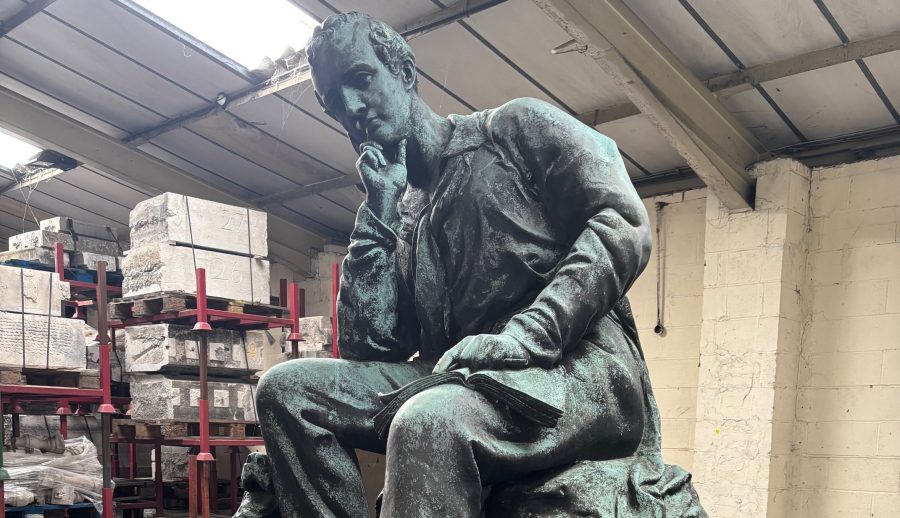
The triumphant unveiling of Byron’s statue in Hyde Park today marks the end of 200 years of dithering about his significance.
When he died in 1824, campaigning for Greek independence, he was the toast of Europe – far better known than the other romantic poets. He was just 36. But to say that Byron’s legacy has been contested since would be an understatement.
Even though the crowds for his funeral procession back in England were as epic as those for Diana the following century, doubts about whether to have a statue erected of him surfaced almost immediately because of his supposedly dubious morals.
The Dean of Westminster refused the suggestion that Byron be buried in Westminster Abbey, so the body went back to his home of Newstead instead. The Dean was equally adamant that no effigy of the poet be placed in Poet’s Corner.
To say that Byron’s legacy has been contested would be an understatement
To understand the depths of suspicion towards him, one has only to read Blackwood’s Magazine’s review of Don Juan which had called him ‘an unrepenting, unsoftened, smiling, sarcastic, joyous sinner’ before they ran out of adjectives. In the following fusillade, they said they had never read ‘such an infusion of genius and vice’.
It didn’t help that he was perceived to have run away from England a decade before his death (calling it ‘that tight little island’) amid rumours about his relations with both his half-sister and his wife. Nor that since living in Italy, he had become far more politicised through the influence of his friend Shelley, writing fierce attacks on both the British government of the day and the monarchy.
His friends commissioned a fine statue by Bertel Thorvaldsen, which was shipped over from Rome and shows the poet poised in thought, with pen in hand. For ten years they tried in vain to persuade Westminster Abbey to host it; so instead turned to Trinity College Cambridge, where Byron as a student had once famously kept a bear – not out of caprice, as is often thought, but to make the political point that even a bear could get a degree as long as they spent enough time in the university precincts.
Even at Trinity they encountered problems. By now it was 1844 and attitudes had become yet more entrenched with the Victorian era. The College Dean refused to allow the statue into the famous Chapel antechamber, alongside the busts of Newton and other Trinity grandees. Only with the personal intervention of the Master, William Whewell, could he be put safely in the library instead. But still there was no public statue.
It took the efforts of a later generation of admirers, like Disraeli, to finally get a statue erected; even then, in a very British compromise, it was hidden away on a corner of Park Lane which was slowly surrounded by roads. During the 20th century it was completely invisible to the passer-by unless they wanted to brave three lanes of unregulated traffic.
Even now, it has taken a huge effort to get his statue moved to a proper and more prominent position within Hyde Park, on the border with Kensington Gardens. The Royal Park authorities were apparently dubious at first and requested a statement as to the value and legitimacy of Byron given his ‘reputational issues’.
Suspicions still swirl around him. When I was getting my novel published about what might have happened if Byron had not died in Greece but lived on to fight another day, in South America where he wanted to go, several agents asked me if I had not realised that ‘Byron has been cancelled’. Louche, aristocratic and a supposed womaniser is not a good look in times that have become equally as puritan as the Victorian.
Yet the suspicions are often unfair. Many critics of Byron’s masterpiece, Don Juan – and particularly those who haven’t read it – assume it celebrates a womanising hero, like the opera. In fact, what scandalised the early 19th century public and worried Byron’s publisher John Murray was that it celebrated and admitted female sexuality. The hero is a young teenage boy who is regularly seduced by older and more experienced women.
There have been no such worries in Greece where he’s still seen as a hero. His death in Missolonghi, from illness not military action, kick-started support for the Greek independence movement which he had joined. Plenty of little boys are still called ‘Biron’, or ‘Vyron’, and his name is on street signs. An entire suburb of Athens is named Vyronas in his honour. For the bicentenary of his death, when the movement for this statue in Hyde Park really began, the Greek ambassador told me his country owed an incalculable debt to Byron, who had lent money, support and prestige to a cause ignored until then by the rest of Europe.
After a determined campaign led by the current Lord Byron, the statue will now be in an extremely prominent place, seen by motorists as well as pedestrians on the final turn before you leave Hyde Park to join Bayswater Road, and appropriately near the Italian Gardens. It is also on the old North Ride, the circuit for horses and carriages that loops round to meet Rotten Row. As such it would have been promenaded past by the old aristocratic ‘ton’ of Regency London; one likes to think their ghosts might now tip their hats to their most infamous member.
Would Byron himself have been pleased? It is hard to tell. He was notoriously fussy about how he appeared in statues and portraits, usually complaining they made him too fat; a constant preoccupation against which he dieted. And he liked to complain his fame had intruded on his privacy, with tourists in Venice treating him as one of the local attractions. But like many a movie or rock star since, he would have hated even more to have been ignored or forgotten.