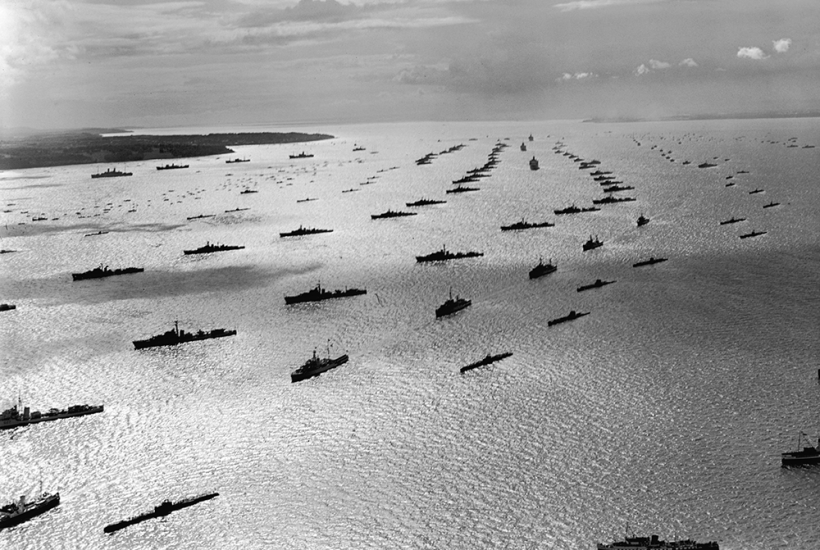
It’s all very well for Andy Burnham and John Healey to say they want to fund defence, but are they aware of just what a perilous situation the Royal Navy is in? Policy failure by successive governments, more focused on election appeal than security, means the state has lost sight of the basics. Ensuring the free movement of global shipping has been a priority for centuries because Britain cannot produce enough food, fuel or raw materials for itself. Along with the nuclear deterrence, shipping routes form the existential core of our national security. These routes – vital in world wars against Napoleon, the Kaiser and Hitler – depended on a powerful, globally deployed navy. The current force is not up to the task.
The place of the ocean in national life and culture has also declined. Seafaring roles and shipbuilding have been outsourced. Essential ships are registered by nations without warships, or even a coast. In the past, the connection between a powerful navy, the interests of the City of London and the economic health of the nation was acknowledged by governments of all parties, and managed by the Admiralty, a great department of state located not 100 yards from Nelson’s Column. The Admiralty built, maintained, crewed and directed the navy in war and peace, stood up to the Treasury and co-ordinated with the War Office on strategy. It worked with Lloyd’s of London to manage wartime convoy systems from the 18th century to 1945, securing ocean trade and destroying hostile economies.
After 1964, British strategy was no longer shaped by the realities of geography and oceanic dependence
After 1945, Britain sacrificed the navy’s wider roles and focused instead on the Cold War defence of West Germany. We relied on America’s immense forces to plug the gaps. In 1964, politicians desperate for more defence cuts abolished the Admiralty, merging the three service ministries into an amorphous Ministry of Defence that lacked any sense of commercial links, cultural prominence and national dependence on the sea. The new arrangement expanded the dominance of the Treasury, which cut major programmes, notably new aircraft carriers, within months of the change. Not only did the MoD ignore the centuries-old priority of maritime security, but it sacrificed critical non-military roles, including acting as the central clearing house for maritime messaging that ensured Britain understood why the sea was central to national security, identity and prosperity. After 1964, British strategy was no longer shaped by the realities of geography and oceanic dependence. Instead it focused on Nato, dismissing other commitments as being ‘Out of [the Nato] Area’. These included the Falkland Islands.
The Falklands War in 1982 demonstrated the limits of Nato support, most of all American – a constant concern as long as Britain is weak. The navy rapidly assembled and dispatched a taskforce, recovered the islands and upheld international order. The success reflected the fact that the navy still owned and ran the maintenance facilities – but only just. They were about to be privatised. Thankfully, because of the swift and effective response to Argentine aggression, plans to cut the navy were reduced, ensuring a strong national response to the tanker war of 1987-88.
Despite the post-1964 decline, when the Cold War ended the navy was still in just about reasonable order. The contrast with today is painful. We need to know who decided to reduce national defences to their current state. Who halved the Type 45 Destroyer build? Who failed to order new frigates to meet the end of life expectancy of the Type 23 class? There have been several times in recent years when the navy has not had a single attack submarine at sea – why were new ones not ordered in time to avoid the fiasco?
Having forgotten why and how this country took such a large role in world history, politicians treat defence as a question of percentages. They do not appear to understand that solutions that work for most Nato partners will not necessarily meet British needs. In this regard, the Nato defence spending goal of 3 per cent of GDP is an unhelpful incentive. It encourages a standardised assembly of capabilities, when the intelligent thing to do is to create defence systems that deliver national security both within the alliance and outside it. Nato would not act if the Falklands were attacked tomorrow. Furthermore, the 3 per cent target fails to recognise specific priorities. For instance, since Germany is building a serious tank force, Britain can focus on the sea, instead of rehashing veteran vehicles.
If Britain were to restore the navy, that would require a consistent long-term building plan to keep the fleet at full strength. It would mean no more Treasury-led funding gaps and quick fixes that leave the navy with massive repair bills for old assets, a shortage of new ships and submarines and a maintenance crisis that private industry appears unable to address. Returning maintenance to nationally owned facilities would be an obvious answer. Private industry has long had a major role in defence, but the Armed Forces and national security are the government’s responsibility and should not be privatised for profit.
Earlier this year, there was a small example of what the navy can still achieve. On 14 June, British forces seized the Cameroon-flagged ‘shadow’ tanker Smyrtos, which had sailed from the Baltic. The operation was legal, swift and effective. Russia’s war economy relies on the illegal movement of oil, gas, fertiliser and grain to fund the Ukraine war. Does our navy have the resources to do something about this at the scale required?
The new government has an opportunity to sort this out before it gets any worse. Wes Streeting, the Defence Secretary, has already said he will resign if not enough is spent on defence. If the government can restore the deterrent fleet, securing more new frigates and much else, then Britain can return to the classic maritime strategic model. Without a fleet upgrade, our interests will be ignored by friends and foes alike.
Got something to add? Join the discussion and comment below.
You might disagree with half of it, but you’ll enjoy reading all of it. Try your first month for free, then just $2 a week for the remainder of your first year.