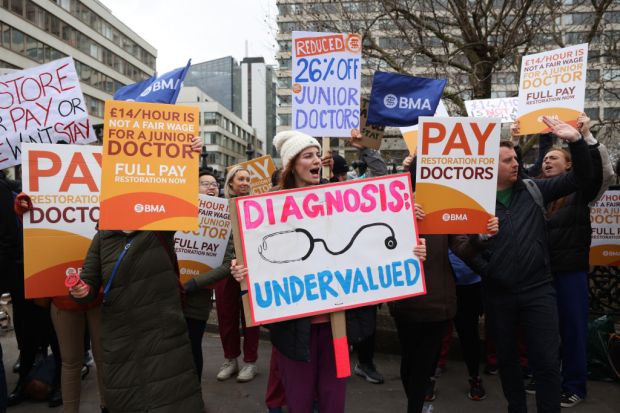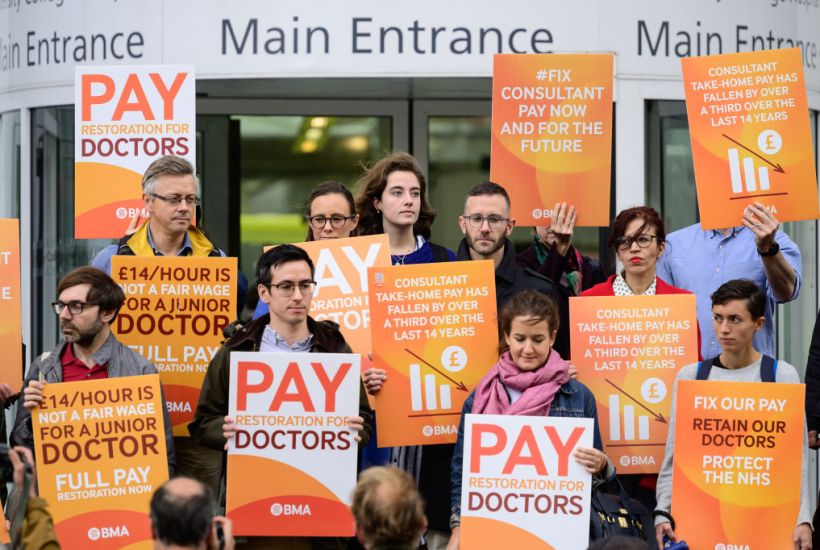
In the emergency department, and on my wards, the strikes sit lightly. My specialty of internal medicine never closes; Easter Monday was a normal working day. The only difference from today until Monday next is that junior doctors will be scarce.
Not terribly scarce, in truth, since many are as disenchanted with the strikes as you might hope. They prefer work to the picket lines. Yet lots are aggrieved by how far their pay has fallen below what they feel they deserve. Many more are furious that their training posts have been awarded wholesale to foreign applicants with no obvious superior merit. If I have worked with any junior in the past year who is enthused about these strikes, they have kept it to themselves – and the young are seldom shy of a grievance.
The strikes are needless on both sides, but continue all the same, to everybody’s cost
The casualties are real, but invisible from where we work. Clinics and surgeries and elective services have been cancelled, at a human cost of needless pain and, surely, some deaths. Then there is the cost to the NHS of employing an old fool like myself to do tasks he was once good at but can now barely remember. The bits of our computer system I usually leave to the juniors are unfamiliar to me. I get stuck, and have to ask for help. I apologise, and say to whichever junior comes to my aid that it must be like watching their grandparents trying to work a video recorder.
They can picture it, just about, much as I can guess what it’s like being unable to afford a flat, before returning home to my comfortable house. Unless you have parents helping foot the bill, buying your independence these days is harder than it was. That is not the fault of the NHS, but it is the fault of our governments. Entitlement is often used as an insult, but it is reasonable to feel that working hard in a decent job should entitle you to afford a house. Junior doctors are not special in this regard, but nor should we expect them to be. There are officially almost ten million more of us than in 2000, overwhelmingly due to immigration, and we haven’t built the homes to house them. The demand is there; our laws limit the supply.
This does not excuse the strikes, but partly explains them. Medicine is a state monopoly, meaning wages are settled by arguments and not by markets. If government wished to pursue value for money aggressively, it might triple places at medical schools, training more domestic doctors than it needed, letting competition drive down wages, and making employees more malleable. Those who fled abroad could be tied to repaying the (highly notional) costs of their training.
A gentler approach would be to restrain wages while making working life more pleasant. Our governments have done neither. The BMA seems led by a radical minority, but the government provides no contrasting example of good sense. The strikes are needless on both sides, but continue all the same, to everybody’s cost.
Growing up I intended to be a GP and ended up in hospital medicine largely by accident. But I am glad to have escaped a relatively solitary working life. On the wards I have the company of juniors to keep me entertained. Almost every junior team has at least one person, often more, whose company and conversation light up the day. As I write I have a book on etymology sitting next to me, the gift last week of a South African junior whose knowledge of the subject, despite English not being his first language, was a joy: no coincidence that his medicine was excellent too.
Medicine must attract people good enough to be doctors. Pay matters, but it is far from all. Workforce planning in this country has been catastrophic. Broader failures of statehood also play a part, and when houses are scarce many people, the young especially, are impoverished. Medicine has also lost a portion of what made it special. The long hours were abysmal, and I remember the depression of facing a shift that started on Friday morning and finished Monday evening, with sleep never guaranteed. But the continuity of care and continuity of teams lent a camaraderie that helped. And the free hospital accommodation for the first three years of junior training, essential when the hours were so long and rotations so brief, helped too. Grotty as it was, it subsidised our spirit and not just our rent.
I think the juniors are wrong to strike, but hope it works out for them. When I took my undergraduate exams and did well, a much older friend congratulated me warmly. He observed, with a chuckle, that it was hard not to hope one’s friends did better than they deserved.