The Albanese government thought it had scored a political win from the leaking of the Coalition’s talking points in the week leading up to Easter. But did it surprise anyone that political parties issue talking points? Informing lazy members as well as retaining a degree of consistent messaging are clear advantages. The Coalition does it; Labor does it.
The ironic thing about this fleeting development was that it was completely obvious that Labor had put out its own talking points about the advantages of renewable energy in the context of the Iran war and the associated ructions in the global fuel market.
They were utterly predictable assertions, all twaddle, but compliant ministers toed the line and sallied forth. The wind and sun are not interrupted by international conflicts. Australia has a comparative advantage in wind and sun. Renewable energy is the cheapest form of energy. The events in the Middle East are a reminder, if one is needed, to accelerate the net zero transition. Sigh.
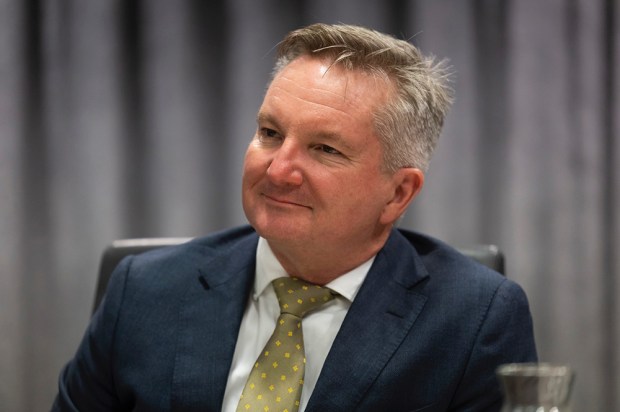
Of course, B1, the Climate Change and Energy Minister, Chris Bowen, was out of the blocks early. He earnestly informed us that ‘solar energy cannot be interrupted by any international dispute’.
He didn’t mention the fact that nearly 100 per cent of solar panels are imported from China and that fossil fuels are integral to their manufacture. He also failed to note that the international dispute doesn’t alter the sun’s unfortunate habit of setting every day. These are mere details to our mastermind.
Then we had this completely absurd statement from the hapless (and hopeless) Tim Ayers – Timbo to Speccie readers – who is currently Minister for Industry and Innovation. (Someone in the government must have a sense of humour – putting innovation in a ministerial title is surely a joke.) Note here that Timbo is a personal friend of Albo, which probably explains a lot.
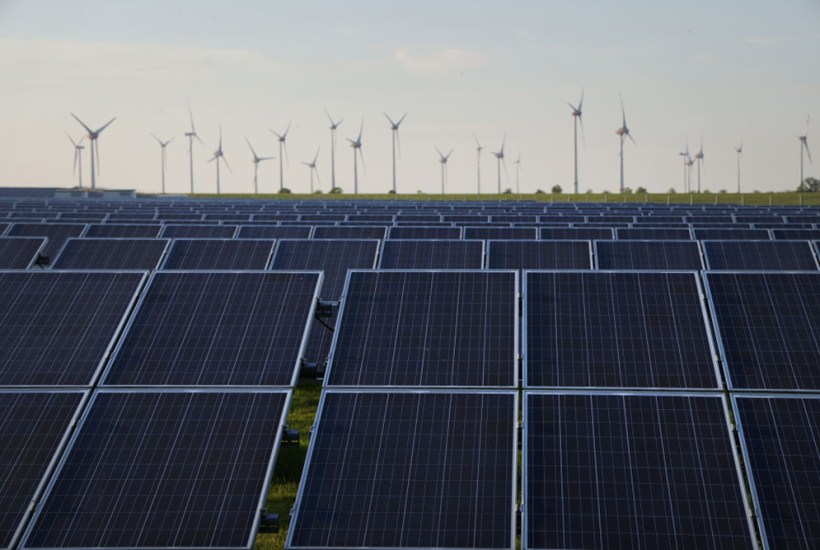
‘No maritime blockade, overseas war or economic coercion can stop Australia’s sun, wind, gas or batteries powering Australian industries,’ Timbo announced on Facebook. Run that past me again. Sun and wind powering Australian industries. What industries would they be? He really must take us for fools.
Mind you, Albo is still banging on about the virtues of Future Made in Australia, even though the billions of taxpayer dollars being shovelled out the door are to save industrial operations that are about to close – think Whyalla Steelworks, the Boyne and Tomago aluminium smelters and the list goes on.
But here’s the real irony: these energy-intensive manufacturing operations are going broke because energy prices have risen so steeply under the decarbonisation transition. They simply cannot compete in the global marketplace because electricity and gas prices are too high. The fact that Australia has one of the smallest manufacturing sectors, proportionately speaking, among advanced economies is no coincidence.
For Labor, however, facts are not allowed to get in the way of Labor thinking. Another inept minister, Clare O’Neil, appeared on Sky News with Kieran Gilbert in the interviewer chair. (How’s that housing target going, Clare?) She stuck strictly to the script given to her.
‘Yeah, Kieran, I think one of the absolute no‑brainers from what’s happening in Iran is the urgency of Australia to become energy independent. So, you know, there’s Liberals who are talking about the need for us to move away from net zero. That is exactly backwards to what we need to be doing.’
According to her – OK, Labor’s talking points – ‘We have the most abundant supply of renewable energy of any country in the world. Renewables are cheaper than other new forms of energy, and our country is already successfully making this transition…. There isn’t a global power that can stop us from using the sun and wind that we’ve been gifted as endowments to Australia.’ (Yet another soliloquy that should be set to music.)
At this point, Gilbert rudely interrupted her by pointing out that freight trucks run on diesel. But Clare had the answer: ‘Yeah, all this is going to take time. It’s not as though we can make these changes tomorrow.’
Gilbert then asked the obvious question about what the government should be doing in the meantime. O’Neil’s response was that the ‘one thing any politician surely would take away from the current context is we need to stand on our own two feet. And the way that I see us doing that in the medium and longer term is through this massive endowment of renewables that we’ve been gifted.’ Of course, she will be long gone in the medium and longer term: I say hallelujah to that. And in the meantime, she is completely clueless.
Now I wouldn’t normally commit so many column inches to a bungling minister demonstrating her ignorance and incompetence, even if it’s a bit of fun. The situation is much more serious than a few clumsy and misleading statements from careerist politicians.
There seems to be a complete misunderstanding of the nature of the problem and the fact that the consequences extend far beyond some inoperative bowsers at some servos. I have noted this before on these pages but it’s worth noting again: Australia consumes twice as much energy in the form of liquid fuels as we do in electricity.
The current crisis is about fuel rather than the broader energy market. Gas and coal are affected to a degree, but the impact is insignificant compared with the market for oil, which then extends to diesel, petrol, aviation fuel, naphtha (plastics) and ammonia (fertiliser). There are simply no economic substitutes for liquid fuels at this stage, the dream of green hydrogen having failed dismally.
CBA Economics has noted that ‘the elongated supply chain disruption in the Middle East has exposed vulnerabilities in Australian fuel markets, with the country heavily reliant on the importation of liquid fuels such as refined petroleum, diesel and jet fuel to power our domestic energy‑intensive industries.’
The further point is made that ‘energy‑intensive agriculture, transport, construction and mining sectors could incur a material hit from persistent fuel shortages and rising input costs.’ We are already seeing a range of prices rise, including oil, chemicals, resins fertiliser and cement.
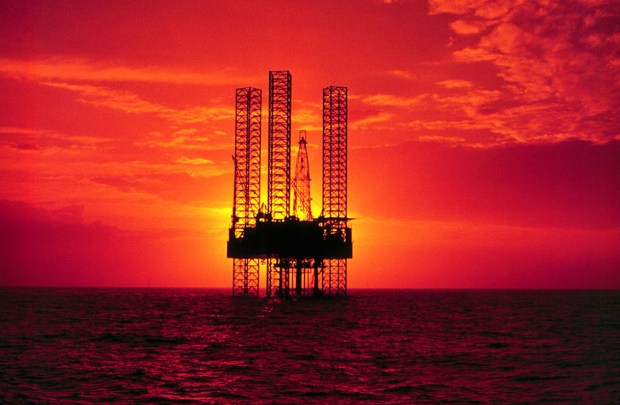
The bottom line is this: the Australian economy is extremely vulnerable because of its almost total reliance on the importation of liquid fuels. Two decades ago, we were pumping out crude oil from various sources, and we had eight refineries processing the output. Now only 20 per cent of our crude oil is sourced locally and it is only light crude oil, which limits its usefulness. There are two refineries on life support.
We used to have a urea factory near Brisbane but that closed several years ago because the price of domestic gas was too high and neither the state nor federal government was prepared to intervene. The Phosphate Hill fertiliser factory at Mount Isa is hanging by a thread. We produce no helium although we could.
The saying: ‘you reap what you sow’ is particularly apposite.
Got something to add? Join the discussion and comment below.
You might disagree with half of it, but you’ll enjoy reading all of it. Try your first month for free, then just $2 a week for the remainder of your first year.