Reform leader Nigel Farage likes to claim that his latest political vehicle is on course to replace the ‘old fuddy duddy’ Conservative party as the dominant force on the centre-right. While the parallel is not exact, comparing today’s battle for the centre-right with the last major party realignment – when Labour replaced the Liberals as the dominant force on the centre-left after the first world war – suggests there are real danger signs for the Tories.
When Herbert Henry Asquith replaced Henry Campbell-Bannerman as Liberal prime minister in April 1908, he inherited one of the largest parliamentary majorities in 20th century history. Yet by the time he finally handed over the reins in 1926, the once-great Liberal party was on its knees. Between the 1906 and 1924 elections, the Liberals fell from 400 seats to just 40, a 90 per cent fall.
Having lost major party status, not even policy innovation could save the Liberals
Contrary to the journalist and historian George Dangerfield’s long-discredited thesis, the Liberals remained in a strong position until the first world war. While there were major political battles over Ireland and the House of Lords, the Asquith government’s domestic record, which included the first old-age pensions and National Insurance legislation, was formidable, far more so than that of the last Conservative government. Rather than fight the Liberals, the new force on the left – the newly-formed Labour party – instead made electoral pacts with them. Indeed, had it decided to fight the Liberals, evidence from by-elections suggests that Labour would have been the real loser: being perceived as the stronger party, the Liberals would have enjoyed a substantial advantage. With the Conservatives in shambles and further propped by dozens of Irish Nationalist MPs, a Liberal eclipse seemed unimaginable.
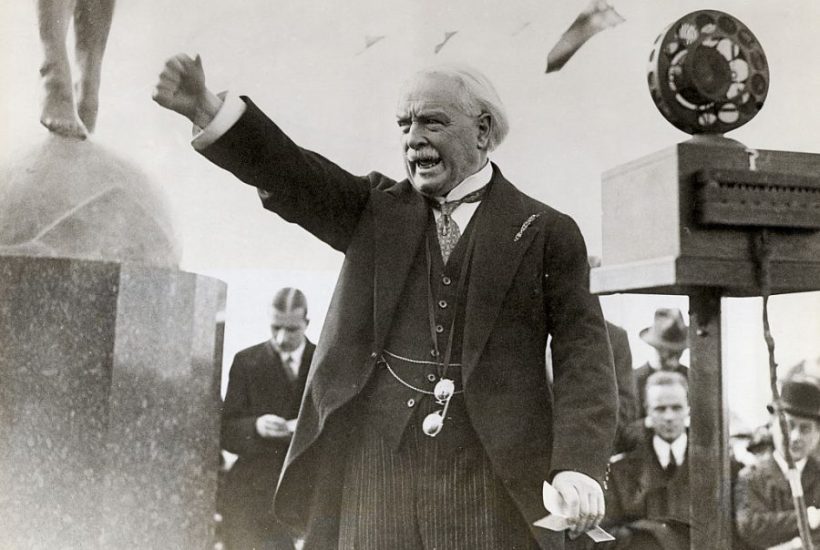
Although governing during a world war would never have been easy for a party whose ideology favoured peace and free trade, a painful split made the problem far worse. Having formed a coalition government with the Conservatives in 1915, Asquith was replaced as prime minister by David Lloyd George the following year. Rather than bow out of politics, however, Asquith – still technically Liberal leader – and his followers went into opposition. Though it wasn’t initially obvious, the split became permanent.
While, as the Tories have demonstrated in recent years, splits are damaging at the best of times, what made this one catastrophic was the opportunity it gave the emerging Labour party. With the institutional backing of the trade unions, whose strength increased during the war, Labour seized its chance and abandoned its pact with the Liberals. Initially, the results were disappointing: at the first post-war election in December 1918, Labour won just 63 seats. But the trends boded ill for the Liberals: Labour had tripled its vote share from the last pre-war contest. Worse, because the Asquith Liberals were almost wiped out, Labour was now the official opposition.
Despite initial flickers of hope, the Labour tide could not be turned back. In early 1919, the Asquith Liberals won three by-elections, and Asquith, who had lost his seat in 1918, himself returned to the Commons in 1920. When the UK went back to the polls in 1922, however, Labour’s advance continued. Whereas Labour now held 142 seats, the combined Liberal factions – the Asquith and Lloyd George Liberals fought separately despite the latter no longer being in coalition with the Tories – held just 116.
Ironically, the Liberals’ more dramatic recovery the following year only highlighted their structural problems. Spurred by Conservative prime minister Stanley Baldwin’s attempt to claim a mandate to introduce protective tariffs, both Liberal factions reunited in defence of that core tenet of Liberalism: free trade. While being rewarded with 158 seats and 29.5 per cent of the vote at the 1923 election – a feat the Liberals or Liberal Democrats have never equalled since – the gains were ephemeral. Instead of winning back former heartlands, such as the industrial areas of Scotland or South Wales, many Liberal gains actually came from Conservative voters opposed to protection. This included seats such as Tiverton and Sevenoaks, that had remained Conservative during the great Liberal landslide of 1906. By contrast, having found a new home in the Labour party, former working-class Liberal voters had no reason to switch back.
Even more disastrously for the long term, the Liberals effectively had no choice but to back the free-trade supporting Labour party, which won more seats, in forming a government. Despite lasting less than a year, the mere existence of the first MacDonald government showed that Labour, not the Liberals, were the dominant force on the left. Structural trends were now reinforcing themselves.
Having lost major party status, not even policy innovation could save the Liberals. Having taken the leadership after Asquith finally stepped down, Lloyd George poured funds – mostly obtained from the sale of honours when he was prime minister – and intellectual resources to give the Liberals another crack. Drawing on the ideas of the Cambridge economist John Maynard Keynes, among others, the Liberals became the first British political party to call on the government to use public works spending to reduce unemployment.
While Lloyd George recognised that an outright Liberal victory was implausible given the party’s dismal starting position, there were high hopes that it could, at least, win around 80 to 100 seats and hold the balance of power at the next election. Yet again, however, the results proved disappointing: with 23.4 per cent of the vote and 59 seats at the 1929 election, the Liberals remained far behind Labour’s 37.1 per cent and 288 seats.
Put another way, the Liberals had fared even worse with an innovative programme than they had with a largely negative one six years earlier. Any lingering hopes for a dramatic Liberal revival were dashed.
Of course, there are differences between the Tories in 2026 and the Liberals a century ago. Even at their post-Brexit worst, Tory leadership dramas never caused an Asquith/Lloyd George type split. Similarly, it’s hard to see Reform UK achieving the organisational strength of the interwar trade union movement. However, if enough former Tory voters stop believing the party has a future, then suffer the Liberals’ fate it will.