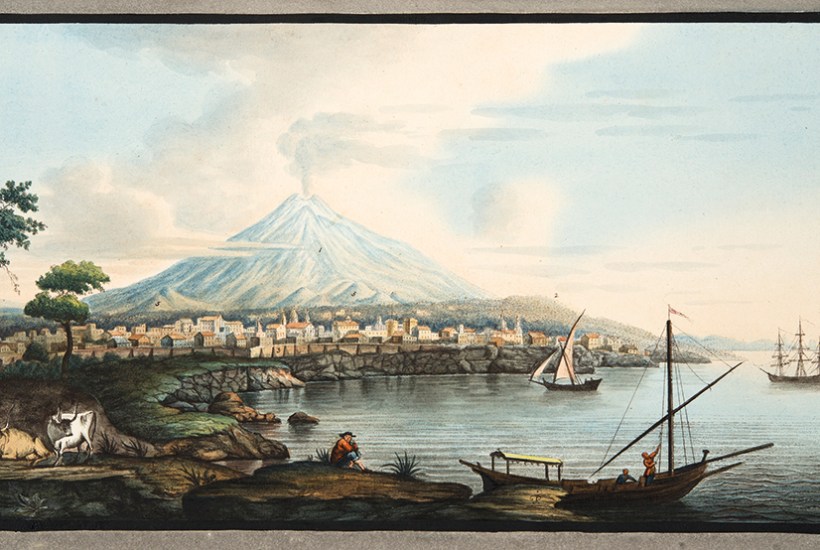
The early Greek inhabitants of Sicily peered into Etna’s crater and declared the volcano to be full of monsters. Its ‘impenetrable darkness’ reminded Coleridge of his opium addiction. Helena Attlee, whose hugely enjoyable The Land where Lemons Grow (2014) won acclaim, brings to her portrait of Etna a softer, more admiring, yet respectful, eye. Unpicking its geological and human history and a landscape ‘cobbled together from the expressions of the Earth’s unrest’ became for her a way of returning to the very beginnings of life.
Mount Etna, almost 3,500 metres in height, is Europe’s biggest volcano and one of the most active in the world, grumbling and spewing for many months at a time. Even when quiet, ash settles everywhere, not soft and grey but black and gritty, the razor-sharp fragments making their way into clothes and shoes. A million people live on its slopes, where the extreme fertility of its soil has fostered rich and abundantly flavoured crops of every kind. Mangoes, papaya and avocados thrive in the damp, semi-tropical warmth of its east side. Orchards and vineyards cluster around its base. Towards the top stand pines, some crushed and charred by eruptions.
Etna’s snow was enjoyed as sherbet by the Arabs and made by the Normans into vast snowballs
Attlee arrived in the spring to the sound of cuckoos. She rented a house from nuns in the village of Milo, 800 metres above sea level, with views over roofs to the sea. It was built, as all Etna’s houses are, of basalt and it looked as if it had grown out of the ground. Like her neighbours, she spent a good deal of her time sweeping, keeping the ash at bay.
A scholar of all things Italian, and especially Sicilian, with an eye for the quirky and the poetic, Attlee does for Etna what she did for lemons: she delves deep into the history of the volcano and the relationship of its people to their unpredictable land. She writes authoritatively about the collision of tectonic plates and of magma forcing its way through weaknesses in the Earth’s surface to become lava; and she describes in detail its great eruptions of 1669 and 1928, which saw the destruction of whole villages and forced their inhabitants to emigrate.
There is a good chapter on Etna’s snow, turned into a trade by the Greeks, enjoyed as sherbet by the Arabs and made by the Normans into vast snowballs, rolled from the top of Etna down to the coast, to be trampled down into layers separated by ferns and leaves, cut into chunks and exported in sacks of waxed cloth. Its snow lords became very rich.
What interests Attlee as much is modern life in this uncertain landscape – the way that generations of families have built up orchards and vineyards and created thriving timber businesses out of Etna’s 30 ancient species of trees, each used for a different purpose, never forgetting that their livelihoods can suddenly be destroyed. As spring turned to summer and then autumn, she visited sawmills, beekeepers, nomadic shepherds and the producers of the area’s special ricotta. She watched donkeys being milked for medicinal purposes and talked to the farmers who grow the emerald-green pistachios, widely used as flavouring, including for pasta and bruschetta. She rode the narrow-gauge railway that winds its way round the slopes, studying the different microclimates that have shaped the landscape. And she explored the revival of Etna’s once flourishing wine trade, sampling the grapes and discussing the way they change dramatically with every metre they climb. Talking to these growers gave her a sense of ‘having glimpsed the volcano’s very DNA’.
Attlee loves the taste of things. The food she eats, its freshness, colour and smell, is described in charming detail. She has a special fondness for the local pastries, made with glistening piles of pistachios under a glaze of icing, the size of golf balls and tasting of rosewater and sap.
Etna’s inhabitants do not take eruptions lightly. The National Institute of Geophysics and Volcanology in Catania manages one of the most advanced early warning systems in the world, collecting data from some 400 sources. The Max Planck Institute has also been fixing transmitters to birds and animals, whose ‘swarm intelligence’ provides early signs of volcanic activity.
Before Attlee left Etna, the volcano offered her a vision of what it is capable of: an eruption bringing orange ribbons of lava cutting paths down the mountainside, the crater belching plumes of smoke and magnificent explosions of light. Such warnings, she writes, are pertinent reminders of the fragility of things, and nowhere is this felt more keenly than in a place where so many gifts are given, and where they can so quickly be taken away.
Got something to add? Join the discussion and comment below.
You might disagree with half of it, but you’ll enjoy reading all of it. Try your first month for free, then just $2 a week for the remainder of your first year.