It’s hard not to experience cognitive dissonance watching Labor’s hapless ministers respond to the global energy crisis.
For five weeks, the world has been transfixed as the US President who wrote The Art of the Deal waged a lethal arm wrestle with the millenarian mullahs running Iran, for whom haggling in a bazaar, even over nuclear weapons, is imbibed with mother’s milk.
Awaiting the outcome was nerve-wracking. Most game theory assumes that both actors are rational. But what happens if your opponent is a regime run by religious zealots who are looking forward to Armageddon?
For that matter, who is running Iran? Ever since Ayatollah Khamenei was assassinated on the first day of the war, his praetorian guard, the Islamic Revolutionary Guard Corps, having failed in its primary duty to protect him, seems to have usurped his position. But who among them is calling the shots and for how long, given the speed with which Israel was moving through its bingo card, eliminating them?
All that seemed certain was that Khamenei’s son, who was named his successor and has only appeared as a cardboard cutout since his ascension to Supreme Leader, seems as likely to turn up in the flesh as the 12th Imam, who has been in hiding since 874 AD.
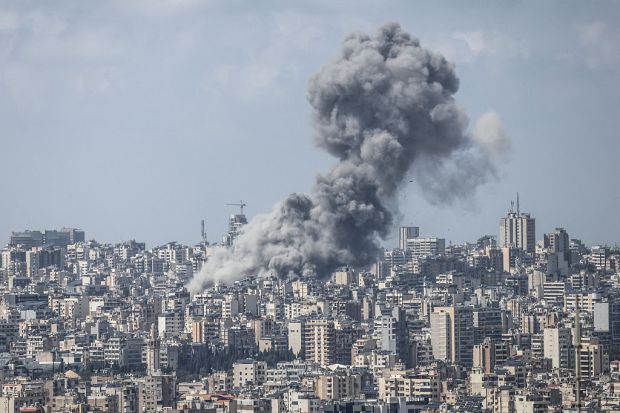
Then, at a millisecond to midnight, metaphorically speaking, Iran blinked. In return for a ceasefire, Iran’s Foreign Minister Araghchi has said the Strait of Hormuz will reopen for a fortnight, and 20 per cent of the world’s fuel that has been held hostage will be released.
Was it the f-bomb that Trump dropped? Was it Trump’s threat to ‘end Iranian civilisation’? Perhaps. All we know is that Araghchi decided that it would be wiser not to call Trump’s bluff. For that, we can all be grateful.
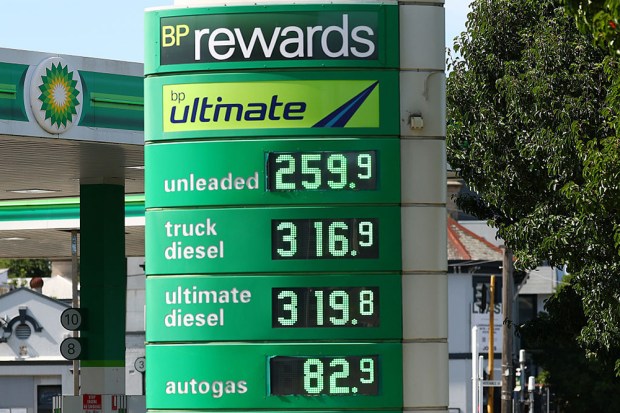
The relief at the fall in the price of a barrel of oil was immediate. It is just possible that if this ceasefire can be parlayed into something durable, a global recession and a repeat of 1970s-style stagflation can be avoided.
One might hope that such a near-death experience might prompt the Albanese government to admit that the policies it has pursued for the last four years – a perilous dependence on a fragile supply chain controlled by hostile nations – have led us to the brink of disaster and it was time to prioritise energy security and genuine resilience.
No such luck.
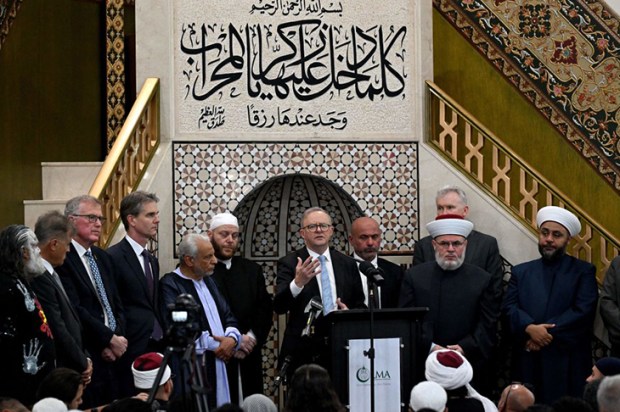
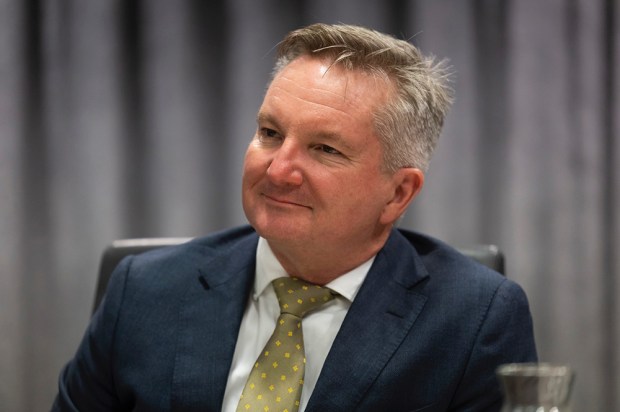
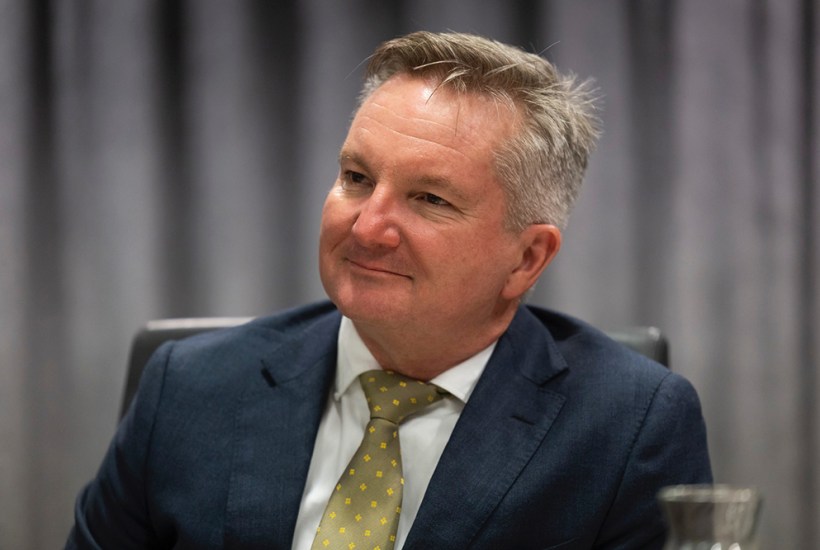
At the National Press Club, Climate Change and Energy Minister Chris Bowen insisted that removing Labor’s target of 82 per cent of electricity being generated by renewables by 2030 from its draft national policy platform did not mean Labor was abandoning it.
Anyone can see that this target will never be met. According to the Clean Energy Council, which supported it, it implied a 240 per cent increase in the annual rate of new renewable generation compared with the then-recent average. That didn’t happen. Offshore wind projects have been abandoned. Green hydrogen projects, despite billion-dollar taxpayer-funded subsidies, have never got off the ground.
But Bowen was having none of it, insisting that the 82 per cent target ‘is government policy, has been government policy, is government policy, remains government policy, is the position of the government’, with the strange repetition making him sound even more like a malfunctioning cyborg than usual.
Moreover, Bowen insists that ‘Labor will continue to drive the record uptake of renewables, including household solar and batteries’. Just what we need.
The Cheaper Home Batteries Program (launched 1 July 2025) has already blown out from $2.3 billion over the life of the program to 2030 to $7.2 billion. Thankfully, the program is under review, and a major reduction in incentives or an early wind-up is hopefully coming ahead of the federal budget.
That Labor is blind to the problems in its policies is evident when you read their draft policy platform. Take this gem which says: ‘Labor acknowledges that ageing, unreliable coal-fired power stations are driving up -prices every time they break down, and that Australia’s fleet of coal power stations is becoming more unreliable and increasingly costly to operate.’
A rational person would deduce that if the price of electricity goes up when coal-fired power stations break down, that means coal-fired power is cheaper than the power that replaces it. That person would be right, but it seems no one rational is writing Labor policy.
Coal-fired power plants are being ramped up and down to step in and provide power when renewables fail to generate electricity because the sun sets or the wind drops. This increases wear and tear, while the subsidies for renewables push up energy prices for consumers. At the same time, they create irresistible financial incentives for the owners of coal-fired power stations to spend as little as possible on maintenance and close them as soon as possible, which will further drive up the cost of electricity.
If coal-fired electricity were expensive and renewables were cheap, as Labor imagines, why would renewables need to be subsidised, and why would ‘poor’ countries like China and India add significant new coal capacity? For the simple reason that what is vital is energy security. That’s why coal consumption reached record levels in 2025, led by China and India, who comprise around 70 per cent of the world’s annual coal consumption.
Labor used to pride itself on copying climate worriers like Germany, but refuses to acknowledge that Germany has reactivated mothballed or soon-to-be-closed coal plants.
Labor simply lives with the mental conflict of priding itself on cutting emissions by spending billions on green subsidies that drive up the cost of energy while generating massive tax revenue from the export of coal and gas (and emissions), outsourcing manufacturing (and emissions) to China, and further exacerbating our dependence by relying on the Middle East for fuel.
It champions a ‘Future Made in Australia’ based on picking green winners (a contradiction in terms) and handing them $23 billion in subsidies.
In reality, Australia will have no future to speak of without developing its own sources of cheap, reliable, secure energy. That means ending bans on gas and nuclear, and tax breaks for developing liquid fuels.
But don’t hold your breath. Trump may have succeeded in forcing Iran to reopen Hormuz, but with Labor’s fossil fools at the helm, we are still in dire straits.
Got something to add? Join the discussion and comment below.
You might disagree with half of it, but you’ll enjoy reading all of it. Try your first month for free, then just $2 a week for the remainder of your first year.