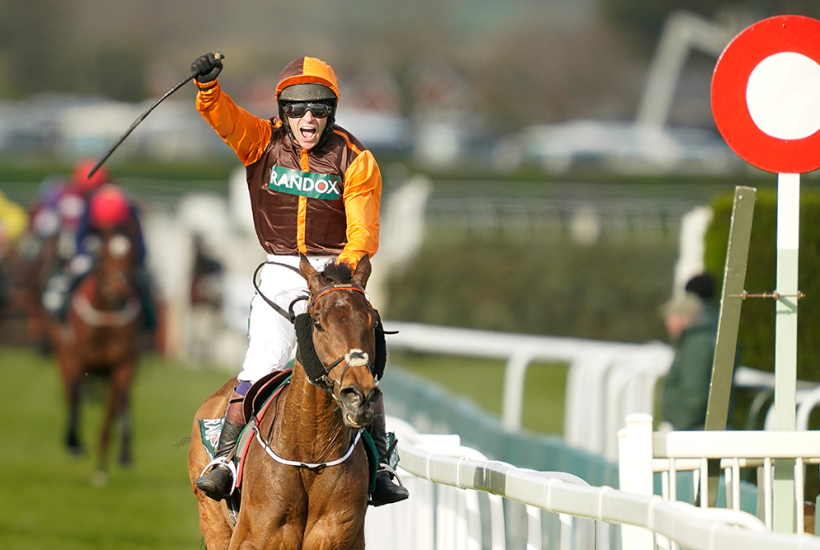
Last week, I had a commuter-hell day. The Great Western train to London was standing room only, horribly delayed, and the tea trolley was a non-runner. The Circle line broke down, and black cabs were rarer than an outsider winning the Derby. All this meant I was late to meet Grand National-winning jockey and all-round racing hero Sam Waley-Cohen.
I was due to see Sam at 4 p.m. at the chic members-only watering hole Kensington Roof Gardens. And boy, did I now need a sharpener. But it was the timing of our meeting that had been playing on my mind throughout my cursed journey.
It reminded me of the brilliantly wicked punchline delivered by John Arlott, one of the great cricket commentators. The New Zealander Bob Cunis stepped up to bowl at the Oval. He was generally considered too slow to be medium pace, but he didn’t turn the ball enough to be a classic spinner. Arlott, in his distinctive gravely voice, said; ‘Cunis, funny name that. Like his bowling, neither one thing or the other.’
And that is exactly how I would describe meeting someone for a drink at 4 p.m. Too late for a post-lunch glass of port and too early for a cocktail.
Sam was looking younger, leaner and fitter than he was in 2022 when he won the National on Noble Yeats. And he was wearing tennis kit. And there was a half-drunk glass of water on the table in front of him. Damn it. Perrier time it was.
‘I suppose Grand National day must feel like your birthday?’ I asked breezily.
‘It’s a happy day,’ he smiled. And boy, can he smile. And why not, I thought? He’s won the flipping National and he’s about to go and beat his brother at Campden Hill tennis club. If this guy isn’t smiling, who the hell is? ‘So yeah, I always have a smile on my face up there,’ he confirmed as I pulled myself together and watched a large espresso martini land on the next-door table. I allowed my eyes to follow it, just in case Sam changed his mind. But I think he’s very disciplined.
Sam first watched the National in 1991, first rode it in 2007, 15 years before he would win it. But he won the Foxhunters’ Chase at Aintree on Katarino in 2005 and 2006. He was bloody good at riding over those fences – a product of the pony club and the hunting field. (Are we still allowed to write that, or does it get us cancelled?)
‘Even in 2007, people were talking about the fences not being as big as they used to be, but I think the magic of the race is still there,’ Sam mused.
‘So what sort of horse do you need to win the National,’ I asked. Because even now, people have very conflicting views on that.
‘Without being too dry about it, you need a bloody good horse. Something rated 140 to 150, but with 10lbs in hand with the handicapper. And that is pretty well a Grade One chaser. You need the speed to lay up [the horses go much faster than they used to on the first circuit because the fences aren’t as challenging], but you also need something with the stamina to stay the four-and-a–quarter miles at a true gallop.’
What Sam’s effectively saying is that the old plodding steeplechaser can no longer win. Making the fences smaller and safer, and increasing the value of the race to £1 million, means that horses which might have been aimed at the Cheltenham Gold Cup in the past are aimed at the National.
The next day I called in on A.J. O’Neill at Jackdaws Castle near Stow-on-the-Wold. If ever a heaven were to be created to train racehorses, the gallops that he trains on with his legendary father Jonjo would be part of it.
I don’t use the word ‘legendary’ cheaply. Jonjo is the real deal: unbelievable rider of Dawn Run, wonderful human being and brilliant trainer.
The two were having a ‘buns’ season at Jackdaws Castle before Christmas, but they had the nous to shut up shop. They gave their horses a break midway through the season to recover from a virus that had gone through the yard.
The O’Neills are an incredibly tight-knit, hospitable family. Jonjo Jr is a talented jockey, and A.J. has a great attitude for a young trainer. His father must love having him in partnership. But I suspect Jacqui is the all-powerful matriarch. (I’m thinking a younger version of Margaret Mullins, Willie and Tony’s mother.) When the shit hits the fan, which it invariably does if you’re training 120 horses, she is probably the one to keep the show on the road.
And that is what the team had to do this season after their horses were off-colour. It’s the hardest thing in the world to do, especially when your competitors are banging in the winners. But they were rewarded with two victories from seven runners at the Cheltenham Festival. That is an unbelievable turnaround – pulling those irons out of the fire under those circumstances is some feat.
But this is some yard. When you have ex-jockeys like Alan Berry and Johnny Kavanagh working for you and riding them at home, you can make horses. Good people attract talented grafters in the racing game.
Johnnywho, one of the O’Neills’ Cheltenham winners, is now being aimed at the National. He looked so well in himself, having a quiet breeze on the gallops last week under Berry, and he fits Sam Waley-Cohen’s criteria of a winner – albeit he needs two to drop out to get into the race.
But no one will know how much Cheltenham took out of him until he’s (probably) jumping the Canal Turn for the second time next week. Racing is an inexact science – a little like afternoon-drink etiquette.
Got something to add? Join the discussion and comment below.
You might disagree with half of it, but you’ll enjoy reading all of it. Try your first month for free, then just $2 a week for the remainder of your first year.