Participants at the Winton British Solving Championship face six rounds of fiendishly difficult chess problems. The problems have an exam-style rubric, where marks are given for the right answer, but also for relevant variations to the main idea. Each round contains a different genre of problem: mate in two, mate in three, longer mates, helpmates, selfmates and studies (e.g. ‘White to play and win’).
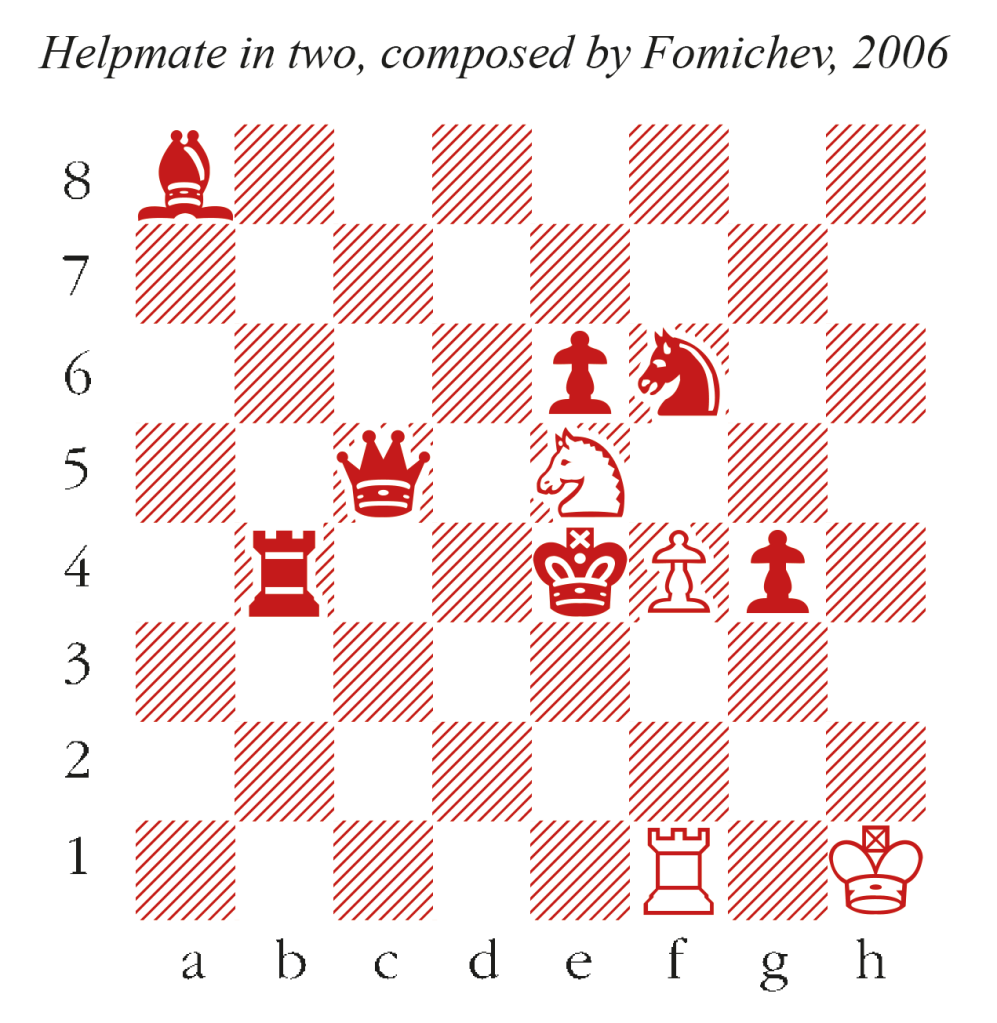
Helpmates can be particularly confusing for the uninitiated, because unlike vanilla chess where the play is adversarial, a helpmate is a display of choreography, where the sides cooperate to bring about mate as briskly as possible. For example, the shortest possible helpmate from the normal start position involves conspicuously poor play from the first player: 1 f3 e5 2 g4 Qh4 mate (sometimes known as Fool’s mate). Nevertheless, composers have mined the concept for witty and elegant ideas. Take, for example, the problem below, which was used in the Minor section of the British Solving Championship this year. It is a helpmate in two moves, composed by Eugene Fomichev. By convention, Black moves first and White gives checkmate, so the move sequence would be: B-W-B-W (checkmate). In this problem there are two solutions (see the bottom of the article) with a deliberate aesthetic link between them.
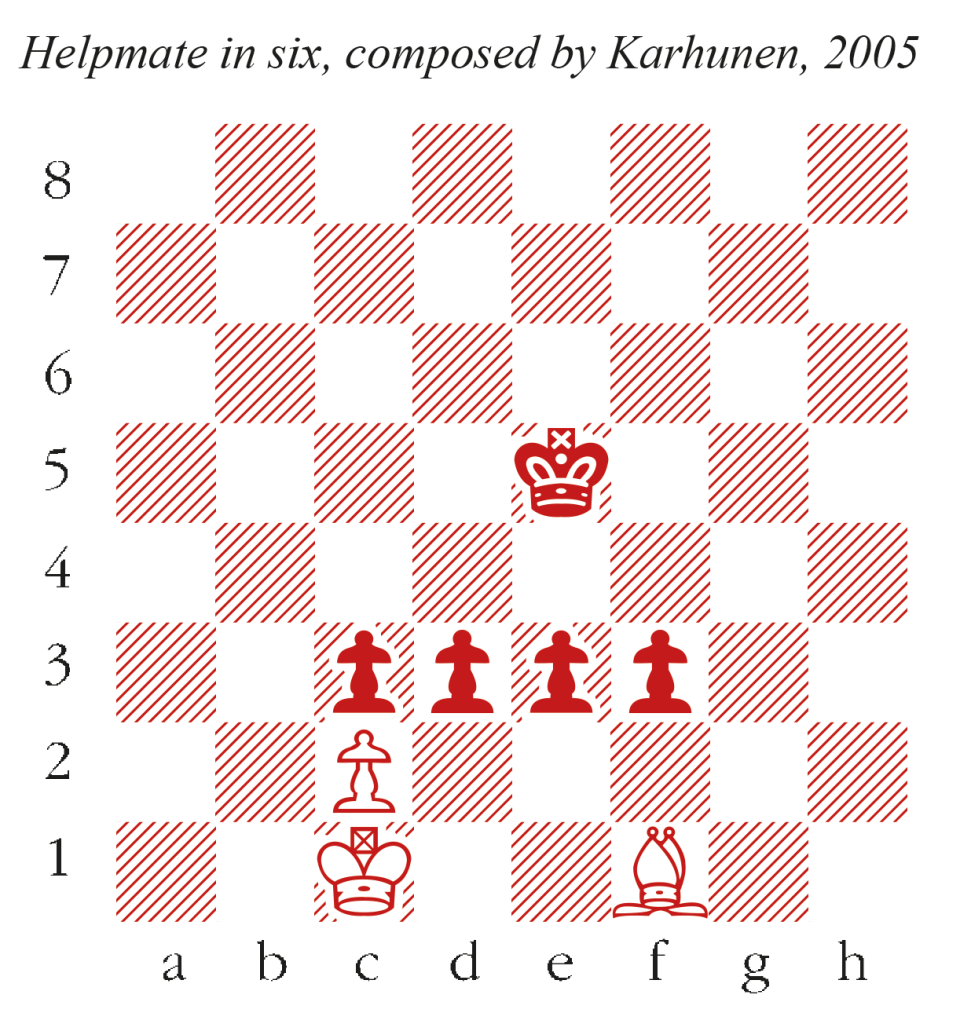
The 2026 event was held over a full day at Harrow School in London, and was won by John Nunn, already a three-time world solving champion, who finished ahead of reigning British champion David Hodge by the narrowest of margins. Nunn described the following position as the most enjoyable problem of the championship. It is a helpmate in six, composed by Kari Karhunen, i.e. Black moves first, and White’s sixth move delivers checkmate. This time there is only one solution, and the main difficulty is that with so few pieces it is hard to construct a mating position at all. Allowing White’s c-pawn to promote to a queen takes too long, as does another idea I considered, e.g. 1…d2+ 2 Kb1 e2 3 Bg2 e1=B 4 Bh1 Ke4 5 Bg2 Ke3 6 Bh1 Ke2 7 Bg2 Kd1 8 Bxf3# (seven moves each). The ingenious solution fashions a mating position ‘in mid-air’ – see below.
The Candidates Tournament, in which eight players compete for the chance to become the next world championship challenger, began in Cyprus on 29 March, and runs until 15 April. The Women’s Candidates event takes place simultaneously. More information, and the official commentary stream, can be found at www.candidates2026.fide.com.
Solutions to puzzle 1:
a) 1… Kd4+ 2 Rf3 Ne4 3 Rd3#
b) 1… Kf5+ 2 Nf3 Re4 3 Nh4#
Solution to puzzle 2:
1… Kf5 2 cxd3 c2 3 Kb2 c1=Q + 4 Kb3 Qc7 5 d4 Qf4 6 Kc4 Ke4 7 Bd3
Got something to add? Join the discussion and comment below.
You might disagree with half of it, but you’ll enjoy reading all of it. Try your first month for free, then just $2 a week for the remainder of your first year.