Jonathan Rivett, a columnist with the Age, recently provided an answer to the question of why so few Australians join unions despite the apparent benefits. He points to the familiar culprits: free-riders, employer hostility, ignorance of the $251 weekly wage premium that union members supposedly enjoy. But perhaps the more uncomfortable explanation is simpler. It’s not that workers misunderstand unions, it’s that unions no longer do what they’re supposed to do.
Once the most powerful force for working-class advancement in this country, unions have spent the past two decades drifting away from their core mission and into the thicket of identity politics, culture wars, and international affairs. If unions want to survive, they need to return to what they were built to do – fight for workers.
Look at the National Tertiary Education Union as a case study. The NTEU exists — in theory – to fight for the wages and conditions of university staff: the casual tutors on insecure contracts, the professional staff squeezed by budget cuts, the academics navigating crushing workloads. These are real, material problems that demand real, industrial solutions. Yet in recent years the NTEU has devoted considerable energy to one niche topic: transgenderism, a phenomenon that less than one percent of the Australian population identifies with.
The human cost of this ideological drift is illustrated by the case of Holly Lawford-Smith, a philosopher at the University of Melbourne who holds gender-critical views – the position that biological sex remains a relevant and material category in law and public policy. For several years she has faced sustained activist hostility: boycott campaigns, posters branding her a Nazi, and online efforts to associate her with extremism. In 2023 she lodged a formal complaint with the university alleging bullying and an unsafe workplace. The university ultimately cleared her of wrongdoing – but her union, the NTEU, was conspicuously absent from her corner.
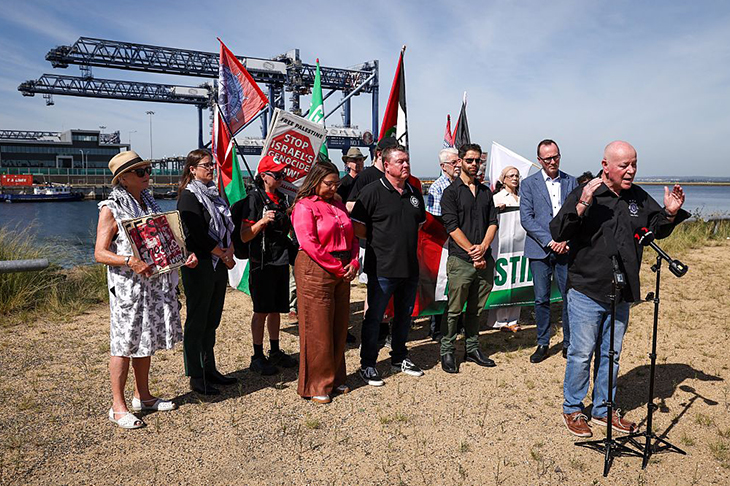
That absence is hard to separate from the union’s prior conduct. Amy Sargeant, a trans activist and National Convenor of Queer Unionists within the NTEU, publicly described Lawford-Smith as a ‘transphobic bigot’ and criticised the University of Melbourne for treating her attendance at a gender-critical rally as a personal matter. Sargeant amplified posts mocking Lawford-Smith’s scholarship and questioned whether academic freedom protections should even apply to her. As with gender, many Australia unions have become preoccupied with anti-Israel activism, a cause that has nothing to do with workers rights in Australia. With figures like this holding senior positions of power within unions, what hope is there that there will be a focus on genuine workers rights, and not on fringe ideological positions?
This is the essence of the problem. Modern unions have convinced themselves that the labour movement and the progressive cultural movement are one and the same. They are not. A 23-year-old retail worker worried about her rent does not need her union to have an opinion on gender theory. A construction worker on an insecure contract does not need his union issuing statements on settlements in the West Bank. What they need is an organisation that will sit across the table from their employer and fight, hard and without distraction, for better pay and fairer conditions. That is the deal. That is the only deal a union is authorised to make on behalf of its members.
The left’s drift toward identity politics has not simply distracted unions from economic concerns – it has actively alienated the working-class constituency that unions exist to serve. Many ordinary Australians hold traditional or conservative views on social questions. They are not bigots, nor extremists. They are people who go to work, pay their dues, and expect their union to have their backs on the job. When they see their union taking sides in cultural debates that divide rather than unite, they feel unwelcome. They leave. And who can blame them?
Then there is the CFMEU. The CFMEU has dominated Australian headlines for years with allegations of corruption, intimidation, stand-over tactics, and organised crime links. Criminal proceedings have been brought against officials, and the federal government placed the union into administration in 2024 amid mounting evidence of systemic misconduct. And yet, even as its own house burned down around it, the CFMEU found time to wade into Middle Eastern geopolitics – encouraging members to attend anti-Zionist rallies. A union simultaneously under criminal investigation and issuing foreign policy positions is a union that has lost all grip on what it is actually for. The same can be said about the Australian Education Union, whose executive took a side and made allegations about Israel – a move which I know has isolated many of its Jewish members.
There is also something deeply patronising about the assumption that workers need their unions to curate their political worldview. The free-rider critique – that non-members benefit from union-negotiated gains without contributing – misses the point entirely. Many workers who decline to join are not freeloading. They are making a conscious choice to stay out of organisations they find preachy, politicised, and disconnected from their daily lives. None of this requires dismissing the genuine achievements of the union movement.
The path forward is not complicated. Unions must ask themselves a simple question before taking any position: does this directly affect the wages, conditions, or safety of our members? If the answer is no, stay out of it. Leave foreign policy to diplomats, biology to biologists, and cultural battles to those who wish to fight them on their own time and dime.
Got something to add? Join the discussion and comment below.
You might disagree with half of it, but you’ll enjoy reading all of it. Try your first month for free, then just $2 a week for the remainder of your first year.