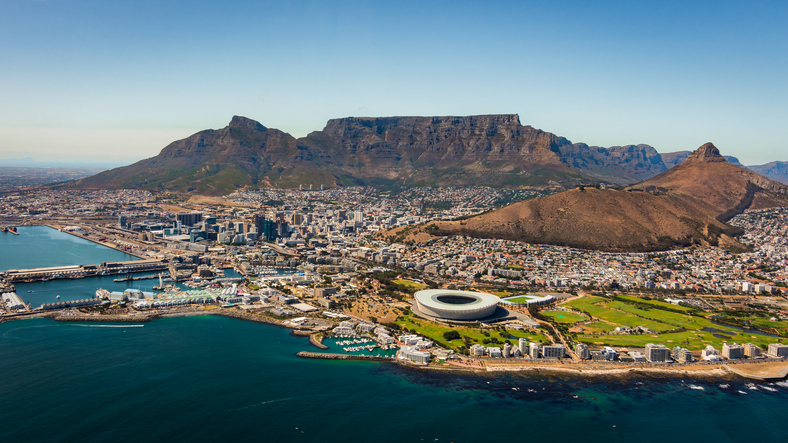
You only realise how depressing it has become to live in Keir Starmer’s Britain when you land in Cape Town towards the end of an interminable northern winter. Your mood immediately lifts – and it’s not only because of the warm ocean air or the diamond sky above Table mountain. There is a contented buzz about the place.
Take your seat in a bar or restaurant in one of the coastal suburbs spread out along either side of the Cape peninsula, and the mood is upbeat and relaxed. The multi-racial staff are young and cheerful, diligently going about their business. No one is grumbling about the price of energy. The proprietor won’t be telling you how he is having to lay off half the waiting staff because of Rachel Reeves’s National Insurance raid.
This is a pleasant surprise to me. I lived in South Africa in the 1980s and have regularly returned to chronicle what has seemed like endless post-apartheid decline. It has never been difficult to be depressed about South Africa, for its problems assail you at every juncture.
A decade or so ago, during the low point of President Jacob Zuma’s grotesque misrule, local bookshops were full of doom-mongering volumes with portentous titles asking, ‘Can South Africa survive?’ It was a daft question, though the anxiety behind it was real. The young, the educated and ambitious were packing for Perth and London.
The veldskoen of schadenfreude is truly on the other foot now
But no longer – or at least not nearly so much. It would be wrong to overstate it because, by any measure, the country’s progress since the 1994 democratic election which brought Nelson Mandela to power has been desperately disappointing. But at least it now feels as though that inexorable decline has been arrested, and the country has stumbled onto a plateau of contentment.
Key to this has been the elimination of ‘load-shedding’ – protracted periods of power cuts caused by the systematic looting of the state electricity company by African National Congress (ANC) party cronies. In the end, the problem was simply solved when the government was forced – by popular rage – into loosening the state’s monopoly on power generation. Miraculously, the lights and burglar alarms came back on.
Crime is no longer the dominant topic of conversation in white circles. For sure, South Africa’s murder rate in the townships is horrifying, but for the middle classes of all races, crime is now more a background anxiety than a daily obsession.
Johannesburg, as well as many other towns and cities, has materially declined in the past three decades, and most ANC-led administrations have essentially collapsed through corruption and incompetence. Drive through any town across the interior and its outskirts are pockmarked with squalid squatter settlements of wooden pallets and plastic sheeting, populated by lost, hungry souls. State-funded health care for the poor is virtually non-existent. The societal transformation promised by Mandela and his heirs has not materialised because too many of the old activists simply exploited their connections to enrich themselves.
The Cape province has done better because it has been ruled by the Democratic Alliance (DA), the white-led successor to the old liberal Progressive Federal party, Helen Suzman’s outfit. The bigger problems are in old Natal and Transvaal, where the ANC’s writ still runs. Nationally, the picture has improved since the party’s support collapsed at the last general election so sharply that they had to form a coalition with the DA. This has materially improved central government.
Maybe it feels so good here because I have just arrived from a knackered Britain, with its slow-motion re-enactment of reactionary 1970s socialist policies taxing jobs and ambition. South African friends ask, with facetious concern, if I’m okay because they hear such terrible things about our Starmerite dystopia. The veldskoen of schadenfreude is truly on the other foot now.
The single most cheering political development of the year is an audacious attempt by a 75-year-old white grandmother to bring Johannesburg back from oblivion. People laughed last year when Helen Zille, the former leader of the DA who successfully ran the Cape province for a decade, declared that she would run for mayor of Johannesburg in an election expected later this year. Her ambition is nothing less than to revive the decrepit city that used to be the economic dynamo of Africa.
The sceptics are not laughing now: she has a decent chance of emerging as the head of a governing coalition. Zille is an old leftie journalist from the Rand Daily Mail, where she helped expose the security police’s hand in the 1977 killing of the Black Consciousness leader Steve Biko. Zille is also Jewish, which does not go unnoticed here: anti-Semitism masquerading as opposition to ‘Zionist genocide’ has taken ugly root.
It turns out, though, that Zille is a brilliant retail politician. Her populist stunts are cutting through in a 90 per cent black city beggared by ANC corruption and incompetence. She cannot drive past one of the gigantic potholes along the city’s neglected thoroughfares without jumping into them for a photo op. The central theme of her campaign is sorting out the city’s water crisis caused by neglect and corruption. At the moment, the streets of Johannesburg frequently run with cascades of water from burst pipes, while residents in the suburbs cannot shower or flush toilets.
Zille is fighting for the votes of the poor and the aspiring black middle class, who increasingly are too young to remember Mandela’s liberation heroics and no longer owe automatic allegiance to the ANC. She is a determined anti-woke crusader who likes to provoke the bien-pensant by ruminating online about some of the benefits of colonialism – which has her old ultra-liberal white allies clutching the drapes.
When I catch up with her on Zoom on the campaign trail, she tells me she remains a proud liberal in the tradition of John Stuart Mill and is not an obsessive libertarian but an activist with attitude. In Johannesburg, she says she is up against ‘a criminal, mafia state’ in which ‘corruption is now the system’. Against this she promises ‘muscular liberalism, as voters don’t care whether the water engineers who fix the water pipes are black or white’.
Three decades ago, no one would have given an elderly Jewish grandmother a chance of winning power in South Africa. The Zille ascendancy is both a measure of the ANC’s political disintegration and of the country’s new political maturity. I have a sneaking feeling she will win – and that her victory may well transform South Africa.