Did Argentina pick the wrong timing in trying to conquer the Falkland Islands? It would almost certainly have had more luck if it had waited until Keir Starmer was in Number 10.
Just three days after the Argentine invasion, Margaret Thatcher sent a taskforce led by 65 Royal Navy ships, out of its total of about 90 major vessels. It’s doubtful Britain today could mount such an operation. Decades of cuts have reduced major naval vessels to 25 of which around ten are operational – startlingly, fewer than those deployable by the Royal Navy’s once-infant cousin, the Royal Australian Navy. The only area of Royal Navy growth has been in its corps of admirals – today 40, compared to around 20 in 1982, or four per operational ship. Surely a theme for a Gilbert and Sullivan operetta?
If Argentina were to invade today, not just Britain’s degraded military capability but Starmer’s woke foreign policy instincts would make a robust response unlikely. The leftist international law obsessives around him, who worship at the altar of ‘decolonisation’, would ask by what right Britain could defend territory which Argentina has persuaded most of ‘the global south’ to believe it acquired by imperial aggression. Seen from that perspective, surely the right course for a progressive Britain would not be military force but diplomatic negotiations. The objections of the UK-loyalist Falklanders could be safely ignored – just as the inhabitants of another embarrassing post-imperial relic, Gibraltar, have not been consulted about Labour’s agreement to Spain controlling their borders.
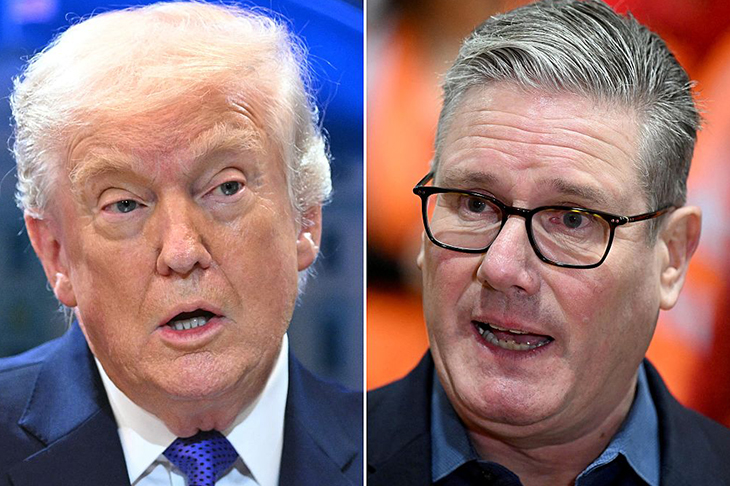
Starmer’s view that international law absolutism must trump all in foreign affairs, plus his obsession with appeasing Muslims, has led to the greatest crisis in US-UK relations in recent history. Trump didn’t want anything more from the UK for his Iran operation than the use of two British bases. Starmer capitulated to ministers led by pacifist net zero fanatic Ed Miliband insisting that Britain must refuse. Trump was furious both because such unhelpfulness was ‘unprecedented’, and because it made US Air Force flights longer, with more requirement for mid-air refuelling. Britain is now grouped by the White House with socialist Spain as America’s most useless European allies.
Tony Blair encapsulated the view of most of Britain’s (and Australia’s) post-second world war leaders when it comes to the special relationship: it is ‘the indispensable cornerstone’ of security, and when Washington asks for support ‘you better show up’. Responding helpfully to such requests – whatever their merits – has usually been treated as paying the insurance premium for US help if ever needed. Like Australia (not helping out in the 1990s Balkan wars), Britain has previously broken this rule once, in its refusal to contribute troops to the US effort in Vietnam. But it minimised negative US reactions by providing every other possible kind of support – logistical, intelligence and training, plus diplomatic backing. Lyndon Johnson and Richard Nixon never publicly said anything close to their being ‘very disappointed’ with Harold Wilson or Ted Heath, as Trump has said of Starmer.
If the Iranian regime falls, Britain will be remembered as having made no more than a grudging contribution. Even though the UK has said it’s vital that Tehran not acquire nuclear weapons and condemns it on many other fronts, Starmer at least initially wanted nothing to do with the war – so deployed no naval assets to the region despite ample warnings of the planned US-Israeli action. The idea of joining an attack on an Islamic country alongside the Islamo-left’s main hate figures, Trump and Israel, was anathema. Humiliatingly for Britain, after the Iranian-backed drone strike on one of its Cyprus bases, France and several other European countries responded quickly by deploying substantial naval assets to the region, well before a sole British warship began its journey there.
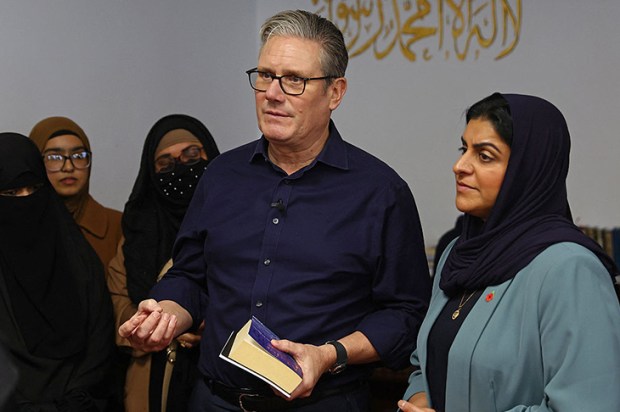
The 26 February by-election in Gorton and Denton, previously one of Labour’s safest seats, was one of the first major political aftershocks of the demographic shift to Britain becoming a much more Muslim country and highlighted the dilemma Starmer now faces. Labour lost more than half its previous voters in the electorate – including many Muslims – and came third after the Greens and Reform UK. The result has clearly deepened Labour’s panic that it could lose a swathe of its seats if Muslim voters it long took for granted keep defecting to the Greens. Consequently, Starmer now takes every possible opportunity to grovel to the UK’s four million Muslims (about 8 per cent of the population). He’s singled them out for praise as ‘the face of modern Britain’ and has created an ‘anti-Muslim hate’ tsar – a unique privilege among the country’s religions – and a highly contentious official anti-Muslim hate definition. You can bet he’ll do nothing about widespread illegal ‘family voting’, where Muslim men guide their wives filling out their vote in supposedly private booths.
Starmer’s response to the US over Iran has made it clear that if there’s a choice to be made between relations with Washington and Muslims, the latter get priority. What a change from the early days of his prime ministership when he was so keen to prove wrong those who forecast bad relations with Donald Trump that he ignored warnings and appointed ‘Prince of Darkness’ Peter Mandelson as ambassador in Washington – because he was seen as a uniquely-skilled ‘Trump whisperer’ who could keep the White House on side with leftist Britain.
The King’s planned state visit to the US, together with continuing working-level US-UK intelligence and military co-operation, will be presented unconvincingly as proving the continued strength of the special relationship, but a further big blow to US-UK relations is likely coming over the future of Diego Garcia. Trump is mercurial but, especially after his bitter recent words about Starmer, he’s unlikely to be brought around to signing off on Labour’s plan to hand sovereignty over the base and the rest of the Chagos Islands to China-friendly Mauritius – which is also pro-Iran – which he’s described as ‘an act of stupidity’.
The strange apparent friendship between Trump and Starmer has probably died. And even if Starmer were knifed after the likely disastrous 7 May local elections, Labour-White House relations would likely remain frosty.
A thaw will have to await the UK’s next post-Labour prime minister.
Got something to add? Join the discussion and comment below.
@markhiggie1
You might disagree with half of it, but you’ll enjoy reading all of it. Try your first month for free, then just $2 a week for the remainder of your first year.