Leave the US to it
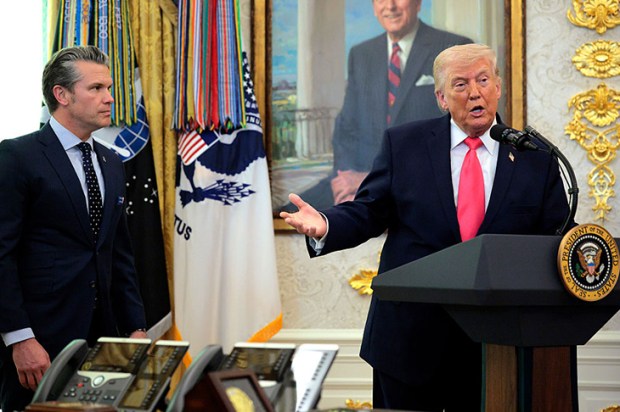
Sir: I was struck by the dichotomy of your 21 March issue. Christopher Caldwell describes President Donald Trump’s world-affecting miscalculation in attacking Iran (‘The end of Trumpism’), while the editorial exhorts us to climb aboard this runaway train to ‘finish the job’. The conflux of multinational involvement in this fiasco is already reminiscent of the tumbling dominoes of August 1914. Underlined by three colliding religions, the scale is now much larger and touches the entire planet. The Americans, for whom the ‘special relationship’ is skin-deep, made this bed and should lie in it, not us.
J.B. Cowper
Taplow, Bucks
Net loss
Sir: I fear Michael Gove underestimates the extent of Ed Miliband’s malign influence (‘The Miliband supremacy’, 21 March). It is clearly felt in Scotland. Ministers here have just upheld on appeal a decision of Edinburgh council to refuse permission to a householder wanting to make his flat available for short-term lets. The quoted grounds for refusal were that the flat might be used by overseas visitors whose travel would have an adverse effect on net-zero ambitions. Moreover, such visitors would probably use more laundry than permanent residents (the grubby Scots?) and that too would prejudice net zero.
Peter Mackay
Kincraig by Kingussie
Classic error
Sir: Harry Mount’s article about the decline and fall of classics teaching (Spectator Schools, 14 March) is correct. There are several factors at play. In the mid-1960s, university departments such as modern languages and English literature dropped O-level Latin as a requirement for acceptance, while head teachers find it difficult to allocate resources to a handful (at best) of pupils choosing A-level Latin. Additionally, many parents see no point in Latin (‘No one speaks it any more’).
While it is true that the teaching of classics is on life support, one could argue that a similar fate awaits English literature as year on year the number of A-level entries declines; modern languages are similarly in peril as AI or Google Translate become the preferred alternative. The warning signs are all too evident for university departments.
Terry Carter
Edlesborough, Bucks
The long view
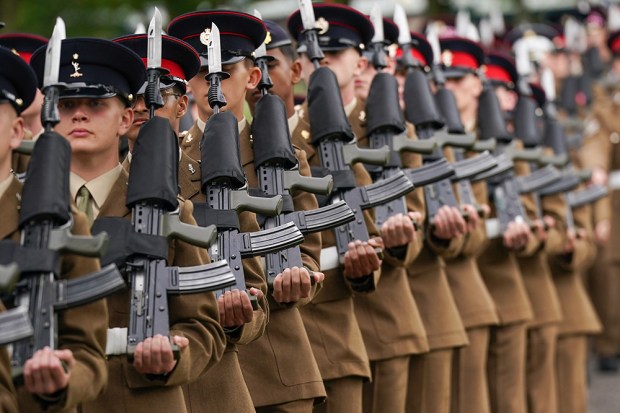
Sir: I have had the honour of being commanded by General Sir Michael Rose and the good fortune to be one of his students at the Army Staff College, Camberley, when he was commandant. The ‘ride’, on both occasions, was exhilarating to say the least. So was his article (‘Battle softened’, 21 March) about what makes for an effective fighting force. But his piece does contain, dare I say it, the odd misfire.
I do wonder if serving army officers share his doubts about soldiers’ willingness to destroy the King’s enemies, if required. Not in my regiment, the Fusiliers, I think, nor in others. If there are doubts about ‘diversity and inclusion’, it is more likely these concern the struggle to look after our female soldiers and ensure they can serve their country with pride, without being subjected to intolerable abuse.
General Rose also highlights the high level of Commonwealth personnel. The rule of thumb used to be no more than 15 per cent Commonwealth recruits, based on the ability to integrate those from different cultures. So if the figures are considerably higher than that, as General Rose reports they are in the Coldstream Guards, there is indeed an issue. How we respond is crucial.
We should recognise firstly that throughout history the ethnic make-up of even very English regiments was ‘hideously diverse’: during the Napoleonic Wars, it was said that the ‘lingua franca’ of the army was Gaelic. Secondly, I would ask what it is about current military service that makes it so unattractive to potential British recruits. Pay, conditions, equipment, of course; but the moral intangibles must also be addressed, the need for a sense of deliverable purpose and national pride in service.
General Rose’s greatest strength as Staff College commandant was his openness to debate and challenge. I hope he will accept my points as proof of how excellent a teacher and leader he was.
Colonel (Retired) Simon Diggins
Tring, Hertfordshire
Hold your fire
Sir: With the respect due to an officer of General Sir Michael Rose’s senior rank and distinguished service, he misses one significant factor that constantly chips away the morale component of the army’s fighting power: the pernicious effect of veterans telling anyone who will listen that everything in the modern army is terrible and that it was all much better in their day. Neither is, in fact, the case.
Major William Dunlop
Shaftesbury, Dorset
Degree of wonder
Sir: Lara Brown’s analysis of the financial benefit or otherwise of a university education appears to ignore the fact that going to university almost always enriches lives (‘Gown and out’, 21 March). I was elevated out of a dull secondary education in a dreary suburb and thrust into a world of imagination, enquiry, discipline and sheer wonder at the beauty, power and glory of mankind’s works. I never earned a king’s ransom, but every day since has been enriched by those four years of simply reading, thinking and listening.
David Edwards
Norton-sub-Hamdon, Somerset
Battle royal
Sir: Rory Sutherland was right to call the American Declaration of Independence ‘one of the whiniest publications in history’ (The Wiki Man, 14 March). One of its louder complaints – the supposed tyranny of George III – rests on a basic constitutional muddle. Many of the Founders took their understanding of the English constitution from William Blackstone, who wrote elegantly of the Crown’s powers in law. What they failed to grasp was the political reality: by the mid-18th century, those powers were exercised by ministers dependent on parliament, not by the King.
Having thus conjured a royal bogeyman, they overthrew him, only to construct a presidency more potent than the monarch they claimed to resist.
Jonathan Roland
Sale, Cheshire
Peer pressure
Sir: Several of your columnists have expressed regret over the exclusion from the House of Lords of hereditary peers. Conservatives in public life tend to eulogise whatever part of our constitution or heritage is currently under attack from the leftist wrecking-ball on the assumption that all such attacks are irreversible. If these opinions had been expressed not as regrets but as feisty defences since 1999, the elegies might not be needed now.
If you think hereditary peers should be part of the House of Lords, make that case and sell it, with the aim that the next conservative government (of any party) will add this constitutional vandalism to its list of things to repeal. After all, in England’s history we have something better than an unbroken constitutional tradition. We have a Restoration.
Lucy Healy
St Albans
Got something to add? Join the discussion and comment below.
You might disagree with half of it, but you’ll enjoy reading all of it. Try your first month for free, then just $2 a week for the remainder of your first year.