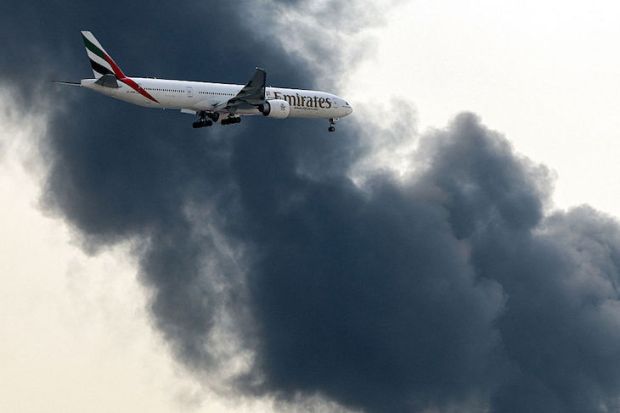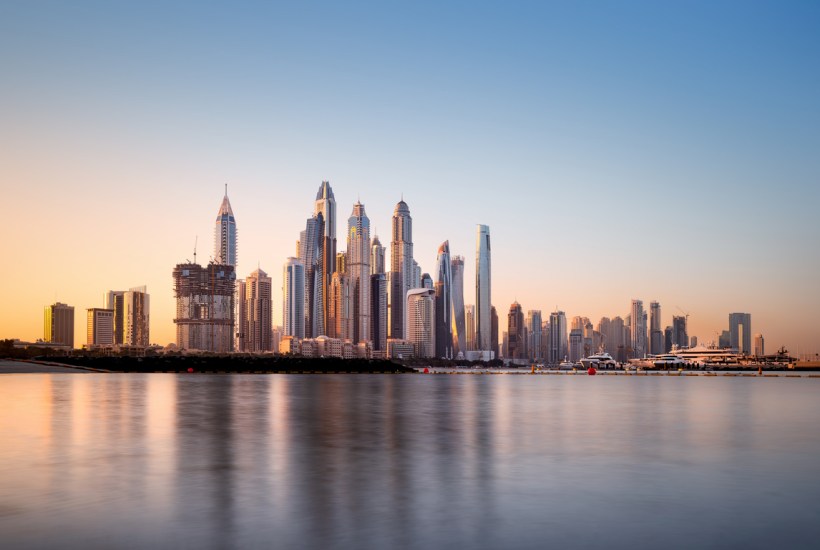
As the Islamist regime in Iran attacks Dubai, Abu Dhabi, Riyadh, Bahrain and Kuwait with drones and missiles, some in Britain are quietly happy to see the Gulf’s skyscrapers lose their shine. ‘Dubai has no culture or history,’ say the armchair critics. Is this British bitterness caused by contempt of a former colonial power? When it comes to measures of wealth preservation, attracting millionaires, rule of law, social safety, artificial intelligence adaption and combating Islamist radicalism, the UAE comes out far ahead of the UK. But being British, we can’t acknowledge this, so we insinuate our snootiness is about culture, history, risks and future stability. The snobs are wrong.
We insinuate our snootiness towards Dubai is about culture, history, risks and future stability. The snobs are wrong
When Islamists hounded me out of England, I found two new homes: America and Arabia where I spend three months of the year. My Saudi maternal cousins teach in the Prophet Mohamed’s mosque in Medina. My partner, an Emirati, is from Dubai. In Arabia, I have found a people and a place that is unknown to those who come in and out with business cards for quick deals. An old chivalric code, adab, or etiquette, informs people’s interactions.
The UAE has taken inspiration from the classical and enlightened Islam of the great philosopher-jurist, Sheikh Abdullah bin Bayyah. This has not only been effective in all but defeating Islamism, it has also allowed culture to flourish.
There is a Louvre and Guggenheim in Abu Dhabi and a museum of the future in Dubai – all public testaments to a private culture of art and debating ideas.
This applies as much to individuals. Take Zaki Nusseibeh, a polymath with one of the largest private collections of books and modern Arab art. Zaki is now the cultural advisor to the president of the UAE, Sheikh Mohamed bin Zayed Al Nahyan.
The house of Al Nahyan traces its lineage back to the time of the Prophet. Sheikh Zayed, the founding father of the UAE, often talked about how his ancient ancestors converted from Christianity to Islam. Just as Egypt’s history is in its hieroglyphics, Arabian tribes and families maintain the history of the region with its oral traditions, the noble lineages of the desert.
The social contract here with people is different. Consensus is gained at the majlis, the regular gatherings of the rulers and the ruled. The sheikhs rarely grant newspaper interviews: the ethos is different, less needy than democratic politicians seeking validation. Wilfred Thesiger’s Arabian Sands captured some of this secrecy. Leading members of the house of Al Nahyan have intentionally cultivated a culture that brings to the fore talent like Zaki.
Noura Al Kaabi, a cultural icon among younger Arabs, has led the reconstruction of cultural heritage sites in Iraq and Lebanon that were destroyed by war and terrorism. With a combination of wisdom and warmth, from her ministerial position she has cultivated love for the arts across the region by fostering Arabic language, music, opera concerts, and new galleries.
Yasser Hareb in Dubai, a friend of Paulo Coelho and the late Pope, has written a string of bestselling books, and is now a successful film producer. He is a rare intellectual who in conversations moves from Aristotle to Heidegger with ease, referencing great Arab minds like Averroes and Ibn Khaldun as though he were with them.
Sultan Saoud Al Qasimi is an art collector in Dubai. The founder of the Barjeel Art Foundation, which houses 1,200 contemporary works by Arab artists, he has lent to British galleries. Sultan has mentored hundreds of young artists in Arabia and beyond. His presence and incessant sense of enquiry has led to him teaching a semester at Harvard. Need I go on?
Lest we forget, it was Arabia that produced Andalusia – eight glorious centuries of Muslim Spain from which the minds of Aquinas and Maimonides helped birth the European Enlightenment. This is not my claim, but that of the late great Rabbi Lord Jonathan Sacks.
Dubai was part of a medieval trading route from the ninth and eleventh centuries, evidenced by oral history and archeological sites in Jumeirah. A church and monastery from the seventh and eighth centuries found in Sir Bani Yas island confirms this in Abu Dhabi. Qasr Al Hosn, the ancestral home of the house of Al Nahyan since the 1790s, has artefacts dating back to 6000 BC. But Dubai is not about the past, but the future.
This cosmopolitan inheritance of the UAE fosters a business ethos. Christians, Jews, Hindus, Muslims, Sikhs and atheists trade freely. Temples, synagogues, churches, and mosques are not far from bars and clubs. Let the individual choose. Islamist Iranian bombs cannot destroy a Dubai where Sheikh Mohamed bin Rashed Al Maktoum has carved a culture of competition and survival, but also generosity of heart. His go-to phrase, ‘nothing is impossible’, reflects the ambitious hustler culture I see in both New York and Dubai.
The UAE, despite the war, is standing by the United States. Rather than being a bitter ex, Britain should join the fight and bet on an ever-greater Dubai.