This month marked the two-hundred-and-fiftieth anniversary of Adam Smith writing what remains one of the most thorough demolitions of bad economic thinking ever committed to paper. The timing is exquisite, because Australia’s political class has decided that doing precisely what Smith argued against constitutes good economic policy.
Across the major parties, a consensus has quietly solidified in Canberra. Australia must make things. Manufacturing is cool again. The Future Made in Australia agenda, dressed up in the language of Harvard Economic Complexity analysis, tells voters that if the government simply subsidises the right industries, the nation can clamber up the economic ladder and out-compete the world. It is the kind of thinking that sounds sophisticated until one realises it has already been tried and repeatedly failed.
The Harvard Economic Complexity Index deserves a word. A favourite of the neo-central planner, it is a product of the Harvard School of Government, not the Harvard School of Business. It tells a reader what a country already does and how complex those activities are. It does not tell a reader what is commercially viable, what a real market would finance, or whether any identified opportunity could survive without a government subsidy attached. It measures complexity. It does not measure viability. Using it to guide Australian economic policy is as rigorous as using a horoscope to set interest rates.
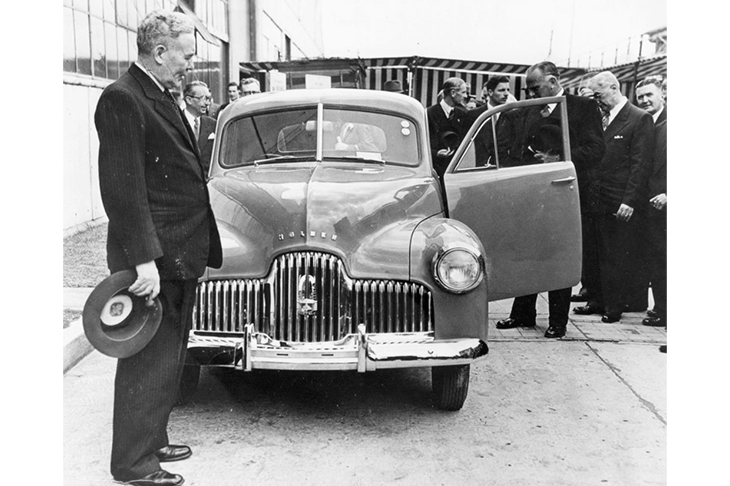
But there is something deeper at work than a bad idea. There is nostalgia. There is a definite misty-eyed quality to the policy conversation, a longing for the hum of factory floors. The thunder of V8s rolling off Broadmeadows and Elizabeth production lines, Simpson washing machines and Kelvinator fridges rolling out of Adelaide and Orange. All of it occupies a sacred place in the national memory. The same golden haze settles over the clothing and footwear factories where workers spent their days hunched over machines in deafening sheds, breathing fluff and dye, returning home with ruined backs and fingers worn to the bone. Labour that was genuinely hard and often dangerous.
Politicians are sighing wistfully about the 1950s, 1960s and 1970s as though those decades represent some golden template that modernity recklessly discarded.
A gentle corrective is in order. Australian-made cars were, by any objective measure, comparatively unreliable and expensive. They burned oil, leaked when it rained, and rusted through before the warranty expired. This was not a secret. It was the verdict of Australian consumers themselves, who, when offered a choice, chose not to buy them. The lesson of the Australian car industry is not that government abandoned it prematurely. The lesson is that government subsidised it for far too long, propping up a product the market had already reviewed and politely declined.
The whitegoods and clothing factories by and large made decent products. The problem was cost. Behind tariff walls, labour and capital were locked into industries that could not survive open competition. When those walls came down, both were freed, redirected into the industries and services that built modern, prosperous Australia. That is not a failure story. It is precisely how structural reform is supposed to work.
Now there are serious people in this country, people with big titles and big offices and taxpayer-funded staffers, who dream of restoring the days of factories and smelters. One simple question invites itself: who exactly is going to work in these places? What chance is there that any of the central planners designing this industrial renaissance have earmarked their own children for the night shift?
Australia already has a quiet crisis in farm succession. The next generation simply does not want to take over the family farm, even when it represents a direct inheritance. If young Australians cannot be persuaded to run a property they stand to inherit, it strains credulity to imagine them lining up to ladle molten metal, spot-weld body panels, or hunch over an industrial sewing machine in a government-subsidised facility that exists primarily because a minister needed a good press release.
Which brings us to the National Reconstruction Fund, the $15-billion taxpayer slush fund through which the government has chosen to operationalise its industry policy hallucinations. In practice, the NRF has become a plaything for politicians and overpaid bureaucrats to reward projects that photograph well and carry the warm glow of national iconography, regardless of whether those projects can stand on their own feet or whether Australia has any particular advantage in producing them.
Exhibit A: the NRF contributed $45 million to the refinancing of Arnott’s, a company owned by American private equity giant KKR. The official announcement celebrated this as helping to take Tim Tams to the world. What it actually represented was Australian taxpayers joining over 150 other lenders in refinancing the existing debt of a foreign-owned biscuit manufacturer.
Then there is the $36-million loan to Patties Food Group, the Hong Kong-owned maker of Four’N Twenty pies which received public funds to modernise pie production. One searches in vain for the compelling national interest argument that places meat pies alongside sovereign defence capability or fuel security.
This is mercantilism. The belief that national wealth derives from making and exporting things, from the state picking winners, from protecting industries against the indifference of the market. Smith demolished this argument in 1776. History has since done the demolition again, repeatedly, with empirical force. Mercantilism enriches the protected. It impoverishes everyone else. The costs are diffuse, spread across millions of taxpayers. The benefits flow to industries lucky enough to attract ministerial affection and a good origin story.
Smith did allow an important qualification. Defence, he wrote, ‘is of much more importance than opulence.’ Strategic capacity can justify intervention, and there is a legitimate conversation to be had about national security and sovereign industry. Fuel, fertiliser, defence manufacturing: these are areas where a serious government might make a sound argument for keeping production onshore, and that conversation deserves to happen honestly. But Australia has not had a serious government for over 25 years, and these industries have been allowed to wither accordingly.
The difference between genuine strategic industry policy and what the Australian government has been doing is the difference between protecting a country and working a media cycle. One is hard, unglamorous, and requires a government willing to make enemies. The other requires a ministerial office, a press release, and a bias for spending other people’s money. For a quarter of a century, Australia has known which one it got.
Got something to add? Join the discussion and comment below.
Dimitri Burshtein is a Senior Director at Eminence Advisory. Peter Swan AO is professor of finance at the UNSW-Sydney Business School.
You might disagree with half of it, but you’ll enjoy reading all of it. Try your first month for free, then just $2 a week for the remainder of your first year.