Sunday marks what would have been the 100th birthday of Kenneth Williams. It’s tempting to try to imagine what he would have been like had he lived longer, though the absurdity of our age might have been beyond even his acid observation. That’s perhaps the most interesting aspect of Williams: he can’t be imagined in the present day at all. As recent as his lifetime was, it was one so utterly bound by the 20th century as to feel distant.
How so? Well, his critics would point to the Carry On films. A young and serious acting talent, coached in Shakespeare by Olivier no less, was wasted, so the argument goes, on trivial smut, consigning him to perma-residence in the world of Ted Heath and the Wombles novelty record. Even ITV, hardly a broadcaster known for its weighty intellectual content, now puts a warning for ‘stereo-types that might cause offence’ on some Carry Ons. Williams himself claimed he couldn’t stand innuendo: ‘If I see one in a script,’ he said, ‘I whip it out immediately.’
The actor claimed he couldn’t stand innuendo: ‘If I see one in a script,’ he said, ‘I whip it out immediately’
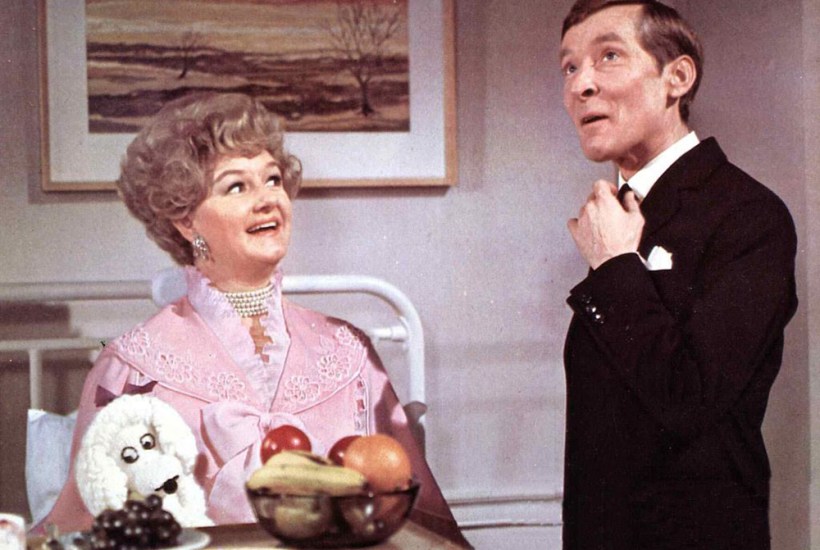
Of course, this argument does not do the Carry Ons justice. They have considerably better wordplay than almost any contemporary comedy. Williams’s voice helps: his ability to go from lugubrious RP to nasal cockney scold, even when playing an Indian maharajah or an agent of the French Revolutionary police, adds to the joy of it all. His delivery, like that of any genuinely brilliant actor, was transformatory. His most famous gag – ‘Infamy, infamy, they’ve all got it in for me!’ – had been trotted out by Denis Norden some years before Carry On Cleo, yet it was Ken’s delivery as the camp, selfish and cowardly Caesar that elevated it to legendary status.
The films are clever, absurd and supremely funny. Just watch any love scene between him and Hattie Jacques; she, a borderline sex addict, playing a prude and he, a fussy homosexual, playing a lustful heterosexual. Williams was not an actor who burdened his audiences with identity or politics; most of what we know of his private life comes from his diaries. Those Carry On love scenes aren’t just funny, but all the more human given the tortured lives many members of the ‘gang’ had to lead.
Speaking of members, Williams became associated with a particular genius of getting humour past the censors. He excelled doing this through his characters of Rambling Syd Rumpo and ‘Sandy’ in Round the Horne. The brilliance came from not saying anything filthy at all but using either nonsense words, such as when Rumpo talks of his ‘nadgers’, or by winking to the audience, such as when Julian and Sandy talk of having ‘a criminal practice which takes up a lot of our time’ while running a firm called ‘Bona Law’. Williams brought this talent to the Carry Ons, which, despite their reputation, are at their best when the jokes are implicit, not explicit. When it really breaks down is when the smut becomes overt – as in the inexorable late Carry Ons: Behind (1975), England (1976) and Emmanuelle (1978).
The power of inference (as in Carry On Dick when informed by a lady that Turpin ‘took my most prized possession’, Williams replies ‘oh come, my lady, surely that went years ago’) is why intelligent people often love the Carry Ons. I know a Rhodes scholar who, when asked if he had a favourite, replied ‘Carry On Up the Jungle’ after a nano-second’s hesitation. This implicit trust that the audience will be both clever and smutty enough to get the joke is another thing which makes Williams’s oeuvre seem so alien today.
Williams was also a fantastic raconteur – another lost skill, as anyone who has watched Miriam Margolyes tell horrible stories and be lauded for it will know. He was a reflective man, with a melancholic, anarchic side, as his diary entries reveal. The British comic sensibility often has this darkness. It’s there in Waugh and Saki, in Jack Point from The Yeoman of the Guard and in Malvolio’s discordant misery at the end of Twelfth Night as the other characters celebrate. You can trace a direct line from Malvolio to Basil Fawlty, David Brent and Mark Corrigan, via Kenneth Williams. Unhappiness and the bringing of joy have a long and intertwined history.
This saw its apex in Williams’s performances on chat shows, especially Parkinson. Nothing will make you feel we have lost something very profound in the world of light entertainment more than watching his sensational reading of Betjeman’s ‘Death in Leamington’, given with Maggie Smith in front of the poet himself. The eloquence of his 1973 Parkinson appearance is striking, not just of the panellists, but also of the well-informed, thoughtful audience. Despite a preponderance of university degrees, it would be impossible to assemble a group of random people for such a high-level public conversation today.
Williams had no such privileged education. He grew up in working-class King’s Cross with a social life centred on the still gloriously unreconstructed Boot pub. He was apprenticed to a map-drafting business in Holborn and then went to the Far East for the war. Yet he was intensely cultured and intellectually curious – a proud autodidact.
Perhaps that is why many modern actors and critics look down on Ken, because he represents a tradition so alien to now: a conservative, self-taught, working-class man who made things people actually wanted to see and lived to entertain rather than hectoring audiences through art. He is so distant from the typical actor we see on the chat-show sofa today. It speaks to what is lost that, unlike, say, Olivia Colman recently, it would never have occurred to Williams that it would be interesting to tell the public that he identified as a gay man.
There are still, just, fragments of the world of Kenneth Williams by which one might honour him – a trip to the Boot and a Carry On session.
Got something to add? Join the discussion and comment below.
You might disagree with half of it, but you’ll enjoy reading all of it. Try your first month for free, then just $2 a week for the remainder of your first year.