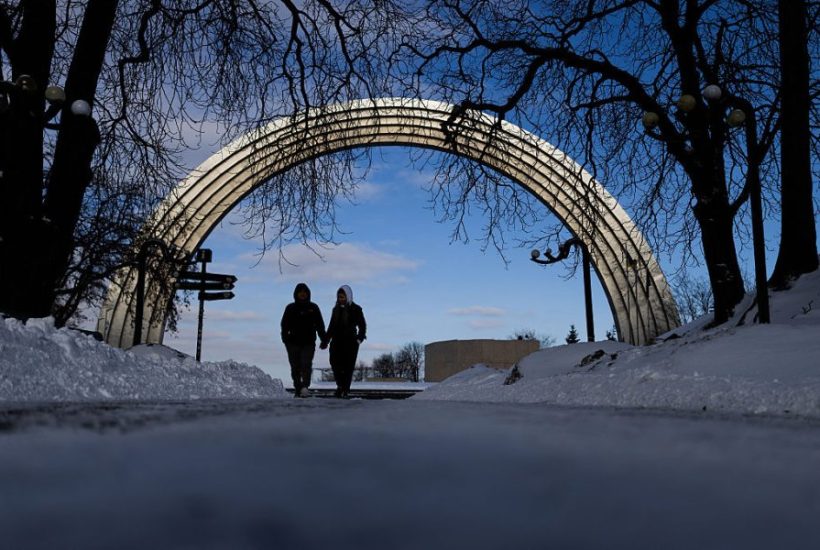
People say love develops more quickly in war – because in a world where anything can happen, what is there to lose? Single and in Kyiv for a while, I decide to swallow my distaste for dating apps and start swiping.
The first thing I notice is how many men are from Turkey and based a thousand miles away. How would this work? I decide to focus on the local ones and start chatting to a couple of guys. One seems reasonable if a little forward. He suggests meeting pretty quickly, then calls to chat. I don’t really know Ukrainian norms but frankly, hearing someone’s voice gives me faith that they are real.
Dima is a lawyer. We arrange to meet at a metro station at seven the next evening. He has made peach ice cream and is going to bring some. A meeting feels like a good start. In London, men I match with seem to use dating apps to temporarily replace loneliness with small talk, rather than to find actual partners.
The good men in Ukraine are impressively chivalrous
The texts don’t stop. I don’t mind but struggle to find much to say to a man I have never met. He sends me music, tells me he was born in Donetsk, then sends me a PDF of poetry he has written. I’m reminded of that phrase about love burning brightly and then burning out quickly.
I pause when he asks me for a selfie. I don’t know what exactly he’s after but I don’t feel particularly comfortable so I bat it aside. In the morning, a picture comes of him lying in bed. Not naked or anything, just in bed. From my limited and patchy experience of dating apps, I cannot quite comprehend why someone (anyone) thinks this view of themselves is ever appealing. Do men know that this is an instant turn-off? Should they be told?
I decide to dodge the bullet again and send him a picture of the view outside my flat. He says something neutral but the texting slows. I relax and get on with my workday.
Given we arranged a public spot and in the spirit of meeting new people, I decide I’ll go. ‘I’m on my way,’ I text as I leave. I spend the journey chatting on the phone and don’t notice that the allotted time has lightly passed. I try to call Dima. He hangs up. I call again and he hangs up. I text him a message of three question marks and call again. He hangs up.
At this point, I’m surprised that he starts typing. ‘I am where your picture is.’ For a split second, I panic. Has he actually geo-located the view from my window and turned up in front of my house? ‘I was expecting normal communication but you sent me nothing so I have made other plans.’ I relax because it doesn’t sound like he’s a creepy stalker, just a bit of an arse. I block him, obviously.
I have a brief interaction with a man who only wants to meet inside his car. I decide not to pursue this one.
I quickly discover the texting shorthand. Agreement is ‘+’ or ‘++’, and smiley faces don’t have a colon for eyes, just a bracket. Efficient. I adapt so I don’t stand out as an outsider.
The first man I meet in real life is avoiding conscription and hasn’t left his residential complex in four years. The complex has cafés, shops and a school, but all the same, it must be a claustrophobic existence. I wonder briefly if this is a shortcut for inviting women to his bedroom, but he suggests meeting in a café and calls me beforehand, which admittedly, has not turned out well so far. Mostly, I’m curious.
I ask him how he manages to avoid the police if they come looking for recruits. ‘I know everyone around here and notice anyone who doesn’t fit in. And I can run more quickly than anyone else,’ he says, missing the modesty.
I ask why he avoids fighting. ‘Everyone comes out either injured or dead,’ he says. ‘It’s an industry of death.’ I try to suggest that some people have been fighting for many years. ‘Very few. And anyway, you can’t control that,’ he says. It’s hard to argue with him but I also wonder whether anybody really wants to fight when they go to the front.
Sitting indoors, he has come to the conclusion that he wants to be a father, and quite aside from any romantic connection, he is using the dating app to meet a co-parent. ‘How long do you think it would be appropriate for the child to be with one parent before moving to the other?’ he asks. ‘How about once a month?’ Even given what little I know about healthy environments for raising babies, I find this unnerving.
‘I don’t think looking after a child takes much effort,’ he goes on. We never speak again.
I give up and decide to meet up with a girlfriend and she is a little horrified. ‘Girl, I’m sorry you had such bad experiences.’ She advises me to try a different app.
My next date is more auspicious. He brings a paper bag of macarons and apologises for not bringing flowers. The good men in Ukraine are impressively chivalrous. They help you to put on your coat and give you their hand when you climb out of a car. But Vlad is on leave from his army unit in Sumy and goes back to the front at the end of the week. He will next be in Kyiv in six months’ time.
It certainly doesn’t seem easier to find love in Ukraine. But given everything that’s happening here, and how many are fighting, I find it incredible that I manage to meet more men in person. War changes a lot of things, but it doesn’t stop people from doing the most fundamental things. Searching for love is one of them.