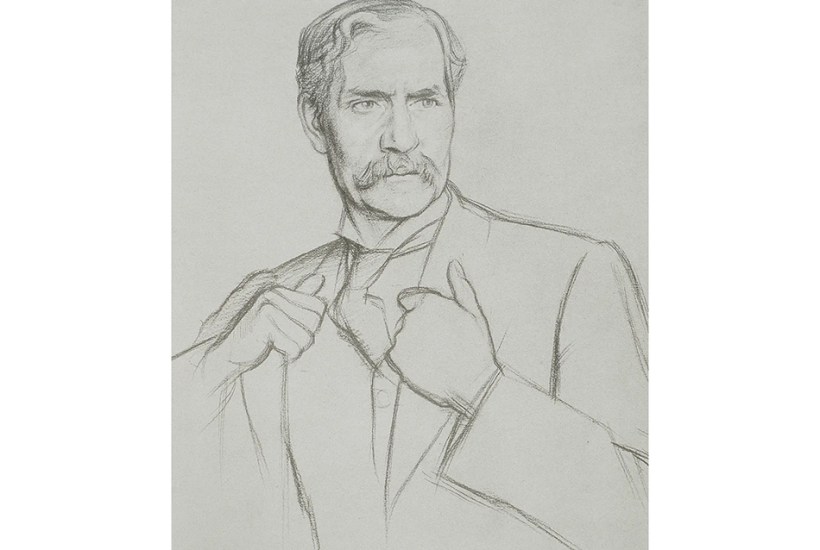
The subtitle of Walter Reid’s biography of James Ramsay MacDonald refers to ‘the extraordinary rise and tragic fall’ of Labour’s first prime minister. The rise was not especially extraordinary. In the first decades of the 20th century several people from relatively humble backgrounds – David Lloyd George and John Burns from outside MacDonald’s party, and Philip Snowden and Arthur Henderson (to give just two examples) from within it – reached the top or very near the top of British politics. But did MacDonald have a tragic fall?
He was prime minister for six of the last eight years of his life; a cabinet minister to within six months of his death; and only left then because he was in his 71st year and in poor health. He turned down a peerage and the Thistle. If all that constitutes a fall, let alone a tragic one, then we need to go back to the dictionary.
Reid is generally sympathetic to his subject, and with good reason. Mac-Donald, in the summer of 1931 when he led a Labour administration, behaved heroically in overlooking the narrow interests of his party by forming a National Government with Conservatives and Liberals. Not only was the country running out of money; it was running out of potential creditors. British banks could have failed; Britain could have gone broke; what passed for a welfare system would have failed and, with nearly three million unemployed, there could have been widespread civil unrest. As usual, the Labour party that Mac-Donald led was living in a parallel universe of unreality that never asked where the next farthing was coming from. MacDonald saved the country.
His reward – and I think we are supposed to interpret this as the tragedy – was that his party sent him to outer darkness for this. All but three of his cabinet refused to serve under him and Labour stalwarts still speak of him as a traitor. Aspects of this repudiation upset him; but it has long seemed that he felt he chose the lesser of two evils. Reid depicts MacDonald as a romantic; but he appears to have been hardheaded about his sense of duty. He won the deep friendship of George V, which lasted until the King’s death. One suspects MacDonald, the illegitimate son of a servant girl and ploughman from Lossiemouth, felt at the end of his life that he had done rather well.
Reid tells the story competently, if somewhat superficially. His main purpose would seem to be to assist those with an interest in MacDonald – who, not least because of his central role in 1931, is someone highly worthy of interest – and who either cannot find a copy of David Marquand’s definitive biography or be bothered to read such an epic work. Reid honourably declares his heavy reliance on Marquand’s book and answers the obvious question about why he has written another (and less detailed) biography by saying that it is time for a new interpretation.
However, his interpretation – or perhaps it is better described as a depiction – is one that most intelligent readers could construct from reading Marquand, or possibly even just the Dictionary of National Biography’s entry on MacDonald. All the familiar details of the life are in here: the existence as a ‘starveling clerk’ in London in the late 1880s; the rhetorical abilities that pushed MacDonald to the forefront of the nascent Labour party; and the innate ‘nobility’ that allowed him to mix so easily with his social superiors, particularly with society women.
MacDonald won the deep friendship of George V, which lasted until the King’s death
MacDonald was widowed when he was just 45 and seemed never to recover from his bereavement. Reid dismisses – indeed does not even seem to consider – the idea, extensively floated elsewhere, that Mac-Donald had various mistresses in the years after his wife died. He gives relatively superficial accounts of some of the key elements of his political life: his massive unpopularity for opposing the Great War, but also the means of his rise back to the front rank of the party after it. Neither of his Labour administrations is given the detailed treatment each merits; and the reader senses, when Reid is dealing with the National Government, that he is racing to get to the end of the story.
Generally, the book is insufficiently analytical; indeed, I often found myself wondering what grip the writer actually had on the period. He speaks of Lloyd George being the leader of the Liberal Party after H.H. Asquith’s fall in 1916, but he was not: he did not assume that post until 1926. Reid is somewhat unconvincing when he writes about the economics of the world between 1929 and 1931, or of the politics. Montagu Norman was not away sick when Britain went off the Gold Standard (a feat accomplished by his deputy): he was on a boat sailing back from Canada, where he had been visiting his mother. Perhaps most remarkably, Reid seems to be under the impression that Manny Shinwell (the protégé of MacDonald, who defeated him at Seham in the 1935 general election) was a genial old boy. A reading of histories or of biographies from the Labour movement in this period would have told him that there was a widespread view that Shinwell was one of the nastiest pieces of work in politics.
But then the bibliography is pretty thin, as is any consultation of primary sources outside MacDonald’s own papers. MacDonald merits reappraisal, and the Labour party today should grow up about him and his conduct. Perhaps a bankrupt Britain in 1931 would have brought the revolution of which some in that movement still claim to dream. MacDonald, however, wanted nothing of the sort, and deserves credit rather than condemnation for it.
Got something to add? Join the discussion and comment below.
You might disagree with half of it, but you’ll enjoy reading all of it. Try your first month for free, then just $2 a week for the remainder of your first year.