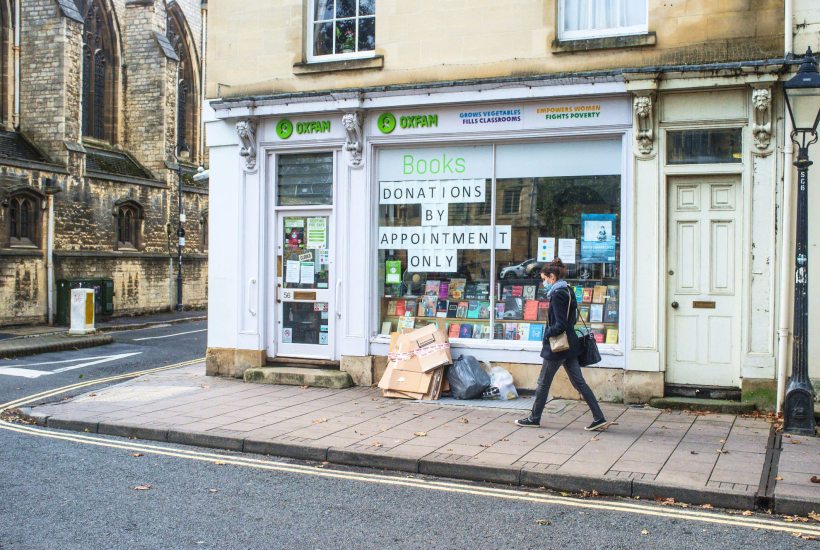
The news that Oxford’s main Oxfam bookshop on St Giles in the city has been threatened with closure is one of the most depressing things I have heard this year. The building’s landlord, Regent’s Park College, has declared that it needs more space for its graduate students. This sums up everything that is wrong both with Oxford University and Regent’s Park, a religious-oriented permanent private hall that I studied at just over two decades ago.
In a city that is largely devoid of good places to buy books, it is a bastion of high-quality stock and knowledgeable staff
Despite the presence of some brilliant tutors and a distinguished cast of alumni – which includes the creators of Industry, the current Times diary editor Jack Blackburn, the journalist Flora Gill and Princess Diana’s goddaughter Alexandra Knatchbull – Regent’s Park was always a place where it seemed that the bottom line loomed larger than at other, rather more celebrated colleges. There was a certain cruel irony that it is situated opposite St John’s, Oxford’s wealthiest institution (there is a famous, though no doubt apocryphal story that you could walk from St John’s Oxford to St John’s Cambridge and never leave land owned by one college or the other).
Regent’s Park has now decided that the Middle Common Room (MCR) must expand – no doubt because graduate students bring in a decent amount of money per capita – and that if this results in the ejection of the first Oxfam bookshop, too bad. A proposed planning statement huffs that, ‘The university has drawn attention to the importance of suitable, inclusive facilities for postgraduate students, and the college must respond. The proposed use of the ground floor and basement of No. 56 St Giles represents the only viable option to provide a fit-for-purpose MCR and dedicated postgraduate study space that meets current needs and enables a vastly improved student experience.’
It has not gone unnoticed that the nearby Eagle and Child pub, which was my de facto local as a student, is having a vast amount of money spent on it courtesy of the American billionaire Larry Ellison and his expensive decision to hire Foster + Partners to remodel it. Alas, there is no plutocrat likely to sweep in to rescue both Regent’s Park and the Oxfam bookshop, so in the absence of a bibliophile white knight, it seems inevitable that a shop that has given enormous pleasure (as well as the opportunity to spend considerable sums) to many may be meeting its Waterloo sooner rather than later.
Spectator readers with reasonable memories might now be saying, ‘But Mr Larman, didn’t you write a piece last year expressing your irritation with the Oxfam St Giles after they refused to sell you some Nancy Mitford first editions at the stated prices?’ I did indeed, and you may read it here. But I have made my peace with the bookshop, if not necessarily the wider charity. In a city that is largely devoid of good places to buy books (the equally excellent Blackwell’s Rare Books, aside), it is a bastion of high-quality stock and knowledgeable staff who charge fair prices for the kind of tomes that you simply cannot find elsewhere in the city.
If you want a first edition costing hundreds of pounds – at the time of writing, you can buy Virginia Woolf’s To the Lighthouse or Kazuo Ishiguro’s A Pale View of Hills – then you won’t be disappointed. But it’s also a place with an excellent and rather more affordable assortment of everything from Anthony Powell to Dickens, a civilised atmosphere and volunteers who will happily offer literary recommendations (and good ones, too) drawn from their own extensive reading before you can say, ‘Call me Ishmael’.
Yet such bookish pleasures may well pale in comparison to the need for Regent’s Park’s MCR to gobble up more space. Oxford has another (in my humble estimation, inferior) bookshop on Turl Street, so perhaps the two establishments might merge if the original and best is to be rendered homeless. But it would not have the same atmosphere. And if this horror comes to pass, it will represent another depressing step in Oxford becoming a less pleasant and less convivial place to live: from the city of dreaming spires to a backwater of insomniac, and decidedly unbookish, inanity.