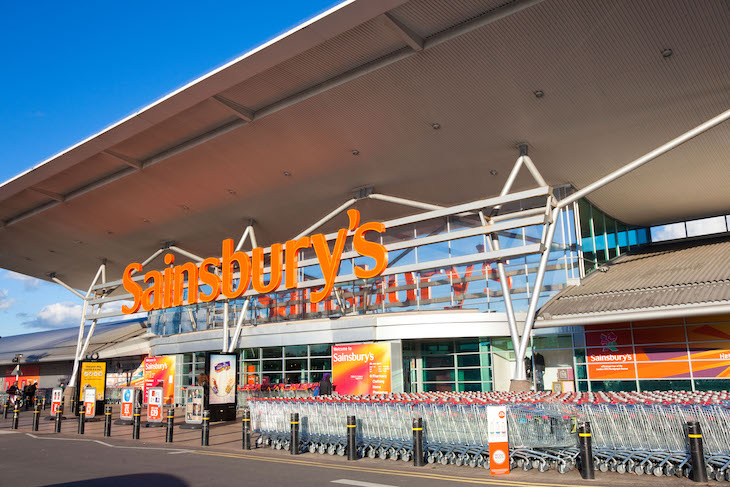
Supermarket customers in Britain are part of a growing experiment in surveillance. After an eight-week trial, Sainsbury’s has made live facial recognition permanent in a big south London store. That shop, the hypermarket in Sydenham, is not far from where I live. I donned a low-brimmed hat and a Covid mask and went to see.
Supermarket customers in Britain are part of a growing experiment in surveillance
I expected only small notices in the windows to alert customers to the presence of the biometric cameras, and so was pleasantly surprised to find both doors of the main entrance flanked by large stand-alone signs explaining the policy. But it soon emerged that the customers walking past the signs were generally unaware that their faces were being scanned and converted into biometric data held by a third party.
Of the half-a-dozen people I spoke to – both male and female and of a range of ages – only one, a young woman who said facial recognition had put her off shopping in Sainsbury’s ‘a bit’, knew about the new surveillance system. Two exiting customers seemed unbothered, but three going into the store said they were unhappy about it. ‘It’s makes me feel strange here,’ said one woman emphatically, tapping her chest. ‘It’s horrible the way everything’s becoming.’
Given the customers’ lack of awareness, I wondered if Sainsbury’s staff were ready with explanations. What happened to my biometric data once it was captured? How was the collection of my personal data consistent with the GDPR requirement for explicit consent?
Inside the store, the first member of staff I approached seemed a little confused about what she called ‘social recognition’ and called a manager. The fifteen minutes I waited gave me a good chance to survey the white cameras that hung over the entrance barriers and consider whether I missed shopping in the once-familiar aisles of what used to be my favourite supermarket.
On arrival, the manager enthusiastically assured me that the supermarket didn’t keep my data. But then the conversation ran aground. For more information, she told me, I would have to scan the QR code on the signs. As I don’t use a smart phone, that was no help, so I left.
The trial of facial recognition began in the Sydenham hypermarket and a small store in Bath Oldfield Park in September 2025 with the company Facewatch installing the technology. In January, Sainsbury’s bosses declared themselves delighted with the results, citing a ‘seismic’ fall in theft. There had been a 46 per cent reduction in logged incidents of theft, harm, aggression and anti-social behaviour, they said, and 92 per cent of offenders did not return. The supermarket chain is now trialing the technology in five more of its London stores.
Facial recognition in British shops is a recent thing, dating back to October 2023 with the launch of Project Pegasus, a business and policing partnership aimed at tackling retail crime. As Silkie Carlo has pointed out in The Spectator, in most democratic countries, live facial recognition in shops is considered unlawful, and the Spanish data watchdog fined a supermarket €2.5 million (£2.2 million) for using it. But in this country it looks as if we’re engaged in a typically British fudge. The use of personal data is governed by data protection law and GDPR regulations so strict – consent must be ‘freely given, specific, informed, and unambiguous’ – you would think that biometric surveillance in public places would be illegal.
Yet the Information Commissioner’s Office has ruled that facial recognition can be lawful if used to detect and prevent crime, provided organisations conduct a Data Protection Impact Assessment. Reading through the ICO’s checklist, it’s easy to see how a corporation with lots of resources could easily carry out what is essentially a bureaucratic exercise and make mass surveillance ‘all right’.
What is harder to see, given the low level of customer awareness at the Sydenham Sainsbury’s, is how the chain can succeed in rolling out the technology ‘intentionally and transparently so we can build confidence as we go’, as CEO Simon Roberts puts it. Clearly the supermarket bosses are hoping a softly-softly approach will win customers’ acceptance for a practice generally regarded as dystopian and unBritish.
Their assumption overlooks a deeper issue. The woman who told me of her deep antipathy to being surveyed at the Sydenham store was expressing an instinctual human aversion to surveillance. For decades, supermarkets have benefitted from the warm feelings that come when we obtain the necessities of life from the same familiar environment. Phrases such as ‘the weekly shop’ or ‘popping into Sainsbury’s’ are testament to a relationship in which the customer regards their chosen supermarket as a benevolent provider. Time will tell as to whether those feelings can survive a shift to panopticon-style surveillance.
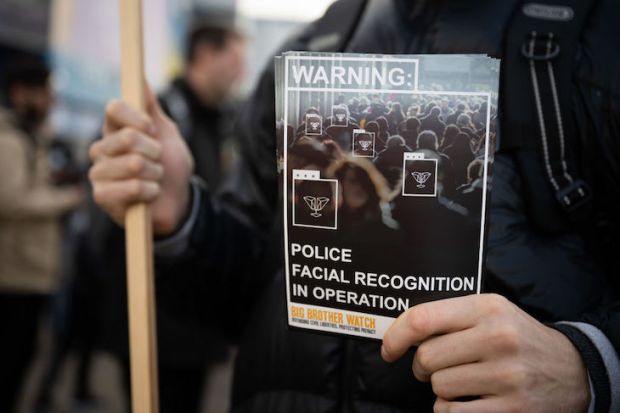
The challenge for Sainsbury’s will be heightened by the possibility of innocent customers being thrown out of the store. No sooner had the company announced the extension of its facial recognition trial than the news broke of a misidentification in its Old Kent Road store. Managers are keen to attribute the mistake to human error rather than a glitch in AI. The suggestion appears to be that more staff training might be the remedy. That is unlikely to be much consolation for customers who have had similar experiences in other shops, sometimes with deleterious consequences for their mental health. Nor does the history of Facewatch, as data controller, inspire confidence. According to Big Brother Watch, in March 2023 the ICO found that the Southern Co-op’s use of facial recognition breached data protection laws in a number of ways, including failing to be transparent and limiting the storage of data.
Experimenting with what Western countries decided is a definite no-no back in the last century doesn’t sit well with me. My visit to Sainsbury’s confirmed that I want no part in the brave new world of supermarket surveillance.