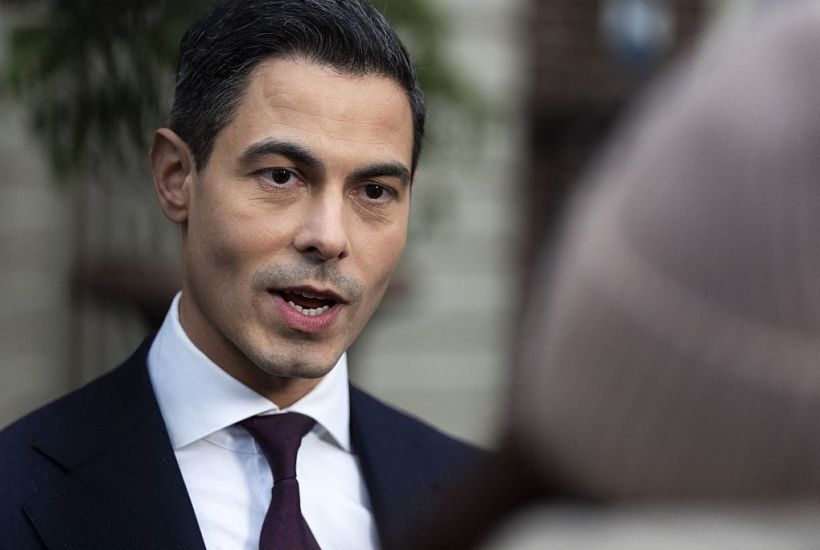
Rob Jetten being sworn as prime minister of the Netherlands would, not long ago, have seemed an exotic proposition. That he does so at the head of the country’s first modern minority government elevates the occasion from unusual to faintly vertiginous.
A cordon sanitaire has been drawn not merely around Wilders but around much of the terrain to the right of the VVD
True, his party, the centre-left D66, finished first in the general election of 29 October, albeit with just 17 per cent of the vote. Yet the coalition he has assembled with the conservative VVD and the Christian Democratic CDA commands the support of just 43 per cent of the electorate. In parliamentary terms it is a minority; in political terms it is a high-wire act. Whether it resolves many voters’ concerns is another question entirely.
The early omens are not encouraging. According to pollster Maurice de Hond, only 27 per cent of voters expressed positive feelings when the coalition agreement was unveiled. Even among the faithful, enthusiasm is muted: 73 per cent of D66 voters approve, as do 72 per cent of CDA supporters, but fewer than half – 46 per cent – of VVD voters are content. It’s hardly a political honeymoon.
As for his political programme, Jetten has pledged to meet Nato’s more exacting defence spending criteria – at a price. A proposed annual €5.2 billion ‘freedom contribution’ will be skimmed from tax adjustments applied to citizens and businesses alike. A whopping €3.4 billion of this additional money will be donated each of the next three years to Ukraine. The rest will provide – badly needed – extra funding for the Dutch defence sector.
Meanwhile, other ‘investments’ are earmarked for climate and agricultural transition: some €20 billion through to 2035 for voluntary livestock buy-outs and related measures, shrinking herds and lowering emissions from the country’s historically strong agricultural sector. More households will be nudged – even compelled – towards hybrid heat pumps. All this as other European governments, confronted with energy insecurity and electoral backlash, tread more cautiously.
Simultaneously, the retirement age will edge towards 70, and the long-frozen annual healthcare deductible – parked at €385 for years – is to rise sharply, potentially to €520 by 2030. Asking the elderly to work longer while paying more for healthcare is not an obviously vote-winning formula. Analysis of the proposed budget changes by the Netherlands Bureau for Economic Policy Analysis (CPB) further provides the opposition with live munitions. Purchasing power, already anaemic, is projected to stagnate, the CPB says.
The opposition scents opportunity. Jesse Klaver, now leading the Green-Labour alliance, laments the burden on lower incomes. Geert Wilders fulminates against higher healthcare deductibles while offshore wind turbines receive largesse. Jetten succeeded in creating unlikely allies of a sort, even before being sworn in.
Just how did we get here? In part through a now deeply embedded culture of political exclusion on the centre-left. A cordon sanitaire has been drawn not merely around Wilders but around much of the terrain to the right of the VVD. Parties deemed insufficiently house-trained were barred by D66 from the coalition. Yet moral hygiene has its costs: sideline roughly 40 per cent of MPs (not to mention their voters) and the parliamentary cake shrinks alarmingly. The VVD reciprocated by freezing out the Green-Labour bloc from the left, further shrinking the cake. The result is a government formed from an ever-narrowing centre, dependent on ad hoc alliances for survival.
But that is not all. Diplomatic amateurism – and therefore potential disaster – is in the air too. Jetten has previously denounced Benjamin Netanyahu as a war criminal and described Donald Trump as a convicted criminal, misogynist and a danger to the world – sentiments that may enthuse party congresses but complicate statecraft. His incoming trade minister (also of D66) appears on a Chinese sanctions list, an awkward fact in a trading nation whose logistics sector depends heavily on commerce with Beijing. The coalition agreement has openly labelled China a threat to Dutch national security, grouping it with Iran and Russia. It has also floated punitive measures – stripping EU funding and voting rights – against Hungary and Slovakia for ‘undermining Europe’. Moral clarity is one thing; commercial and political reality another. Being successful abroad usually involves a fair amount of discretion.
The government’s parliamentary debut this week will be humbling. A sterner test may come at the municipal elections next month, where the VVD in particular could suffer, having passed up an opportunity to press for stricter immigration measures. Yet local elections in the Netherlands have drifted from their national moorings, dominated by hyper-local lists and anaemic turnouts. They are no longer useful as a barometer. At the local level, people have long since begun taking care of themselves and their surroundings.
The VVD may have calculated for potential losses, fielding a crack cadre of battle-hardened ministers to control the finance, defence, justice and security, infrastructure and health ministries. D66 and the Christian Democrats, by contrast, have promoted a crop of relative newcomers. Minority government, however, will demand extensive political skill, patience and an instinct for compromise resembling acrobatics, not to mention a practical attitude instead of being stuck in ideology.
Jetten is wagering that voters will accept higher taxes, longer working lives and ambitious climate spending in exchange for fiscal rectitude, lavish support for Ukraine and international virtue. The parliamentary arithmetic, however, is unforgiving. Opposition majorities could yet force retreats on key measures. To secure even a fragile working majority, Jetten’s most plausible path may lie in discreet co-operation with the Green–Labour alliance – provided tensions with the VVD can be contained – and provided the latter party is willing to take the electoral risk later on.
It is a brave bet for all. Policies may drift even further leftwards under parliamentary pressure. The electorate is restless; confidence in politics hovers near historic lows. Some political observers – the usual suspects – suggest, smiling knowingly, that Jetten’s coalition agreement is merely an opening bid and that concessions to other parties have already been ‘priced in’.
But in the Netherlands it is voters who will be doing the pricing – and they suspect that this first minority experiment is quietly rehearsing its own downfall. Another trip to the ballot box, they feel, may arrive sooner than anyone in the Hague presently admits.
On the other hand, in the unlikely event that Mr Jetten succeeds in his balancing act, his term in office will go down in history as a political masterclass in how to exclude as many unwanted voters as you possibly can.