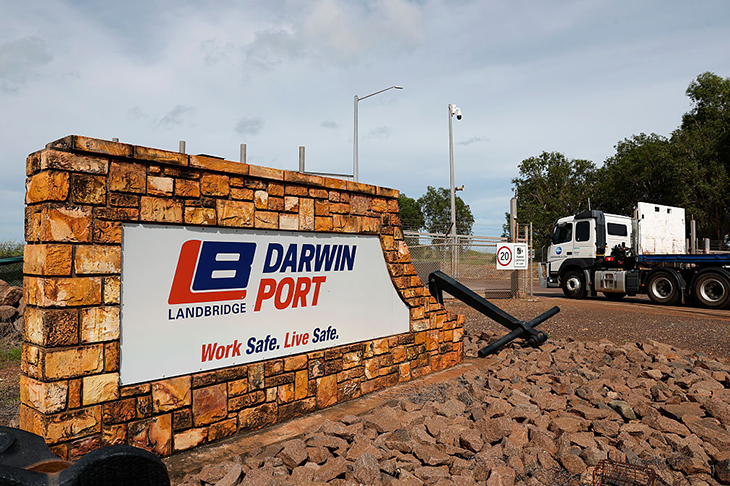
It’s not just about Darwin – but it does explain China’s bullying response to Australia’s bipartisan promises to win back control of the Darwin port’s 99-year lease from the Chinese-owned Landbridge group. Last month saw the first tangible result of a belated realisation in the West, particularly the US, of the urgent need to counter the threat posed by China’s strategic control of key ports (and related shipping routes and supply chains) around the world – a major multi-billion-dollar ‘maritime silk road’ version of its Belt and Road program.
When a newly elected President Trump last year complained that China was in operational control of the Panama Canal by owning the ports at each end, he vowed to ‘take it back’. This January, the Panama Supreme Court annulled Hong Kong-based CK Hutchison’s licence to operate the ports at either end of the canal in a move (hotly contested by China) that the Wall Street Journal described as having ‘broad geopolitical ramifications. It represents a diplomatic defeat for China, as it dents Beijing’s influence in Latin America. It also hands President Trump a symbolic victory for his political and security priorities in the Western Hemisphere’.
Will these two be just the first of China’s 129 foreign port dominoes to fall (apart from those planned for disposal for commercial reasons)? Already there is an expectation that Trump has his sights on the huge 60-per-cent Chinese-owned (with exclusive use for 60 tears) Peruvian port of Chancay, opened two years ago by Chinese President Xi as part of China’s strategic involvement with South America (despite the ‘Donroe doctrine’ of it being the United States’ exclusive sphere of influence). Already the region’s top trading partner, China’s port ownership-control aims at providing guaranteed access to the South American iron ore, copper, battery-grade lithium, soybeans, corn and beef that are essential to its energy and food security.
But the other side of this coin is that China’s domination of maritime trade in terms of volume, shipbuilding activity, and construction and ownership of ports around the world, ‘poses a significant economic and military security threat to the United States’, according to Washington’s Center for Strategic and International Studies. It warns that while investment in port infrastructure around the world is critical to US economic and military security, China has been outpacing the US for years, with its growing network of overseas ports furthering what the Indian Military Review described last year as ‘its ambition to dominate global maritime trade while securing geopolitical leverage over critical shipping lanes’.
‘These investments are strategically distributed across continents – Asia, Africa, Europe, Latin America, and Oceania; control over them enables China to secure vital maritime chokepoints such as the Strait of Hormuz, Malacca Strait, Suez Canal, and Panama Canal. It can influence global supply chains by controlling key logistics hubs. Its control enhances its military capabilities through dual-use infrastructure that can support naval operations during conflicts. Lastly, China’s economic influence is expanded by creating exclusive economic zones around these ports’, warns the Review.
And Asia Society Policy Institute strategy analysts have claimed that China is seeking to ‘weaponise’ this Belt and Road Initiative by requiring the commercial ports it invests in to be equally capable of acting as naval bases; so far, 14 of the 17 ports in which it has a majority stake have the potential to be used for military purposes
But the concerns of the US Council of Foreign Relations over China’s heavy investment in the world’s most-connected ports rest more on its strong influence over the supply chains of global trade; the immediate threat is in China’s varied degrees of investment and ownership in the world’s busiest ports that underpin the global flow of goods.
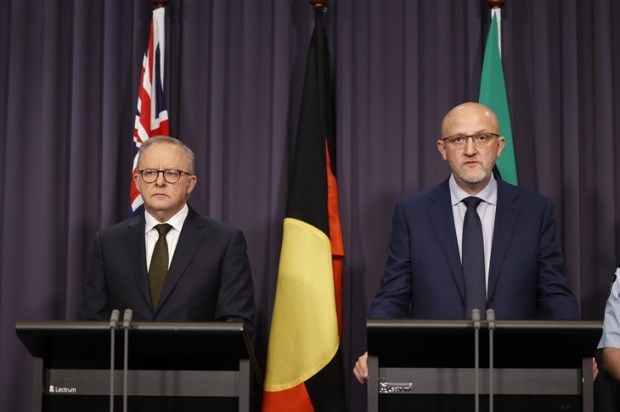
So China’s determination to prevent another of its strategic port dominoes falling lies behind its bullying threats of punishment were the Albanese government to honour last year’s election promise to end China’s controversial 99-year lease of the port of Darwin.
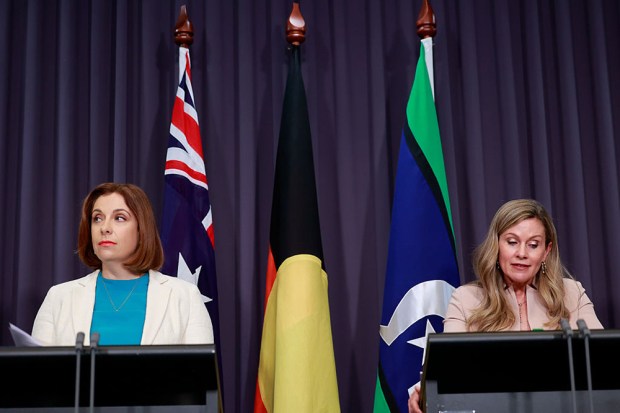
Despite what the Sydney Morning Herald last month described as the Albanese government’s ‘vow to stare down threats of retaliation from Beijing’ and repeated assurances from Prime Minister Albanese (‘we are committed to making sure that the port goes back into Australian hands, because that is in our national interest’) the result of China’s threats so far has been a cringing lack of progress. This has prompted Coalition accusations of deliberately ‘stalling’, with new shadow attorney-general (and former spokesman on foreign affairs) Michaelia Cash calling on the government to ‘produce a proper, transparent plan that protects taxpayers, avoids unintended sovereign risk, and delivers a clean transition to an Australian operator as soon as possible’.
As has been widely acknowledged, the Chinese-owned Landbridge did not need Canberra’s approval to acquire the port lease in 2015 in a tender process from the Northern Territory government. Nevertheless it was ‘examined thoroughly’ by Asio and the Department of Defence, with then secretary Dennis Richardson assuring: ‘We are at one in agreeing that this was not an investment that should be opposed on defence or security grounds.’ And only 18 months ago an Albanese government review concluded ‘it is not necessary to vary or cancel the lease’ as ‘there is a robust regulatory system in place to manage risks to critical infrastructure, including the Port of Darwin’.
So what happened to push this otherwise Sinophile Albanese government (which initially opposed the lease in 2015, anyway) into making this election promise that it is now so reluctant to implement for fear of upsetting China? It has been mugged by reality.
Concerns within the national security community are widespread, with Australian Strategic Policy Institute executive director Justin Bassi claiming that threats from Chinese Ambassador to Australia Xiao ‘were not about protecting China’s national security but rather interfering in Australia’s…. The Port of Darwin is not just a port but is national critical infrastructure which should not be under the control of a strategic adversary…. Darwin is astride critical sea lanes, near key defence facilities and at the centre of Australia’s northern military deployment. The issue isn’t whether the leaseholder has complied with contractual terms, but whether the arrangement still aligns with Australia’s national interest…. Ironically, the ambassador’s attempt to bully Australia into submission (bluntly: if you proceed with reassessing Darwin Port, you’ll pay a price) has effectively only confirmed the reasons for reviewing the lease…. It strips away any pretence that this is merely a commercial disagreement and becomes an assertion that Australia’s sovereign security decisions should be constrained by fear of retaliation.’
‘If Australia backs away now, under public threat, it will not stabilise the relationship. It will signal vulnerability – and the signal would be clearly received, not just in Beijing but elsewhere. As the government frequently says, Australia should cooperate with China where it can, disagree where it must, and engage in the national interest. Reassessing the future of Darwin Port does exactly that.’
Got something to add? Join the discussion and comment below.
You might disagree with half of it, but you’ll enjoy reading all of it. Try your first month for free, then just $2 a week for the remainder of your first year.