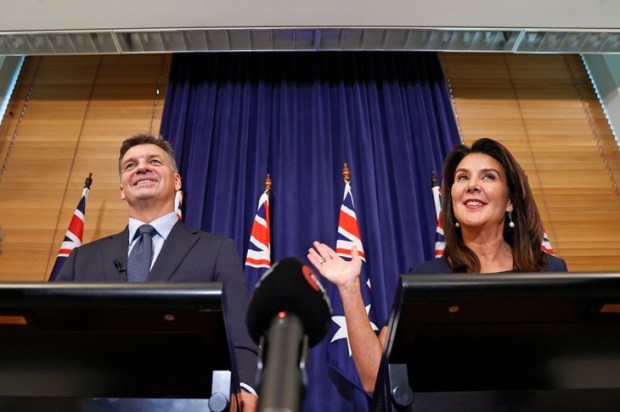
Iwas mindlessly watching the tele the other day. The actor David Wenham was interviewing former prime minister Julia Gillard about her life. She came across as reasonable, professional and courteous.
When asked about her proudest achievements, she singled out the National Disability Insurance Scheme. There was footage of her emotional speech delivered to the House of Representatives. She declared that there would not be trials; there would be action. People with disabilities had waited too long for this moment, she proclaimed, with tears in her eyes.
When it comes to fine, worthy intentions, the NDIS scores highly. But when it comes to actual outcomes, including the burden placed on taxpayers, the scheme is a disaster. It is heading for the rocks after being in place for just over a decade.
It is a classic case of theory versus practice. The idea that choice and competition were sufficient organising principles for a non-means-tested support scheme was naïve in the extreme. Given that recipients’ needs are extremely diverse and often fluctuate, it simply can’t be a one-size-fits-all approach.
The original design of the scheme essentially ignored the additional workforce requirements as well as the clear scope for fraud that a single-payer, lightly regulated arrangement would inevitably involve.
The lack of legislation that clearly defines eligible disabilities has led to an explosion in the number of people assisted under the scheme. The Productivity Commission originally estimated that just over 400,000 people would be eligible; currently, over 700,000 are serviced.
The biggest increase has been in younger people, particularly boys aged 7 to 12 with mild developmental delays/autism. The Commission had made some tentative estimates of the rate of exit from the NDIS, particularly among younger recipients who received early interventions. In fact, the exit rate is trivial. The NDIS is a clear example of Hotel California. It has also become a de facto home for those with mental illness, notwithstanding the existence of other dedicated programs.
The agreed funding division was ruinous for the Commonwealth, allowing states to vacate entire areas of responsibility that had previously been their domain. (Interestingly, Gillard pat herself on the back for her negotiations with the states. It tells you how gullible she was in government.)
The PC estimated the cost at just over $20 billion in real terms. It is now over $50 billion and forecast to cost over $100 billion in the early-2030s, absent significant change. Outlays are one of the fastest-growing budget items, exceeded only by the cost of servicing government debt.
The tragedy is that the NDIS is failing to deliver for those with the most profound disabilities and complex needs. The way the system works means those who require intensive care, often in assisted living arrangements, lose out. By contrast, many children with mild developmental delays are overfunded and inappropriately serviced.
The problem is coming to a head in Victoria, where several thousand severely disabled recipients face the possibility of being removed from long-term accommodation because the not-for-profit service providers cannot make ends meet with NDIS funding alone.
The short history of this impending disaster is that the state government previously met the needs of these recipients. It owned a range of suitable houses to accommodate them. Staff were paid generously under an agreement between the state government and the Australian Services Union.
When the NDIS started, the state government agreed to transfer the homes to not-for-profit organisations and supplement the deal by covering the gap between NDIS reimbursements and the cost of the enterprise agreement. This arrangement was terminated at the end of last year. Service providers now face the prospect of closing homes, going broke, or renegotiating staff agreements to align with NDIS funding. For vulnerable clients, the uncertainty itself is a burden.
By contrast, the South Australian government took the view that some people have such profound disabilities and complex needs that the concept of market choice makes no sense. A trial was conducted in that state, resulting in the state funding the accommodation and needs of some 500 permanent recipients of comprehensive disability support.
At the other end of the spectrum, the number of children on the NDIS with relatively mild disabilities has grown rapidly. They account for an increasing share of total outlays. There is no requirement for an independent assessment of disability level, despite the potential for conflicts of interest when providers making assessments will benefit from recipients’ acceptance into the scheme.
There is also no requirement that the treatments funded under the NDIS are based on any evidence. Indeed, providers are not even required to be registered under the scheme – most are not – although those who claim to have professional qualifications will be subject to occupational regulation.
At this point, it is worth reminding ourselves of that famous quote of Charlie Munger of Berkshire Hathaway: ‘Show me the incentive, and I’ll show you the outcome.’ For parents with children with even slight developmental delays, the attraction of the NDIS is that it provides non-means-tested assistance based on an agreed plan. The cost of occupational therapy, speech therapy, psychological services and the like is often covered in full.
Whether these services are best suited to the child is unclear. Many of the problems that affect children, which may be temporary, were once dealt with in the education system in a collective setting.
But state governments are similarly affected by the new incentives to vacate services they previously funded. Cost-shifting has always been a favourite pastime of state governments, offloading funding obligations onto the Commonwealth if given half the chance.
It’s hard to feel optimistic about the proposed new program, Thriving Kids, that, in theory, should remove some children, at least prospectively, from the NDIS. The states are likely to be lukewarm about funding an area they have palmed off. Also, creating a new name for a funding bucket doesn’t affect total government spending on disability. Note here that Australia’s spending on disability is extremely high by international standards.
The bottom line is that the NDIS is in a bad way, with provider capture an increasing problem. Failing to meet the needs of those with the most profound and complex needs is heartbreaking.
But waste and the program’s escalating costs mean that something will have to give at some stage unless the federal government takes strong action now. Just don’t hold your breath.
Got something to add? Join the discussion and comment below.
You might disagree with half of it, but you’ll enjoy reading all of it. Try your first month for free, then just $2 a week for the remainder of your first year.