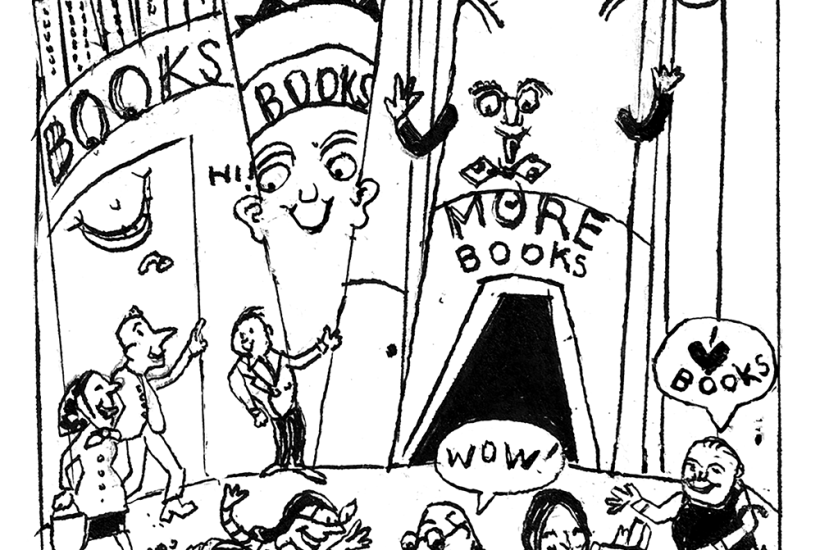
Independent bookshops remain some of Britain’s loveliest places. Quaint, charming, precarious, they are a bulwark against blandness and offer refuge in an age of doomscrolling. The bookseller stacking the shelves is likely to be local, almost certainly poorly paid and a bit moth-eaten. I should know – I own an independent bookshop. We are a flock of sheep, which is why it has proved so easy for a wolf to slip into our clothing.
Walk down a high street today and you may well pass a bookshop that looks just right. Handwritten recommendation cards. Tastefully curated tables. Knowledgeable booksellers. The name over the door reassuringly local. Nothing here suggests scale, leverage or distant ownership. You may feel a small glow at having rejected Amazon. Sadly, that glow would be misplaced, for without knowing it, you are simply buying your books from a different American billionaire: Paul Singer.
Over the past decade, a growing number of bookshops seemingly trading under unique identities have been quietly folded into a single multinational retail group, as part of Book Retail Midco Limited.
Its strategy is simple: expand. This is done either by buying up venerable brands (Waterstones, Hatchards, Foyles, Blackwell’s, Hodges Figgis), or by opening new, independent-sounding stores (The Blackheath Bookshop, The Rye Bookshop, The Deal Bookshop, The Weybridge Bookshop, Harpenden Books, Southwold Books). For readers, the result is the illusion of variety. Different towns, different shopfronts. The ownership, however, is the same, and intentionally obscured.
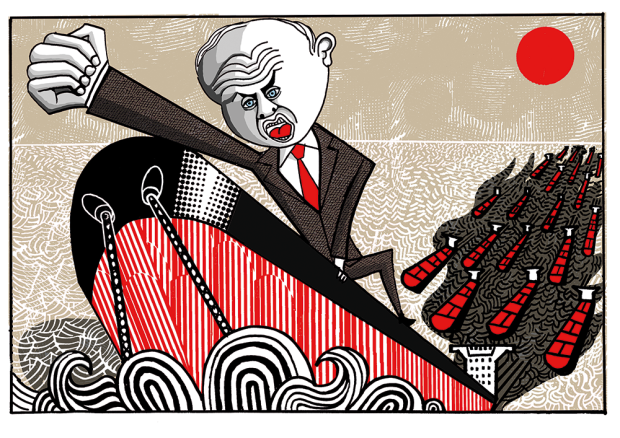
Book Retail Midco Limited is part of a multinational retail and online operation with 1,000 stores worldwide, turning over roughly $4 billion a year and preparing for a stockmarket flotation. The ultimate shareholder is New York-based Elliott Investment Management, one of the largest activist hedge funds globally, with more than $76 billion under management. Known as a ‘vulture capitalist’ for its aggressive, swashbuckling approach, the fund has gone as far as seizing an Argentine naval ship when docked off the Ghanian coast as a tactic to force the Argentinian government to the negotiating table.
The result is the illusion of variety. Different towns, different shopfronts. The ownership, however, is the same
Singer needed a socially acceptable figurehead for this consolidation of bookshops, and who better than James Daunt? In addition to owning his eponymous chain of bookshops and acting as chief executive of Waterstones since 2011 and Barnes & Noble since 2019, Daunt has led this strategy as executive director of Book Retail Midco Limited.
None of this is unlawful. Consolidation is not a crime, and nor is success in retail. Independent bookshops and booksellers could do with being much more commercial. The problem lies in the deliberate decision to disguise ownership in a market where ownership directly affects consumer behaviour.
Bookselling bodies and wider surveys of consumer behaviour consistently show that readers actively choose bookshops they believe to be independent. Local ownership, personalised recommendations and support for local economies are decisive factors in purchasing decisions. This is pertinent when the same book can be bought online with a click, often for less.
When people choose independent bookshops because they believe them to be locally owned, disguising corporate ownership is not a trivial detail. Trading on that perception while withholding the reality is unfair. This is why Daunt’s clothes matter.
A centrally controlled group enjoys advantages that no independent could hope to match – collective buying power, shared distribution, centralised systems and the ability to absorb short-term losses in pursuit of long-term dominance. Range tends to narrow, not expand. Riskier titles are edged out for the predictable sale. Specialist knowledge is replaced by centralised decision-making, and experienced staff are quietly priced out as overheads are trimmed. Smaller, less profitable regional shops become ‘non-core’. These things shape which books are stocked, which authors are promoted, which bookshops survive and ultimately what you end up reading on your summer holiday.
Were Book Retail Midco Limited to trade openly as a chain, these dynamics would at least be visible. When it confuses readers with dozens of local identities, the distortion is harder to see and easier to deny. What appears to be a field of independent competitors is, in fact, a single player with the time, capital and patience to outlast the rest. It can afford to discount, to expand selectively and to wait. The remaining (real) independent bookshops have no such luxury.
No one objects to a chain bookshop. They are an honest expression of scale. What is objectionable is a multinational multi-billion-dollar retail chain that opens a new branch called ‘The Weybridge Bookshop’ and claims on its website that it merely has an ‘independent feel’. Wolves are entitled to eat, but not to bleat. And you, dear reader, are entitled to know.
Got something to add? Join the discussion and comment below.
You might disagree with half of it, but you’ll enjoy reading all of it. Try your first month for free, then just $2 a week for the remainder of your first year.