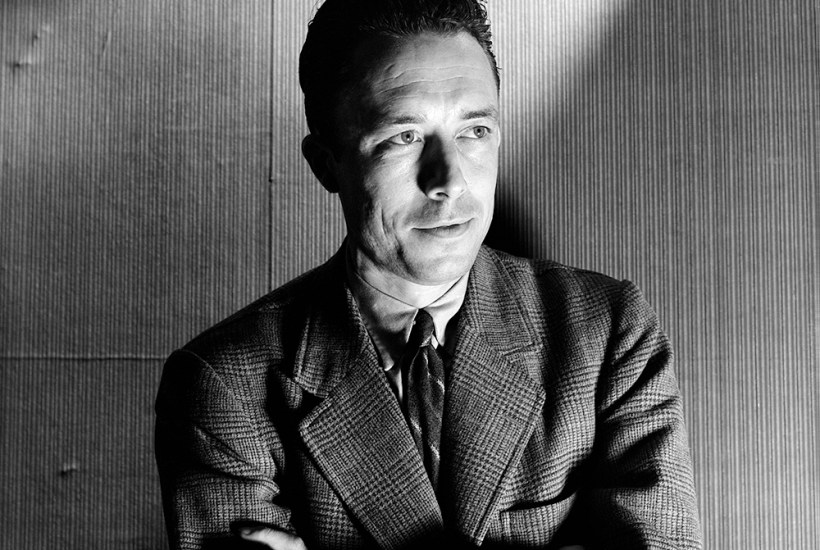
To read Albert Camus’s Notebooks – comprehensive, newly translated and expertly annotated by Ryan Bloom – is to enter the engine room of the writer’s mind and to glimpse its complex workings and components stripped back to their essentials. They comprise an intellectual and spiritual autobiography, not an account of his life. But of course they contain seductive vignettes lifted straight from experience among the aphorisms, observations, drafts and schemas for writings, stitched together in a collage that reflects a remarkably agile mind in constant motion.
The Notebooks bring to mind the fertile chaos of an artist’s studio. Think of Francis Bacon’s, filled with prompts and reminders, the raw rubble of everyday life, preserved in sedimentary layers out of which, alchemically, the paintings emerge. Similarly, Camus’s published essays and novels are here in fragmentary form, as yet unshaped but evolving; and Bloom’s invaluable footnotes help us track the connections, trace the echoes and nail familiar phrases that ambush us from time to time. ‘Today, Maman died. Or maybe yesterday, I don’t know’ – the opening of The Stranger springs out of the undergrowth back in autumn 1938, though the novel would not be published until 1942. Camus was spinning various scenarios and characters for that novel alongside A Happy Death (published posthumously) and soon early ideas for The Plague, working towards fulfilling his sharp injunction to himself from this time: ‘Make notes every day in this notebook; have a work written in two years.’
For the Camus devotee these jottings pay huge dividends, taking one on a deep dive into the writer’s thoughts, ideas and working methods. He used them to track his inner and creative life from 1933 until 1959 (just weeks before his death in a car crash in January 1960), dashing them off initially by hand and later having them typed up. Pity the typist, because his handwriting was at times almost illegible, and Camus, in revisiting the typescripts, had to fill in many a blank where the typist was stumped – often then choosing to expand or amend the entries. Bloom is punctilious in pointing out discrepancies between the versions and retaining the informal quality of the original, with its quicksilver changes of mood and register, from rapture to despair, from enquiry to certitude, and even rare glimpses of optimism: ‘There is in this world, running parallel to the forces of death and subjugation, an enormous force of persuasion. It’s called culture.’
As the owner of an early handwritten draft, given to my aunt, of Camus’s essay ‘Retour à Tipasa’, with its often-quoted phrase ‘In the middle of winter I learned at last that there was within me an invincible summer’, I have seen how much Camus stumbled and switched direction en route to the pellucid clarity of the finished work. ‘I have to write as I have to swim – because my body demands it,’ he has one of his characters say in A Happy Death. But it’s clear that writing did not come easily. He was constantly fighting the turbulence of the waves, to follow his analogy, and his draft is almost impenetrable, its beetling script scored through, words deleted, phrases reversed, paragraphs moved hither and thither in an anguish of creative indecision.
Camus was frequently misanthropic, while ever alive to the startling delights of beauty, sensuality and love
That complexity is apparent throughout the Notebooks, a volume which effectively comprises Camus’s writing laboratory – in the dry runs for later novels and essays; the stress-testing of theories about absurdity, tragedy, nobility and death; in his insistent interrogation of quotes from admired thinkers and writers; in his schemes for future stories, often perfect vignettes in themselves. Woven through are fleeting, enigmatic accounts of life, loves and travels, recalled with rapture, nostalgia and regret.
Camus’s uncompromising integrity required that everything be qualified by its shadow side, giving a wistful, somewhat melancholic tone to his observations. His overwhelming love of his homeland of Algeria was, of course, sharpened by his acute awareness of colonial misrule: ‘Algeria, a country at once bounded and boundless. Bounded in its lines, boundless in its light.’ He could qualify humour with pathos in a few words, describing two blind men who only go out at night: ‘If they run into a lamppost, they can have a good laugh about it. They do laugh. Whereas during the day, other people’s pity prevents them from laughing.’
He was often wry: ‘Notice posted at the barracks: “Alcohol extinguishes the man and inflames the beast” – which only helps him understand why he likes alcohol.’ He was acute about human relations: ‘Absurdity reigns, love redeems.’ He was forensic in seeking out authenticity over appearance; he was plagued by what constitutes a just death, in war and peace, and campaigned energetically against the death penalty in postwar France; he berated himself for personal failings, and was frequently misanthropic, while ever alive to the startling delights of human and natural beauty, sensuality and love.
He could be inscrutable, elliptical and baffling; it’s sometimes difficult to keep up. As the years wore on and fame took him further afield, to the US, Brazil and Greece, entries became more descriptive and less prescriptive; yet the soul-searching continued. Celebrity irked him. He longed for solitude and escape from Paris, yet felt he owed so much to so many. His emotional life was increasingly complicated, and after trying for years to ‘live life like everyone else’, an entry in April 1959 admits defeat, summoning the existential plight of the middle-aged man:
Now I wander amid the wreckage, lawless, torn apart, alone and accepting being so, resigned to my peculiarities and infirmities. I must rebuild a truth – after having lived my whole life in a sort of lie.
He was 45, and would die less than a year later, leaving us with this searching, knotty, invaluable record of his thoughts and yearnings. He always believed that the only way to outwit absurdity and cheat mortality was to harness creativity, work hard and to leave behind something of worth. The Notebooks are part of that hard-won legacy.<//>
Got something to add? Join the discussion and comment below.
You might disagree with half of it, but you’ll enjoy reading all of it. Try your first month for free, then just $2 a week for the remainder of your first year.