The actress Sophie Winkleman has been honest and punished for it. As one of Britain’s foremost campaigners against the digitalisation of childhood, Winkleman regularly takes to the airwaves to speak about the multifarious ways in which the screendemic is harming children. Eyebrows were therefore raised when, earlier this week, Winkleman told the Times that, despite her passionate convictions, she had ‘failed’ and given her twelve-year-old daughter a mobile phone.
Winkleman said that, despite her passionate convictions, she had ‘failed’ and given her twelve-year-old daughter a mobile phone
Winkleman was clear that her daughter has no access to social media on the device, but the admission, shared as a gesture of solidarity with thousands of other parents in a similar situation – and to highlight the need for collective action – was met with a torrent of criticism. Winkleman was unfairly accused of hypocrisy, being ‘too lazy’ to parent and even that – as the daughter-in-law of Prince Michael of Kent – she only ever wanted the children of those ‘below stairs‘ to be denied technology.
The reproval was not limited to Winkleman’s personal decisions; the more substantive criticism is that her proposed solution – for the government to introduce an Australia style ‘ban’ to protect children from social media – is the wrong one. Critics argue that this is a ‘nanny state’ approach, and that it is the role of parents – not the government – to protect children from digital harms.
The row resurrects the age-old question of ‘what is the government for’? Most of us would agree that at the very minimum, the role of the government is to make and uphold the laws that allow civilised society to function. Even the most ardent libertarians recognise that we need government to do what cannot be done by individuals alone, such as maintaining an army, co-ordinating national infrastructure, or ensuring fair trading conditions.
Before technology, the government’s regulatory role was a minimal one but innovation changed all that. The first Industrial Revolution brought huge benefits but also brutal suffering, as children were forced down mines and into mills. Technology enabled the few to exploit the many and only government regulation could stand up to vested interests and protect those working in the factories. Or consider the invention of the motor car, again a vehicle – excuse the pun – for freedom and progress. Before road regulation, thousands died every year in road traffic accidents. If there were no speed limits, Highway Code, pedestrian crossings or traffic police, then no parent – however diligent – could teach their child how to cross a road safely.
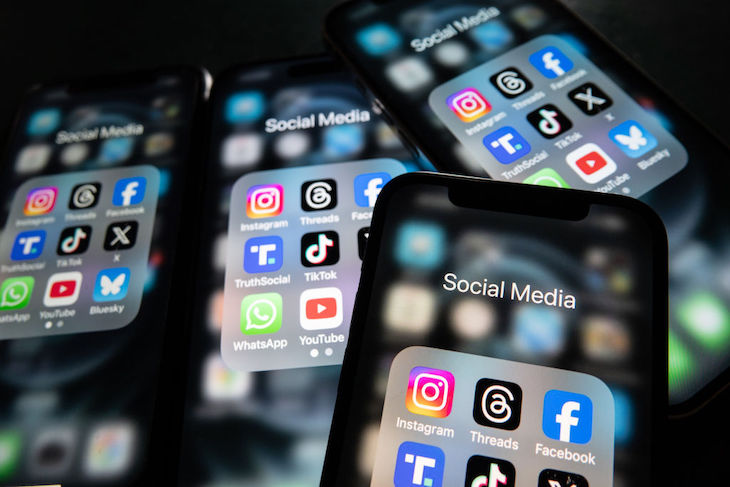
In the 21st century, we are living through another technological revolution. In the space of just over a decade, smartphones and social media have changed the way we live. There have been upsides to this, but the downsides, especially for children, are increasingly evident.
Declining cognitive function, stunted language learning, plummeting educational scores, exposure to obscene material, ballooning sexual exploitation and the tragedy of a childhood spent glued to a screen. Almost all children over the age of ten now own smartphones and the average amount of time spent online is around nine hours per day.
Smartphones and social media apps are designed for addiction; our children’s attention is now exploited for profit by US tech firms in the way that their labour was exploited by 19th century industrialists.
Those who say this is a problem for parents assume that mums and dads can just ‘stop’ teens from using social media in the same way that they can stop a three-year-old from snatching his brother’s toy car. But social media is not a toy, it’s a culture, one in which all teens are immersed. The choice facing parents – to allow children into a world of danger or exclude them from the world altogether – is an invidious one, similar to the dilemma facing parents of old who could ‘choose’ to send their child down a mine or starve.
Is it more likely that all of a sudden the vast majority of modern parents are useless, lazy and irresponsible, or that we have come up against a product – perhaps even an empire – too powerful for the family unit to withstand?
Those who reject the call for government intervention seem to think parents should watch over their children and control their every move. Of course this is true when a child is two years old. But raising children well means giving them increasing independence as they age. Teenagers should not be constantly monitored; ‘helicopter parenting’ prevents adolescents from maturing into competent adults.
If society is dominated by a technology so unsafe for children that 24-hour surveillance is required to protect them, then it is the technology, not the parents, at fault.
It was brave – and admirable – for Winkleman so openly to admit to being in the trenches. Like Winkleman, I have faced the same agonising dilemma, and like her I believe this is a problem that cannot be solved without legislation. Just as parents cannot protect their children from drugs, unscrupulous employers or road accidents without the help of government regulation, so we cannot alone protect our children from the consequences of the screendemic. The battle between tech and children is not a private matter. We need action from the state, the only entity powerful enough to defend our children from industrial scale exploitation.