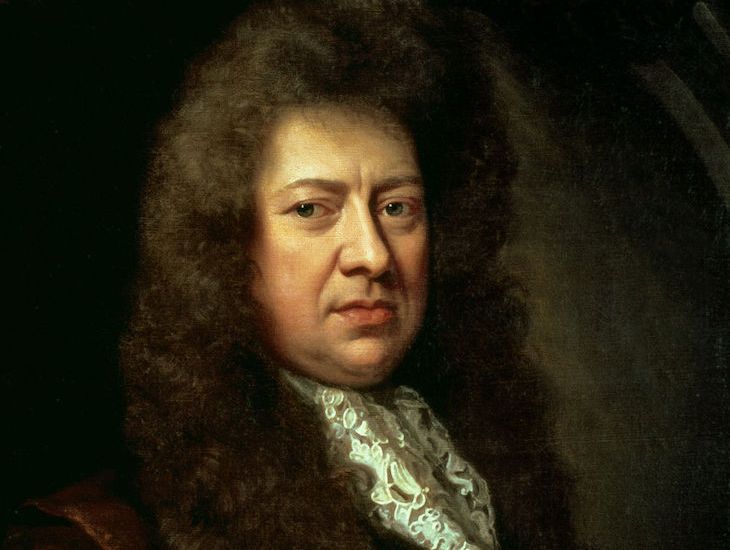
‘I know not how to abstain from reading,’ wrote Samuel Pepys back in the seventeenth century. Were he by some miracle still alive, Pepys would discover that this is a problem entirely alien to most people today. Indeed, his own diaries, avidly pored over by generations gone by, have now been condemned by today’s moralists and seem destined to be ignored.
This ‘new evidence’ seems to have prompted Hinchingbrooke School to review its association with Pepys. But why?
Almost four hundred years after he was a pupil, Pepys is in trouble at his old school. Following a ‘comprehensive consultation’, students at what is now Hinchingbrooke School, but was then known as Huntingdon Grammar, have voted to remove the name of this famous old boy from one of their houses. This is tragic. No other school in the country can boast of having Samuel Pepys as an alumnus. To be able to tread the same corridors as such a notable figure should be a source of pride, not shame.
Call me a cynic, but no child independently concludes that Pepys’s legacy is tainted and reminders of his existence must be erased. They do so only after having first had their heads stuffed full of bias and propaganda. Indeed, a recent analysis of Pepys’ work that has revealed his ‘abusive and exploitative’ behaviour towards women was presented to pupils in what sounds like a whole-school Maoist struggle session. Unsurprisingly, almost 60 per cent backed ditching Pepys.
Children can learn much from Pepys’s unique insight into a tumultuous period of English history. On 22 April 1661, he described the coronation of Charles II: ‘So glorious was the show with gold and silver, that we were not able to look at it, our eyes at last being so much overcome with it. Both the King and the Duke of York took notice of us, as he saw us at the window.’
Four years later, things were altogether more sober. On August 31 1665, Pepys wrote: ‘Thus this month ends with great sadness upon the public, through the greatness of the plague everywhere through the kingdom almost. Every day sadder and sadder news of its increase.’ The following year, he noted, ‘By and by Jane comes and tells me that she hears that above 300 houses have been burned down to-night by the fire we saw, and that it is now burning down all Fish-street, by London Bridge.’ For children studying history, there can be few better introductions to events of the seventeenth century.
But the beauty of Pepys’s work, and what pupils must also be taught, is that his diaries are no objective account. This doesn’t lessen their value to the social historian; it enhances it. We gain insight into the character of a seventeenth-century gentleman. We learn of his foibles and worries, his ambitions and prejudices. Of course, he is no more a perfect character than a perfect chronicler of events. As a real person, Pepys has attitudes and values typical of his time, as well as his own habits and opinions. It is this humanity, along with Pepys’s sheer pleasure in life, that speaks to us through the centuries.
Victorian editions of Pepys’s diaries were edited to leave out some of his more private thoughts. This is not unusual. Anne Frank’s diaries were famously edited by her father, Otto, before publication after the Second World War. But when Robert Latham and William Matthews published Pepys’s original shorthand text in the 1970s, the more controversial parts of his diary were made public for the first time. Just last year, a new examination by the historian Guy de la Bédoyère revealed that Pepys had described fantasies of rape, written about physically assaulting his wife and female servants, and his aim of touching at least one woman’s breasts every day.
This ‘new evidence’ seems to have prompted Hinchingbrooke School to review its association with Pepys. But why? Older teenagers are surely capable of understanding that people, and the past, are complicated. Diaries even more so. Who today would want to be held to account for their private fantasies? But this nuance only adds to what the diaries have to offer modern readers.
As for younger children, why must adults rush to expose them to the darker side of people in times gone by? It is disorientating to grow up in a Year Zero, where the past has been razed and heroes destroyed. Children who make it to adulthood without ever having seen the good in anything are left with only cynicism.
This year has been declared a National Year of Reading. Adults are quick to blame social media for children’s reluctance to pick up a book. But perhaps our inability to celebrate the past, and seemingly desperate need to transform books into morality tales about the present, is also profoundly off-putting to young readers.