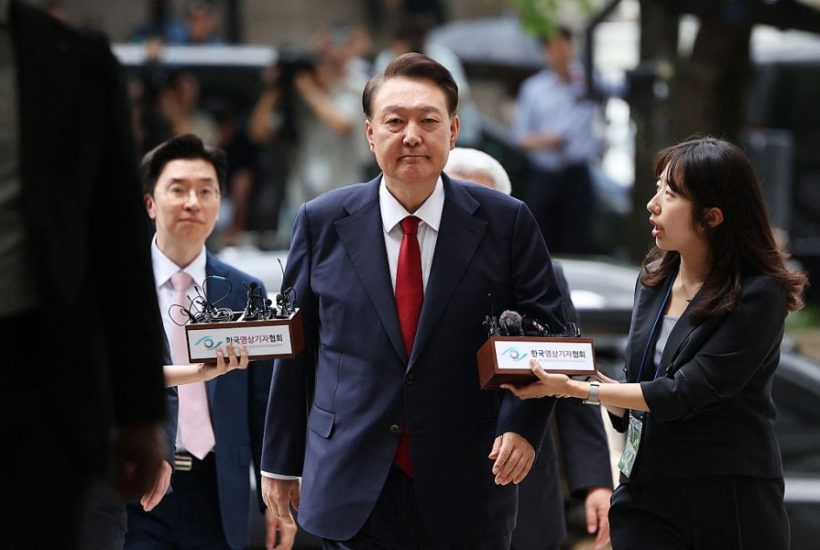
Think of the death penalty and North Korea’s executions of individuals convicted of so-called ‘anti-state crimes’ may spring to mind. The resilient democracy of South Korea, however, probably would not. Nevertheless, this week has seen South Korean prosecutors call for the country’s former president, Yoon Suk Yeol, to be handed the most extreme of all punishments for his notorious declaration of martial law on 3 December 2024.
At the first of his four trials this morning, the former president was handed a five-year prison sentence for having ‘plunged the country into political crisis’. But as his left-wing successor, Lee Jae-myung, reaches his six-month anniversary in office, putting Yoon on trial will offer little catharsis for South Korea’s domestic polarisations – which is not going anywhere anytime soon.
Yoon’s short-lived pronouncement of martial law that December evening will forever go down in the history books. Unlike many of its Western counterparts, South Korea is a highly youthful democracy. Prior to its democratic transition in 1987, martial law was anything but rare. This was a time when the suppression of civil liberties saw the country undergo exponential economic growth, allowing it to evolve from its post-Korean war rags to its subsequent riches. 2024, however, was different. By then the fourth-largest economy in East Asia and the thirteenth-largest in the world, the declaration of martial law by a South Korean president facing a myriad of domestic battles was nothing short of unbelievable.
Political polarisation in South Korea has hardly disappeared
Following his impeachment that December and eventual ousting in April that year, Yoon has consistently denied the charges levied against him. He has maintained that he had no choice but to act how he did owing to hostile opposition forces colluding against him. The most severe charge brought against him accuses him of being a ‘ringleader of an insurrection’, an accusation which was frequently peddled by the South Korean left prior to his trial. This particular charge faces three possible outcomes, of which South Korean prosecutors must ask for only one: life imprisonment with or without labour, or sentence by death.
Capital punishment by hanging remains legal in South Korea. As of 2023, the country’s death row had nearly 60 inmates waiting to hear their fate. Yet, the last execution in the country took place in December 1997, after which the liberal then president, Kim Dae-jung, imposed a moratorium on executions. In 1996, former president Chun Doo-hwan, himself no stranger to the imposition of martial law, was sentenced to death on account of treason, insurrection, and the unlawful declaration of martial law during the student-led Gwangju uprising in 1980. Chun’s sentence was commuted to life imprisonment the following year. Six months later, he was pardoned. With the moratorium remaining in effect to this day, Yoon might face a similar reality – but we will have to wait until February for the verdict in this particular trial.
For all the unacceptability of Yoon’s actions, his opponents – including his successor, Lee – were anything but guilt-free. Dramatic leftist overreach to remove Yoon from office, such as by attempting to impose a travel ban on him following his impeachment, backfired. Whilst his popularity reached a nadir of 11 per cent in mid-December 2024, support for him and his party, the conservative People Power party, rose to nearly 50 per cent in the period between his impeachment and removal from power.
The start of this year, by contrast, has been far more peaceful in South Korea than the start of 2025, when nationwide protests both for and against Yoon swept across the country. Yet, political polarisation in South Korea has hardly disappeared. The current administration has been adopting a cautious approach of trying to please everyone at the same time, whether Donald Trump, Japan’s ‘Iron Lady’ Sanae Takaichi, or China’s Xi Jinping, all of whom President Lee has met for bilateral talks.
Yet, the question remains as to just how long such an approach can last. Having been in office for six months, Lee’s cabinet already shows signs of factionalism on key issues such as Seoul’s alliance with Washington or reconciliation with North Korea. What is more, Lee must be realistic about his desire to forge a friendship with Xi. It is one thing to take a selfie with his Chinese counterpart on the Xiaomi smartphone he had previously gifted to him, as was the case last week. Getting China on board to mediate the North Korean nuclear issue is a far more difficult task.
In the Seoul detention centre, Yoon Suk Yeol has been joined by his wife, Kim Keon-hee, not for emotional support but for alleged crimes of her own. These include allegations, which she denies, of stock price manipulation, the acceptance of political bribes, and meddling in elections during her husband’s presidential election campaign in 2022. Whatever the futures of Yoon and his wife look like, the trials and tribulations facing South Korea and its Western allies and partners will only become increasingly acute. Whether the threats emanating from Beijing and Pyongyang or the need to manage ties with Washington, global challenges won’t wait for domestic political squabbles to abate.