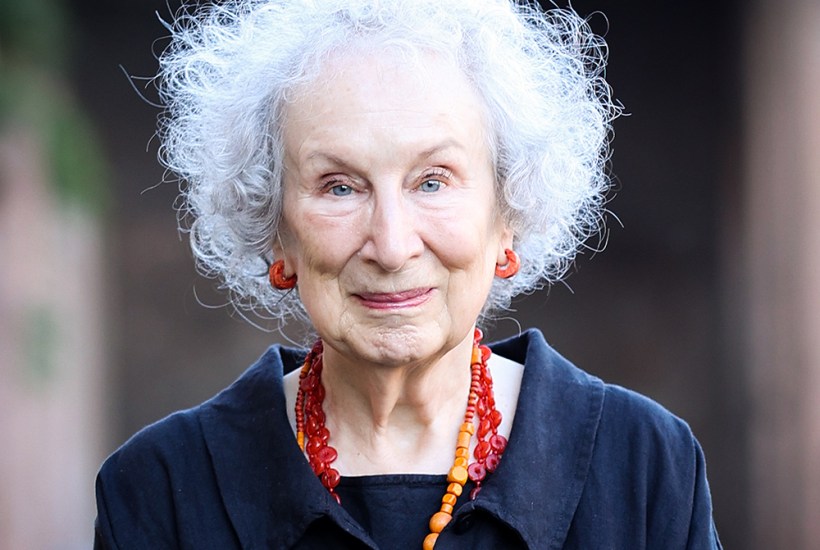
In the introduction to Book of Lives, Margaret Atwood recalls her initial response to the suggestion that she write a memoir: ‘Who wants to read about someone sitting at a desk messing up blank sheets of paper?’ Her autobiography was hardly the stuff of high adventure: ‘I wrote a book, I wrote a second book, I wrote another book, I wrote another book.’ This is not what they meant, her publishers replied: ‘We meant a memoir in, you know, a literary style.’
While Book of Lives is about a great deal more than Atwood churning out prize-winning novels, it is not written in a ‘literary style’. The style, if anything, is anti-literary. Atwood’s voice is casual, chatty, often catty. Instead of strong sentences we have hollow phrases, such as ‘here’s the thing’, ‘you never know’, ‘those were the days’, and ‘time will tell’. Atwood agreed to her publishers’ proposition, she writes, because a memoir allowed her to ‘depict myself in a flattering light… reward my friends, trash my enemies and pay off scores long forgotten by everyone but me’.
These benefits are embraced with such gusto that I wonder why she waited until she was 85 to get round to them. Added to which she has perfect recall, as though her most significant experiences had been cellared for just this purpose. Not since Hemingway’s A Moveable Feast has a novelist revealed such a well-stocked memory palace. Atwood remembers every halloween costume she ever wore, every camp song she ever sung, the unique smell of the lavatories on the Greyhound route between Toronto and Cambridge, Massachusetts in 1961, the name of her Harvard ‘roomy’ in 1966 who left the cap off the toothpaste (Susan Milmoe, Sociology, from White Plains, New York), the pastel-coloured wallpaper frieze in the narrow room which could only be reached through the main bedroom in the haunted farmhouse she bought in Ontario in 1972, and the flea bites she got on the park bench in Merida, Mexico City in January 1976.
The second of three children, Atwood was born in Ottawa in 1939. Being a Scorpio, she explains, she ‘holds grudges’. She also hoards compliments, including the note written 75 years ago by one of her teachers to another, praising her ‘feeling for words’ and ‘observing eye’. Her natal chart, reproduced in chapter one, predicted that she would have ‘esoteric interests’ and make an ‘implacable enemy’. Because her character was predestined, Atwood has little time for self-reflection and no patience with Freud: ‘I was more interested in the paper people I could create than doing deep dives into my own psyche.’ One of her theories about novelists is that ‘they don’t know more about human nature than other people: they know less, and their novels are attempts to figure it out’. Her exploratory drive as a novelist does not extend to her role as memoirist, where her insights take the form of soft Q&A sessions, such as ‘Do I carry some lingering resentment? Yes. I do’, and shallow ‘life lessons’, such as ‘You can’t tell from looking at a person how bright they are, or what they are thinking’.
Atwood’s father was an entomologist, who took his family for long vacations in the wilderness of northern Quebec, where she developed a love of the natural world. Her childhood was happy until, aged nine, she was horrifically bullied at school. The experience was returned to in her autobiographical novel Cat’s Eye, where the protagonist is made by her three best friends to dig her own grave and then lie in it. Atwood would scoff at the suggestion, but it may have been then, to defend herself from future pain, that she developed what she calls her ‘heart of stone’.
She could have been a biologist, but, aged 16, chose poetry instead. Her first book of poems appeared when she was 22, the year she began graduate studies at Harvard, where it was assumed that, being Canadian, she had been raised in an igloo. Her second collection was published in 1965: both books won prizes. Canadian writers were at this point as rare as pandas (‘Canadian writer? Isn’t that an oxymoron?’ quipped one English wit). But the decade saw the country evolve from a literary backwater in which the best known book was the Bible to a place in which it was possible for literature to flourish. Atwood was part of that progression: ‘There is nothing so motivating as a blank page,’ she writes. ‘It cries out to be scribbled on.’
The Edible Woman, the first of her 18 novels, appeared in 1969, the year she married her college boyfriend, Jim Polk, with whom she had a daughter. The marriage lasted five years, after which Atwood lived with the novelist and ornithologist Graeme Gibson, who died in 2019. During this time she changed from being ‘famous in Canada’ to being world famous, when The Handmaid’s Tale was believed, after Trump’s first inauguration, to have been prophetic.
Atwood and Gibson did not marry, initially because he already had a wife, Shirley, who refused to give him a divorce, and then because he wanted no more Mrs Gibsons. There is a moving account of his death from dementia, but running alongside Atwood’s love for Graeme is her loathing of Shirley. While Shirley was demanding and unreasonable she was also, Atwood concedes, a fragile depressive from a violent home who had been dealt a relentlessly poor hand.
Why, in that case, is Shirley denied all sympathy? Had she been one of Atwood’s ‘paper people’, she would have been drawn with depth and complexity instead of mockery and derision. When Shirley’s boyfriend kills himself on a train track in Port Hope, Atwood cracks that Shirley’s plans to move to Port Hope were now ‘obviously kaput’, because ‘you can’t relocate to a town where the lethal squashing of a lover has taken place’. When another of her boyfriends then also commits suicide, we are drily informed that ‘Shirley was once more prostrated’. When Shirley’s own dead body is found by a friend, who tells Atwood that she had ‘never seen such a terrible thing’, Atwood comments that, as an ‘Auschwitz survivor’, this distraught friend had surely ‘seen a lot of much more terrible things’. It is a low blow to measure the lonely death of an unhappy woman against a genocide.
Atwood has never pretended that women were the nicer sex, which is one reason for her power as a novelist. Her fiction is fuelled by the cruelties we inflict on one another: Cordelia, the chief bully in Cat’s Eye, and Zenia, the false friend in The Robber Bride, are nightmarishly real. What Atwood had to say about women added a much needed dimension to feminism, and for that we must all be grateful. The cruelties in Book of Lives, however, seem redundant and diminish the work.
If Atwood the memoirist seems entirely unrelated to Atwood the novelist it is because, as she puts it in her introduction, writers have a body double: ‘There’s the daily you, and then there’s the other person who does the actual writing.’ Book of Lives is the work of the daily Atwood rather than the writing self, which is what makes it such a dispiriting read. An alternative title might have been ‘Women Beware Women’.
Got something to add? Join the discussion and comment below.
You might disagree with half of it, but you’ll enjoy reading all of it. Try your first month for free, then just $2 a week for the remainder of your first year.